Lesson Goal: To quickly internalize the Secondary Dominant Seventh Chords in all keys… by ear, intellect, eye, and muscle…
Table of Contents
Prerequisites
Basic music reading skills… the LOVE of music… and the discipline to study and practice.
back to… Table of Contents
What are Secondary Dominants?
Secondary Chords are a powerful and widely used way to expand the harmonic (and melodic) possibilities of music beyond the diatonic notes in any key. A Secondary Dominant (can be a major triad, dominant 7th, diminished triad, or diminished 7th chord) is a chord that resolves to a scale degree other than the tonic using the concept of tonicization explained below.
back to… Table of Contents
Primary Dominant Seventh Chord in the Key of C Major
Let’s begin our exploration of secondary dominants by reviewing the primary dominant I-V7-I chord progression in the key of C Major…
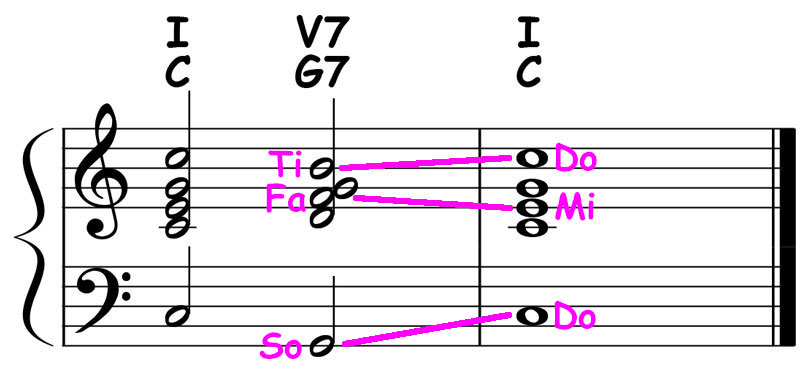
Notice the very strong (dominant) harmonic tension created by the G7 chord (V7) and the strong sense of relief with the return of the C chord (I).
The harmonic tension created by the primary dominant seventh chord comes from five sources:
- The inherent harmonic instability of the tritone interval (B-F).
- The strong harmonic desire for B (Ti) to resolve to C (Do). (This attraction is so strong that B (Ti) is often called the leading tone, because it so strongly leads the ear back to the tonic C (Do)).
- The strong harmonic desire for F (Fa) to resolve to E (Mi).
- The strong harmonic desire for D (Re) to resolve to C (Do).
- The strong harmonic desire for G (So) in the bass to resolve to C (Do).
Sidebar: If you drop “the 7” in the G7 chord, you have a G major triad, which has the same dominant function… just with a little less harmonic tension that the G7 because the F is missing.
back to… Table of Contents
The Concept of Tonicization
A similar tension-release formula can also be used to approach any diatonic major or minor chord other than tonic (I) chord. This concept, called “tonicization”, can be thought about in two steps:
- Pretend that the diatonic target chord is a new tonic chord.
- Approach the target chord (x) with its corresponding “V7” as explained below.
Sidebar: Diminished triads and diminished seventh chords are also used as secondary dominants. So as not to overwhelm you by doing everything everywhere all at once, only secondary dominant seventh chords will be discussed here.
back to… Table of Contents
Secondary Dominant Seventh Chords in the Key of C Major
We begin our discussion of the Secondary Dominant Seventh Chords in the key of C Major by realizing that any of the five diatonic major or minor triads besides the tonic (I) chord may be “tonicized” by approaching it with its Secondary Dominant Seventh Chord.
In the key of C Major the five diatonic triads other than the C(I) chord are Dm(ii), Em(iii), F(IV), G(V), and Am(vi)..

Let’s explore the tonicization of each…
Secondary Dominant of the F Chord
- F is the IV chord in the key of C.
- C7 is the V7 of F.
- C7 is the V7 of IV.
- RNA = V7/IV.

Reading Tip: The appearance of Bb (Te) in a major context is an indicator that a V7/IV may be occurring.
Ear Training: Notice the immediate sound and feeling of tension, harmonic pull, and sense of direction that’s created when the secondary dominant chord appears.
Secondary Dominant of the G Chord
- G is the V chord in the key of C.
- D7 is the V7 of G.
- D7 is the V7 of V.
- RNA = V7/V.

Reading Tip: The appearance of F# (Fi) in a major context is an indicator that a V7/V may be occurring.
Secondary Dominant of the Dm Chord
- Dm is the ii chord in the key of C.
- A7 is the V7 of Dm.
- A7 is the V7 of ii.
- RNA = V7/ii.

Reading Tip: The appearance of C# (Di) in a major context is a strong indicator that a V7/ii may be occurring.
Secondary Dominant of the Am Chord
- Am is the vi chord in the key of C.
- E7 is the V7 of Am.
- E7 is the V7 of vi.
- RNA = V7/vi.
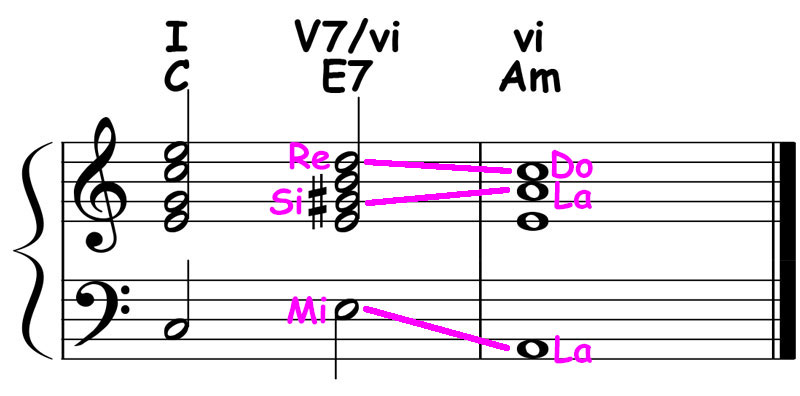
Reading Tip: The appearance of G# (Si) in a major context is an indicator that a V7/vi may be occurring.
Secondary Dominant of the Em Chord
- Em is the iii chord in the key of C.
- B7 is the V7 of Em.
- B7 is the V7 of iii.
- RNA = V7/iii.
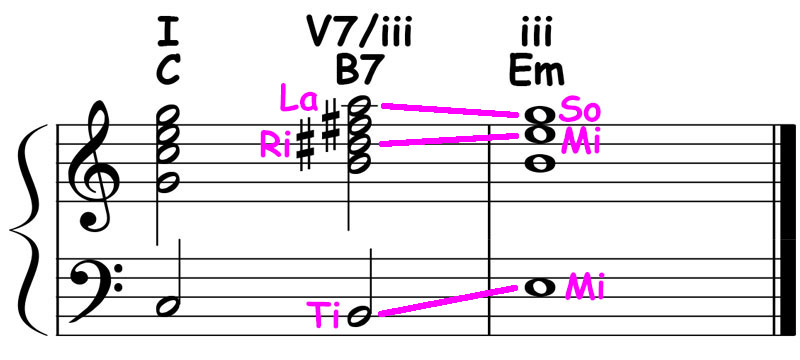
Reading Tip: The appearance of D# (Ri) & F# (Fi) in a major context is an indicator that a V7/iii may be occurring.
Ear Training Note: With a little experience, you will start to recognize secondary dominants by sight and sound. Don’t fuss over the details right now. For the moment, it’s enough to understand the concept of extending harmony using Secondary Dominants.
back to… Table of Contents
Secondary Dominant Seventh Chords, All Keys
Any interest in a reference table, flashcards, play along scores and MP3s, or other study aids to help you internalize the secondary dominant seventh chords in all keys?
[insert study aids here]
back to… Table of Contents
Are Tertiary Dominant 7th Chords Possible?
Absolutely Yes. It’s possible to have Tertiary Dominant 7th Chords V7/V7/V. Or even beyond V7/V7/V7/V. Don’t worry about the details right now. For the moment, it’s enough to understand that harmony is hierarchical. In other words, harmonies can be nested within harmonies within harmonies. This will all make sense when we real life examples, especially in classical and jazz.
back to… Table of Contents
Tonicization or Modulation?
Sometimes, secondary dominant seventh chords do more than tonicize a diatonic chord in the present key. Secondary dominants are such powerful harmonic building blocks that they can also be used to modulate to a new key center based on the root tonicized chord.
So, how do you tell if the secondary dominant seventh chord is “just” a tonicization or leads to a full modulation?
The test is simple: Sing or hum the note that sounds and feels like Do. THAT is the key center. THAT is the key you are in. If it sounds and feels like the key center hasn’t changed, it’s “just” a tonicization. If the key center sounds and feels like it’s the root of the “tonicized” chord, then it’s a modulation… a bona fide change of key.
The point here is not to quibble about what to call things. The point here is to understand, hear, and feel whether or not a key change has occurred. Such has profound impact on how one comprehends and performs music, whether composed or improvised.
back to… Table of Contents
learn more… Chords & Chord Progressions
Discover more from PIANO-OLOGY
Subscribe to get the latest posts sent to your email.