Learn-by-doing lessons for quickly internalizing the Arabic Scale… by ear, intellect, eye, and muscle…
Table of Contents
Lesson Goal
To quickly internalize the letter names, scale degrees, solfege, notation, sounds, feelings, and visuospatial keyboard layouts for the Arabic Scale in all keys.
Prerequisites
Basic music reading skills… the LOVE of music… and the discipline to study and practice.
Study & Practice Reminders
- Never play these mindlessly and mechanically. Always aspire to play musically.
- Your goal is not to merely memorize these, but to study and practice them until you internalize them using all four musical intelligences: ears, intellect, eyes, and muscles.
- Every time you practice something, you are programming your brain. So always play accurately.
- Practice with a click track or rhythm track. Doing so will give you immediate feedback on any rhythmic misconceptions or places where your timing gets sloppy.
- Record yourself. Always. Listen to the playback immediately. And ask yourself: Is that what you intended to play?”
- If anything feels tense or awkward, stop immediately and experiment with alternative fingerings or choreography.
- Play this in other keys you expect to play in. By the way, once you see the patterns (which is guaranteed if you know your scales and chords) finding the notes in other keys will be a piece of cake!
- If you feel stuck or overwhelmed, realize that anything can and will be mastered if you slow things down or break things down to small enough pieces.
back to… Table of Contents
Arabic Scale Theory
- The Solfege Syllables for the Arabic Scale are Do-Ra-Mi-Fa-So-Le-Ti-Do (no matter what key you are in).
- The Scale Degrees for the Arabic Scale are 1-b2-3-4-5-b6-7-1 (no matter what key you are in).
- The notes for the Arabic Scale in the key of C are C-Db-E-F-G-Ab-B-C…
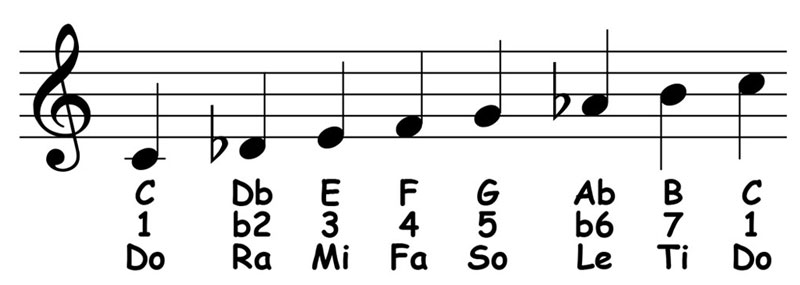
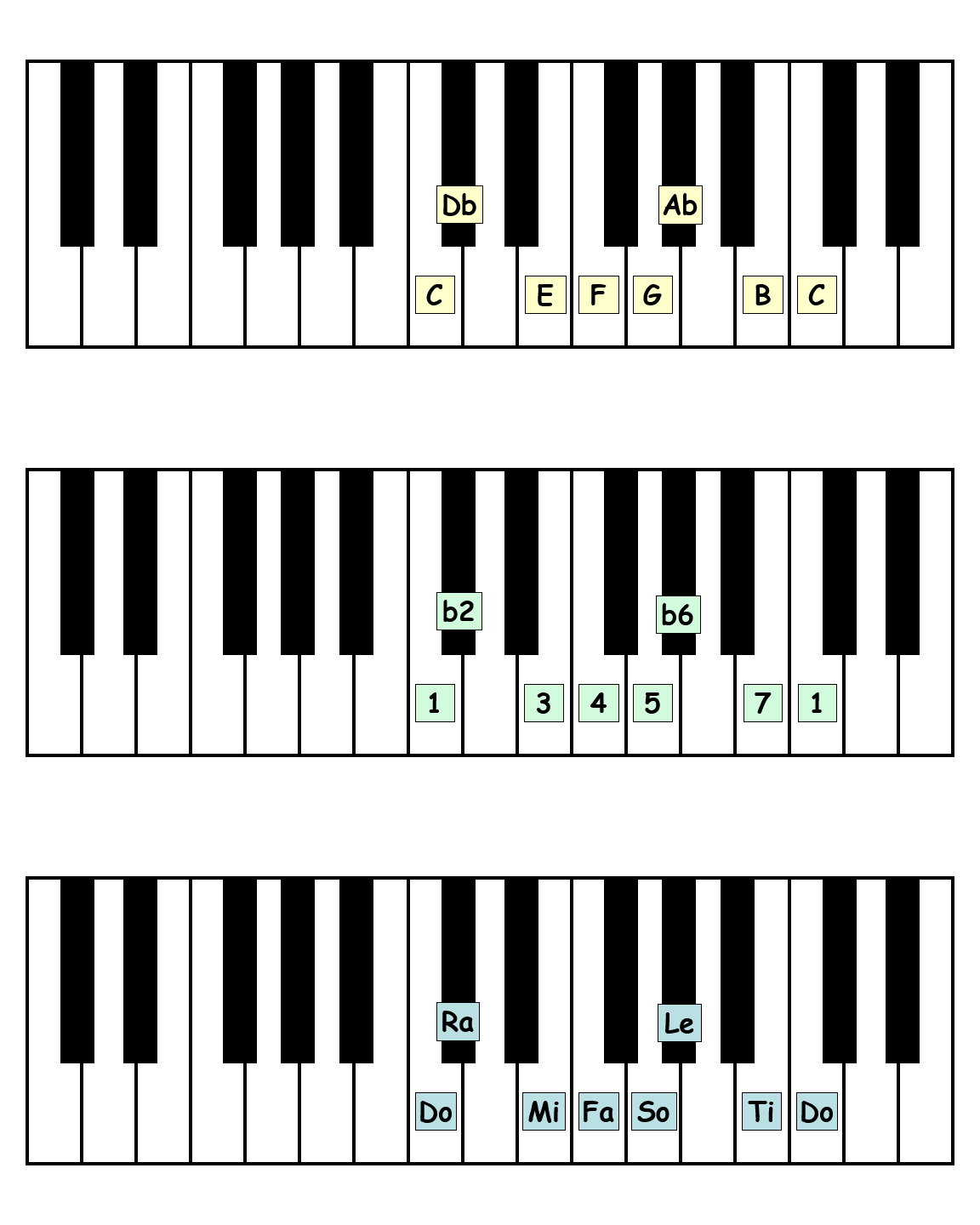
Notice how the distinctive sound-feeling of this exotic scale conjures up visions of casbahs, caravans, and belly dancers.
Comparative Scale Study
Play and sing the Arabic Scale and Major Scale side-by-side–and notice the dramatic effect created by changing two notes: Ra instead of Re and Le instead of La. Notice how these unique tensions allow you to create a whole new kind of music, a very exotic sound that is instantly recognizable!
Arabic Scale Theory, All Keys
Any interest in the scores, keyboard layouts, and MP3s for the Arabic scale in all keys? (Frank will be happy to produce if just one person asks!)
Solfege Ear Training
Reading, playing, and singing the Solfege syllables out loud is an extremely effective way to tune up your ears and to internalize the unique sound-feeling of each note in the scale with respect to the key center Do. Make sure to do this slowly enough for the unique sound-feeling of each Solfege syllable to make a meaningful impression on your mind’s ear.
Linear, Ascending

Linear, Descending

Do-X-Do, Ascending

Do-X-Do, Descending

Special Note about Ear Training in Context
We could sing a lot more musical patterns, but a more effective and efficient approach (80:20 Rule) is to get your ear training material directly from the music that YOU want to play!
back to… Table of Contents
Arabic Scale Theory & Ear Training, All Keys
Any interest? Frank will be happy to produce scores, keyboard layouts, and play along MP3s if someone asks.
Very useful information about the Arabic musical scale.
Thanks for the feedback. It is my privilege to share.
Unfortunately, there are about 160 scales in the Arabic music with most of them having a quarter of a note this is called Hijaz Diwan, and it actually should start from either D or G
you helped me a lot thank you!
My pleasure to be of service!