Lesson Goal: To quickly learn two commonly-used conventions for describing scale structure: Scale Degrees & Solfege… by ear, intellect, eye, and muscle…
Table of Contents
Prerequisites
Basic music reading skills… the LOVE of music… and the discipline to study and practice.
back to… Table of Contents
Scale Structure: Scale Degrees
Lesson Goal: To quickly learn the commonly-used convention for describing Scale Structure using scale degree numbers…
How the Scale Degrees System Works
is a number system that uses the Major Scale as the point of reference…
The system works as follows:
- The number “1” always represents the key that you are in.
- Numbers are assigned to each note in the Major Scale in ascending order.
- In the key of C, for example: C=1, D=2, E=3, F=4, G=5, A=6, B=7
- In the key of G, for example: G=1, A=2, B=3, C=4, D=5, E=6, F#=7
Scale Degrees for the C Major Scale
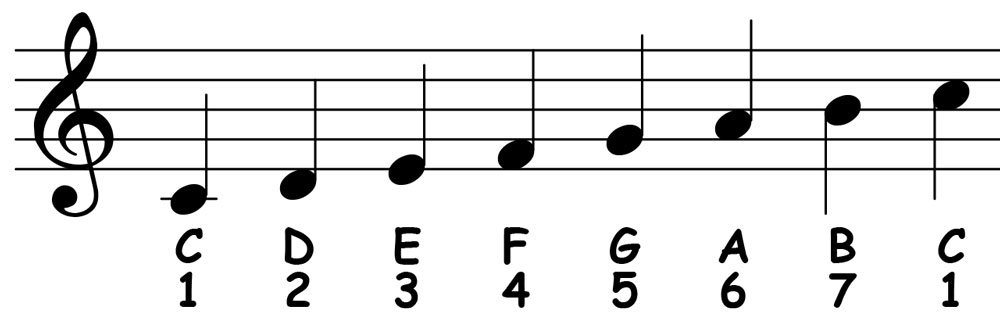
And so, the major scale is said to have a scale structure of 1-2-3-4-5-6-7…

Important Points:
- Remember: Any system for naming things is an abstract and arbitrary left-brain construct.
- The choice of major scale as the conventional reference point does not imply that there is something sacred about the Major Scale.
- Do not let numbers suggest that going up the scale is somehow more important than going down the scale.
- Do not let numbers suggest that a scale is only a linear construct.
- Do not let the numbers suggest that a “4” must exist before a “5” can exist… or that a “3” must exist before a “b3” can exist.
Scale Degrees for the C Natural Minor Scale
Now let’s use the number system to describe the scale structure of the Natural Minor Scale…

And so, the Natural Minor Scale has a scale structure of 1-2-b3-4-5-b6-b7…

Of course, any combination of notes is theoretically possible when building scales, but don’t worry about the details right now. For the moment, it is sufficient to understand the concept of scale structure and the number system described above. You will learn lots more when as your study of scales, chords, and chord progressions unfolds.
back to… Table of Contents
Scale Structure: Number System (Flashcards)
Lesson Goal: To quickly learn the scale structure (using the number system) for commonly used scale types: major, minor, pentatonic, mixolydian, dorian, and blues…
back to… Table of Contents
Scale Structure: Solfege
Why Learn Solfege?
Learning Solfege has at least five huge benefits…
- Solfege teaches you how scales work by giving names to each pitch and connecting these names to how each pitch sounds and feels with respect to the key center and to other notes in the scale.
- Solfege helps you understand that every note in a scale has a certain function.
- Solfege is an effective way to learn how music works (music theory) by singing.
- Solfege develops many musical skills: singing in tune, playing by ear, reading, memorization, improvising, and transposition.
- Solfege provides a common vocabulary for teachers, students, and performers to discuss musical patterns, functions, and relationships.
If you can sing Do Re Mi Fa So La Ti Do up the major scale, you have the talent required to master Solfege, a skill that will take your musicianship to a whole new level!
How Does the Solfege System Work?
The Solfege system works as follows…
The note that acts as the tonal center is named Do, always. In other words, Do is the key that you are in. Once a tonal center Do is established, each of the other eleven possible pitches has a unique “sound-feeling” with respect to this tonal center. Each of these pitches is assigned a name in the form of a unique Solfege syllable.
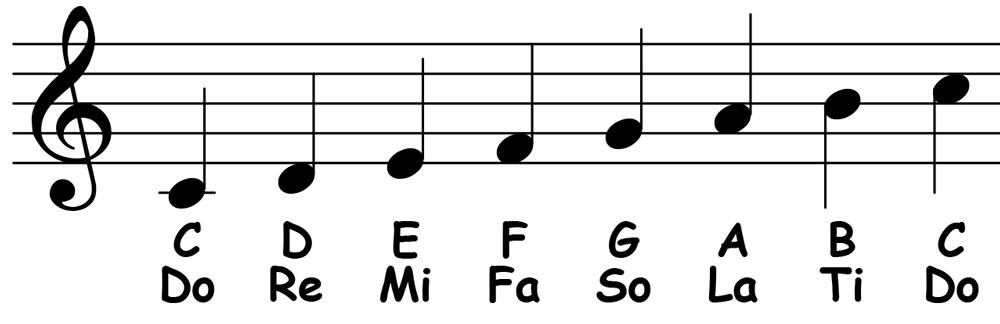
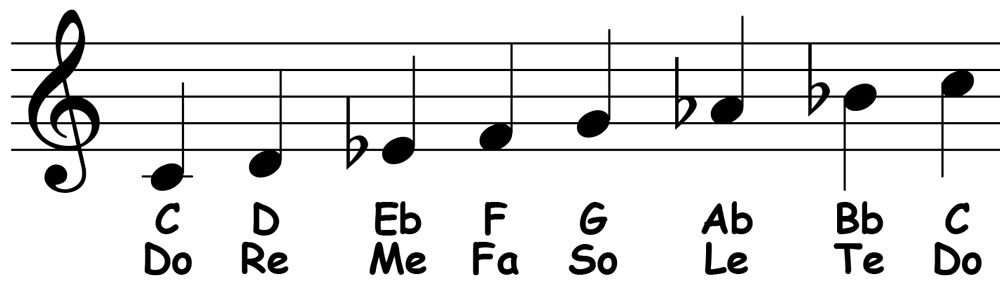
A great way to start thinking and hearing in Solfege is to learn the Solfege syllables for the Major Scale and Natural Minor Scale as shown below…
Solfege Syllables for the C Major Scale
Mi sounds like “Mee”, La sounds like “Lah” and Ti sounds like “Tee”.
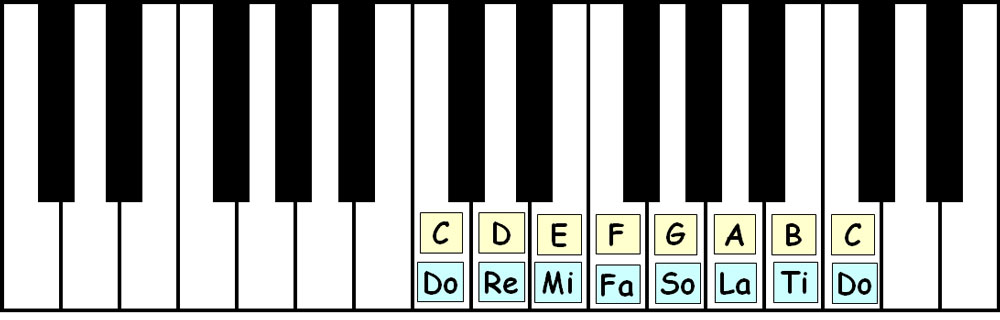
Functions for Each Solfege Syllable in the Major Scale
- Do (also called the tonic) is the tonal center which acts the home base that all the other pitches relate to.
- Re has a tendency to move either down to Do or up to Mi.
- Mi gives the scale it “major” sound. It’s highly consonant with Do, is typically combined with Do to create the major harmony and has a tendency to move scale-wise up or down or to skip to Do.
- Fa creates a harmonic tension and instability and has a tendency to resolve down to Mi.
- So is highly consonant with Do, so much so that it is usually combines with Do to create chords.
- La feels unresolved and tends to resolved down to the more stable So or up to Do.
- Ti (also called the leading tone) has a strong tendency to resolve upward to the Do.
Solfege Syllables for the C Natural Minor Scale
Pronunciation Tip: Me sounds like “May”, Le sound like “Lay”, and Te sounds like “Tay”.

Functions for Each Solfege Syllable in the Natural Minor Scale
- Do (also called the tonic) is the tonal center which acts the home base that all the other pitches relate to.
- Re has a tendency to move either down to Do or up to Mi.
- Me gives the scale it “minor” sound. It’s typically combined with Do to create the minor harmony and has a tendency to move scale-wise up or down or to skip to Do.
- Fa creates a harmonic tension and instability and has a tendency to resolve down to Me.
- So is highly consonant with Do, so much so that it is usually combines with Do to create chords.
- Le feels unresolved and tends to resolved down to the more stable So or scale-wise up to Do.
- Te has a strong tendency to resolve upward to the Do.
The Solfege system for naming pitches is used extensively throughout Piano-ology as an effective way to integrate music theory and ear training. The value of using Solfege will become clear as you continue your studies of scales, chords, chord progressions, and more.
learn more… Scales: Number System or Solfege?
Solfege and the Notion of Keys
Did you know that you can play a melody starting on any of the twelve possible notes?
For example, you can play “Twinkle, Twinkle” starting on the note C…

But you can also play starting on the note G…

or starting on the note Eb…

Notice that the Solfege syllables are exactly the same no matter what note you start on!
In fact, you can play “Twinkle, Twinkle” (or any other melody) starting on any of the twelve physical keys on the piano.
How Many Keys are There?
Since there are twelve possible physical keys on the piano, there are twelve possible physical “keys” in which you can play a piece of music.
But, while there are twelve physical keys, it is possible to write music with no sharps or flats or up to seven sharps or seven flats in the key signature, making at least fifteen keys theoretically possible.
That said, here is “Twinkle, Twinkle” written out and played in all fifteen theoretical keys arranged around the cycle from seven sharps to seven flats…
Don’t merely passively listen to these sound bits. Read the score as you play and sing the Solfege syllables out loud. Doing so is a highly effective way to internalize the sound, feeling, and function of each note in the melody!!!
“Twinkle, Twinkle” in All Fifteen Possible Keys
“Twinkle, Twinkle” in C# Major

“Twinkle, Twinkle” in F# Major

“Twinkle, Twinkle” in B Major

“Twinkle, Twinkle” in E Major

“Twinkle, Twinkle” in A Major

“Twinkle, Twinkle” in D Major

“Twinkle, Twinkle” in G Major
“Twinkle, Twinkle” in C Major
“Twinkle, Twinkle” in F Major

“Twinkle, Twinkle” in Bb Major

“Twinkle, Twinkle” in Eb Major
“Twinkle, Twinkle” in Ab Major

“Twinkle, Twinkle” in Db Major

“Twinkle, Twinkle” in Gb Major

“Twinkle, Twinkle” in Cb Major

Reading & Ear Training Tips
As you play and sing along and notice that…
- Do always sounds and feels like Do, So always sounds and feels like So, La always sounds and feels like La, and so on… no matter what key you are in!
- The “shape” of the melody in the score is identical, no matter what key you are in.
- When you change keys, all the letter names of the notes change, but the Solfege names remain exactly the same. The letter names change because they are arbitrary, but the Solfege names remain the same because they represent the inherent melodic-harmonic function of each note no matter what key you are in.
Understanding these concepts is essential for understanding how scales and melodies work and lays a solid foundation that facilitates ear training, reading, memorization, transposition, composition, and improvisation.
Scale Structure: Solfege System (Flashcards)
Lesson Goal: To quickly learn the Solfege scale structure for commonly used scale types: major, minor, pentatonic, mixolydian, dorian, and blues…
Scale Degrees or Solfege?
The short answer is that you should learn both systems for describing scale structure… for at least six reasons…
- Both systems are widely used in music theory to describe, communicate, and analyze musical patterns such as scales, melodies, and chord progressions.
- Neither system is perfect. Each has its pros and cons, capabilities and limitations.
- Scale Degrees and Solfege are complementary views of the same musical stuff: Do=1, Re=2, Mi=3, Fa=4, So=5, La =6, and Ti =7… always, no matter what key you are in!
- Solfege syllables are better suited for analyzing and doing ear training for scales and melodies.
- Scale Degrees are better suited for describing chord structure, as you will see when you study chords and chord progressions.
- Both conventions will be used throughout the Piano-ology website as appropriate.
The Big Takeaway
When you think about, read, hear, and play a C Major scale, don’t just stop with the letter names. Take your musicianship to the next level by connecting each note in the scale to both its scale degree and solfege syllable! Being able to used all three naming conventions interchangeably will take your musicianship to the next leve, guaranteed!


learn more… Scales
Discover more from PIANO-OLOGY
Subscribe to get the latest posts sent to your email.
I already studied solfeggio with a music theory book, but it was a dense read and some of the concepts escaped me. This cleared a lot of things up. Thank you!
Thanks a bunch for taking the time and energy to comment, Mun. The positive feedback is greatly appreciated… as I aspire to be as clear and concise as I can. That said, please do not hesitate to let me know if something is incorrect or unclear. All the best to you in life and music!
You’re certainly welcome. It’s a good blog you have, with plenty of information. My only complaint for now is that you post so frequently that when I scroll through my WordPress Reader, I often don’t know which post to click on first.
And please call me Haerin. Mun Haerin is a Korean name, so the surname comes first.
: ) Thanks so much, Haerin. It’s nice to meet you. And thanks for teaching me about Korean name customs. My Hungarian name is Péter Ferenc. In Hungary the family name is given first, too.