Quickly internalize the Major 1 6 4 5 Chord Progression (I-vi-IV-V) in all keys… by ear, intellect, eye, and muscle…
Table of Contents
Prerequisites
Basic music reading skills… basic scale, chord, and chord progression theory… basic technique… the LOVE of music… and the discipline to study and practice.
Lesson Goal
To internalize the Major 1 6 4 5 Chord Progression (I-vi-IV-V) in all keys… using all four musical intelligences: ears, intellect, eyes, and muscles.
Study & Practice Reminders
- Never play these mindlessly and mechanically. Always aspire to play musically.
- Your goal is not to merely memorize these, but to study and practice them until you internalize them using all four musical intelligences: ears, intellect, eyes, and muscles.
- Every time you practice something, you are programming your brain. So always play accurately.
- Practice with a click track or rhythm track. Doing so will give you immediate feedback on any rhythmic misconceptions or places where your timing gets sloppy.
- Record yourself. Always. Listen to the playback immediately. And ask yourself: Is that what you intended to play?”
- If anything feels tense or awkward, stop immediately and experiment with alternative fingerings or choreography.
- Play this in other keys you expect to play in. By the way, once you see the patterns (which is guaranteed if you know your scales and chords) finding the notes in other keys will be a piece of cake!
- If you feel stuck or overwhelmed, realize that anything can and will be mastered if you slow things down or break things down to small enough pieces.
back to… Table of Contents
Character of the Major 1 6 4 5 Chord Progression
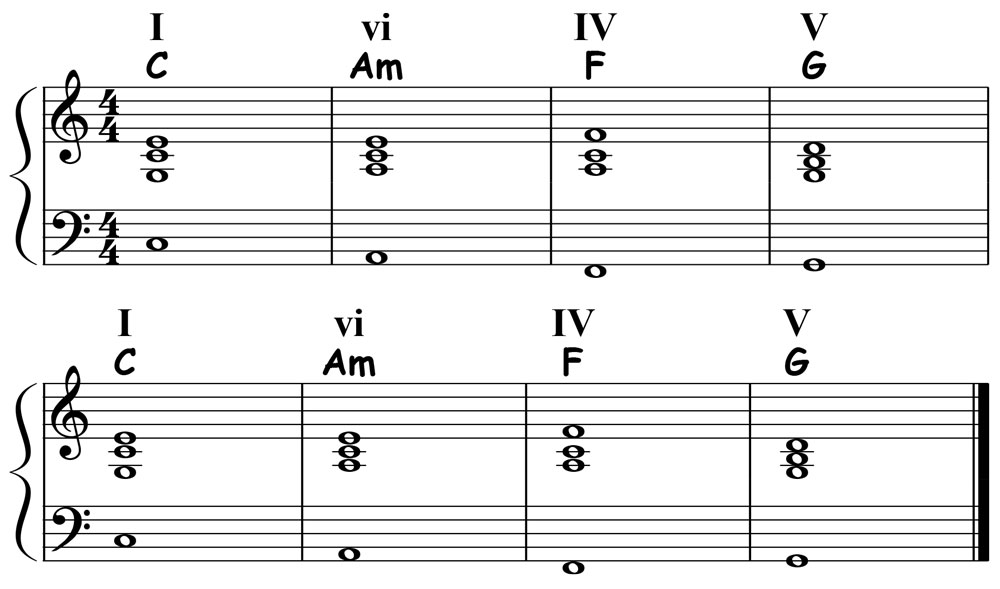
Listen to the Major 1 6 4 5 Chord Progression (I-vi-IV-V) played in the key of C major in 8 bar form and 4/4 time commonly used in rock, pop, and folk music)…
Ear Training Notes
Simply listen and be receptive to the sound-feeling of each chord as a whole, and notice:
- The C chord (I) establishes the major-ness and home key.
- The Am chord (vi) creates a minor-ish harmonic tension.
- The F chord (IV) continues with a major-ish harmonic tension.
- The G chord (V) extends the harmonic tension.
- That tension is released with the return back to the C chord (I).
back to… Table of Contents
Famous Songs that Use the Major 1 6 4 5 Chord Progression
Associating the theory and sound-feelings of the Major 1 6 4 5 Chord Progression (I-vi-IV-V) with music you’ve heard before is a great way to develop your aural awareness. As you listen, be receptive to the overall vibe or gist of the progression as well as the sound-feelings evoked by each chord. Also notice where each chord is placed with the form. To that end, here are some famous examples of the workhorse Major 1 6 4 5 Chord Progression in action…
“Heart and Soul” (The Cleftones)
Key: Ab (major).
Chords: Ab-Fm-Db-Eb.
“Unchained Melody” by The Righteous Brothers
Key: C (major).
Chords: C-Am-F-G.
“I Will Always Love You” (Dolly Parton, who also wrote it!)
Key: A (major).
Chords: A-F#m-D-E.
“I Will Always Love You” (Whitney Houston)
Key: A (major), then B (Major).
Chords: A-F#m-D-E / B-G#m-E-F#.
“Duke of Earl” (Gene Chandler)
Key: F (major).
Chords: F-Dm-Bb-C.
“Monster Mash” (Bobby Pickett)
Key: G (major).
Chords: G-Em-C-D.
“Blue Moon” (The Marcels)
Key: G (major).
Chords: G-Em-C-Db.
“Stand by Me” (Ben E. King)
Key: A (major).
Chords: A-F#m-D-E.
“Earth Angel” (The Penguins)
Key: Ab (major).
Chords: Ab-Fm-Db-Eb.
“Love Hurts” (Nazareth)
Key: G (major), but out of tune with concert pitch.
Chords: G-Em-C-D.
“In the Still of the Night” (The Five Satins)
Key: F (major).
Chords: F-Dm-Bb-C.
“Mister Bass Man” (Johnny Cymbal)
Key: C (major).
Chords: C-Am-F-G.
“All I Have to Do is Dream” (The Everly Brothers)
Key: E major).
Chords: E-C#m-A-B.
“Why Do Fools Fall in Love” (Frankie Lymon & the Teenagers)
Key: Gb (major).
Chords: Gb-Ebm-Cb-Db.
“Lollipop” (Ronald & Ruby)
Key: Ab (major).
Chords: Ab-Fm-Db-Eb.
“Pretty Little Angel Eyes” (Curtis Lee)
Key: E (major).
Chords: E-C#m-A-B.
“You Don’t Own Me” (Leslie Gore)
Key: Starts in G Minor, changes to G Major in the Chorus: “Don’t tell me what to do…”), then moves up to Ab (Major).
Chords: G-Em-C-D / Ab-F-Db-Eb.
“Twisting the Night Away” (Sam Cooke)
Key: A (major).
Chords: A-F#m-D-E.
“Every Breath You Take” (The Police)
Key: Ab (major) but out of tune with concert pitch.
Chords: Ab-Fm-Db-Eb.
“Be My Baby” by The Ronettes
Key: E (major).
Chords: E-C#m-A-B.
Hint: Wait for the Chorus
“Octopus’s Garden” (The Beatles)
Key: E (major), short interlude in A (major), then back to E (major).
Chords: E-C#m-A-B / A-F#m-D_E / E-C#m-A-B.
“Crocodile Rock” (Elton John)
Key: G (major).
Chords: G-Em-C-D.
“Please Mister Postman” (The Marvelettes)
Key: D (major).
Chords: D-Bm-G-A.
“Beyond the Sea” (Bobby Darin)
Key: Starts in F (major), then A (major), then C (major), then back to F (major).
Chords: F-Dm-Bb-C / A-F#m-D-E / C-Am-F-G / F-Dm-Bb-C.
back to… Table of Contents
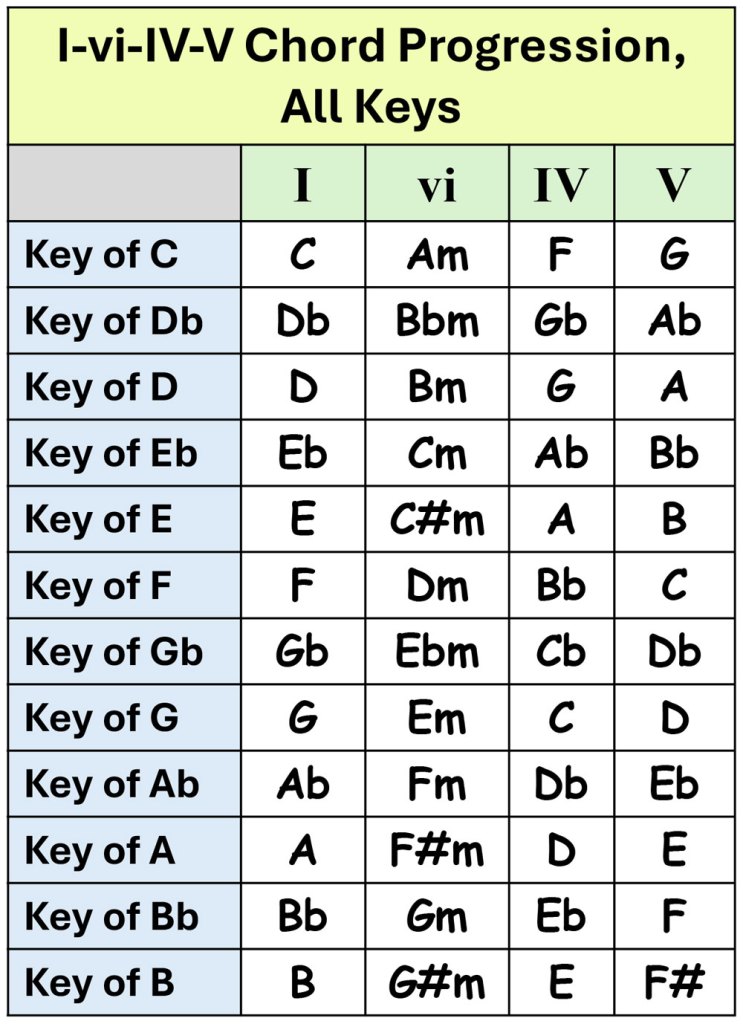
Major 1 6 4 5 Chord Progression, All Keys
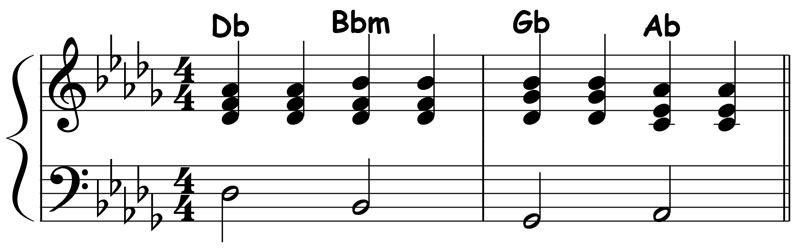
Here is one possible rendition of the Major 1 6 4 5 Chord Progression played in all keys: with chord roots in the left hand and block chords connected by voice-leading in the right…
Key of C (Major)
Say this out loud: “The I-vi-IV-V chord progression in the key of C is: C-Am-F-G“
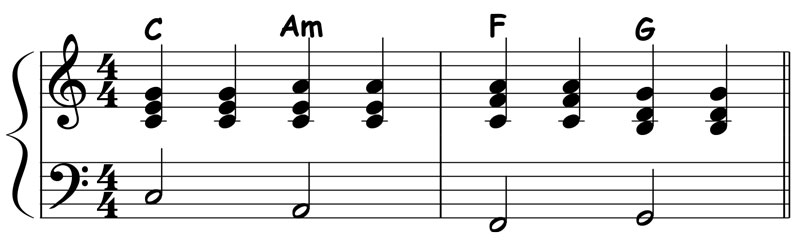
Ear Training Tip: Sing the bass line (Do-La-Fa-So).
Key of D Flat (Major)
Say this out loud: “The I-vi-IV-V chord progression in the key of Db is: Db-Bbm-Gb-Ab“
Key of D (Major)
Say this out loud: “The I-vi-IV-V chord progression in the key of D is: D-Bm-G-A“
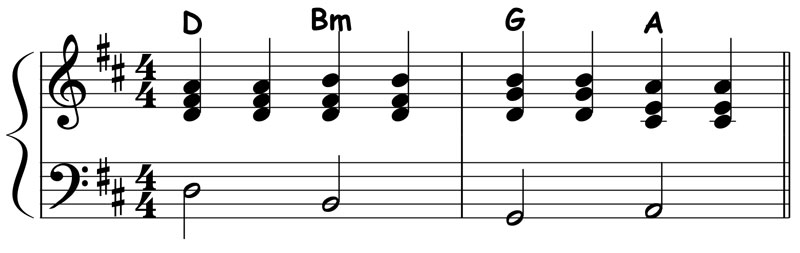
Ear Training Tip: Pick one of the chord voices and sing it through the chord changes. For example, the top voice (So-La-La-So).
Key of E Flat (Major)
Say this out loud: “The I-vi-IV-V chord progression in the key of Eb is: Eb-Cm-Ab-Bb“

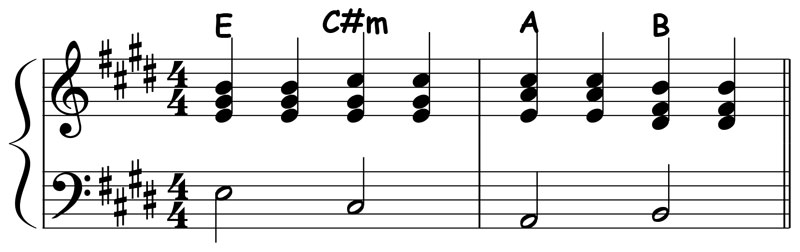
Key of E (Major)
Say this out loud: “The I-vi-IV-V chord progression in the key of E is: E-C#m-A-B“
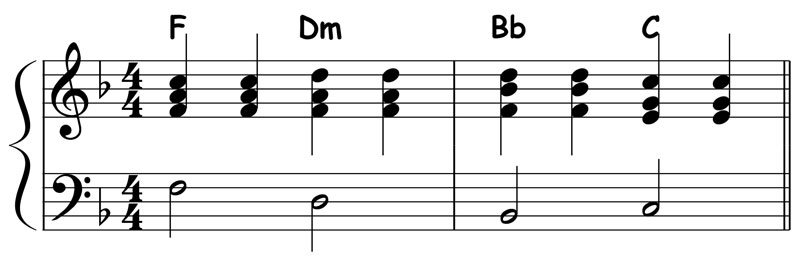
Key of F (Major)
Say this out loud: “The I-vi-IV-V chord progression in the key of F is: F-Dm-Bb-C“
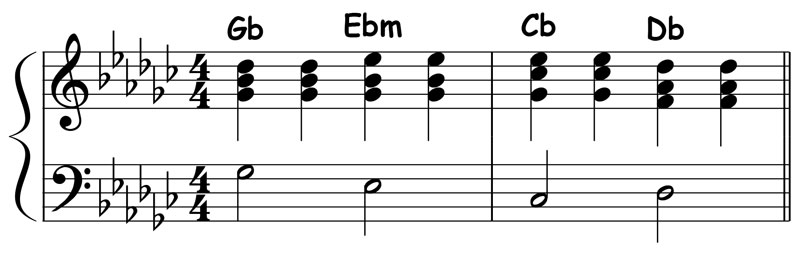
Key of G Flat (Major)
Say this out loud: “The I-vi-IV-V chord progression in the key of Gb is: Gb-Ebm-Cb-Db“
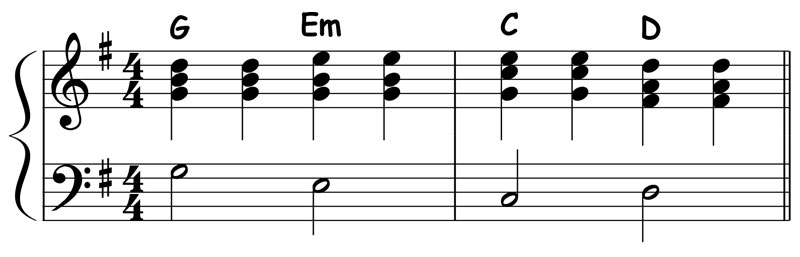
Key of G (Major)
Say this out loud: “The I-vi-IV-V chord progression in the key of G is: G-Em-C-D“
Key of A Flat (Major)
Say this out loud: “The I-vi-IV-V chord progression in the key of Ab is: Ab-Fm-Db-Eb“

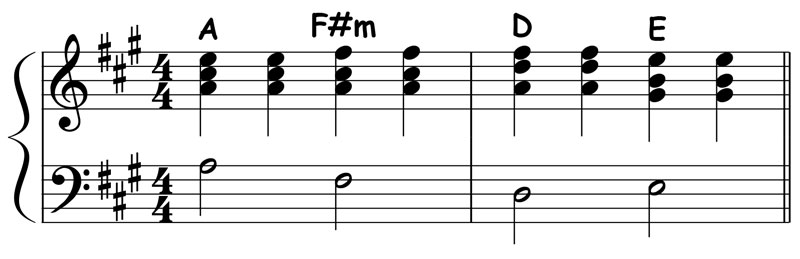
Key of A (Major)
Say this out loud: “The I-vi-IV-V chord progression in the key of A is: A-F#m-D-E“
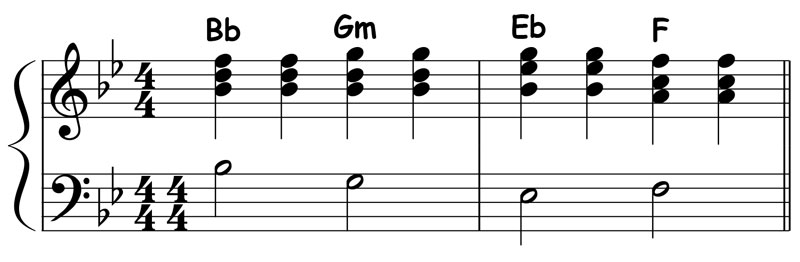
Key of B Flat (Major)
Say this out loud: “The I-vi-IV-V chord progression in the key of Bb is: Bb-Gm-Eb-F“
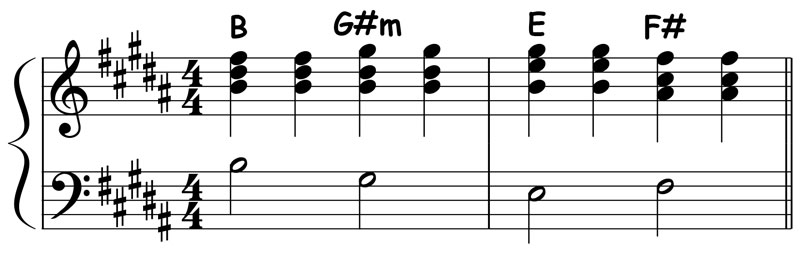
Key of B (Major)
Say this out loud: “The I-vi-IV-V chord progression in the key of B is: B-G#m-E-F#“
Major 1 6 4 5 Chord Progression, Chord Names in All Keys
back to… Table of Contents
Major 1 6 4 5 Chord Progression Play Along Practice Tracks, All Keys (MP3s)
A simple 4 bar rendition of the Major 1 6 4 5 Chord Progression played at various tempos, arranged chromatically ascending in all (Mixolydian) keys…
The benefits of playing along with a click track at various tempos cannot be overstated: slowly at first to have enough time to “think about everything”, then fast enough to be forced to “play without thinking”.
I-vi-IV-V Chord Progression, All Keys @ 80 bpm…
I-vi-IV-V Chord Progression, All Keys @ 100 bpm…
I-vi-IV-V Chord Progression, All Keys @ 120 bpm…
I-vi-IV-V Chord Progression, All Keys @ 140 bpm…
I-vi-IV-V Chord Progression, All Keys @ 160 bpm…
I-vi-IV-V Chord Progression, All Keys @ 180 bpm…
back to… Table of Contents
Pop/Rock Rhythm Tracks
Any interest in play along MP3 Practice Tracks with bass and drums in various styles, keys, and tempos?
back to… Table of Contents
learn more… Pop/Rock Lessons / Chords & Chord Progressions