Lesson Goal: To quickly internalize some bread and butter Major 1 6 4 5 Comping Styles… by ear, intellect, eye, and muscle…
Table of Contents
Prerequisites
Basic music reading skills… basic scale, chord, and chord progression theory… the LOVE of music… and the discipline to study and practice.
back to… Table of Contents
Study & Practice Reminders
- Never play these mindlessly and mechanically. Always aspire to play musically.
- Your goal is not to merely memorize these, but to study and practice them until you internalize them using all four musical intelligences: ears, intellect, eyes, and muscles.
- Every time you practice something, you are programming your brain. So always play accurately.
- Practice with a click track or rhythm track. Doing so will give you immediate feedback on any rhythmic misconceptions or places where your timing gets sloppy.
- Record yourself. Always. Listen to the playback immediately. And ask yourself: Is that what you intended to play?”
- If anything feels tense or awkward, stop immediately and experiment with alternative fingerings or choreography.
- Play this in other keys you expect to play in. By the way, once you see the patterns (which is guaranteed if you know your scales and chords) finding the notes in other keys will be a piece of cake!
- If you feel stuck or overwhelmed, realize that anything can and will be mastered if you slow things down or break things down to small enough pieces.
back to… Table of Contents
Major 1 6 4 5 Form & Harmony
Let’s begin with the simplest interpretation of the Major 1 6 4 5 Chord Progression…
Key elements: 8-bar form, 4/4 time, chord roots in the left hand, block chords connected by voice-leading in the right…

Technique Tips: (1) Use the sustain pedal, but be sure to “un-pedal” with each chord change so that you do not smear and muddy up the sound, (2) Anticipate each chord change and allow the entire form to breathe naturally by having some momentum going into each chord and bass note.
back to… Table of Contents
Major 1 6 4 5 Comping Style #1
Straight time voice-led triads in the right hand and chord roots connected by passing tones in the left…

back to… Table of Contents
Major 1 6 4 5 Comping Style #2
Quintessential “fifties” style piano…
Key elements: triplet sub-beats, block chords with voice leading in the right hand, melodic bass line that creates a strong sense of momentum, direction, and anticipation…
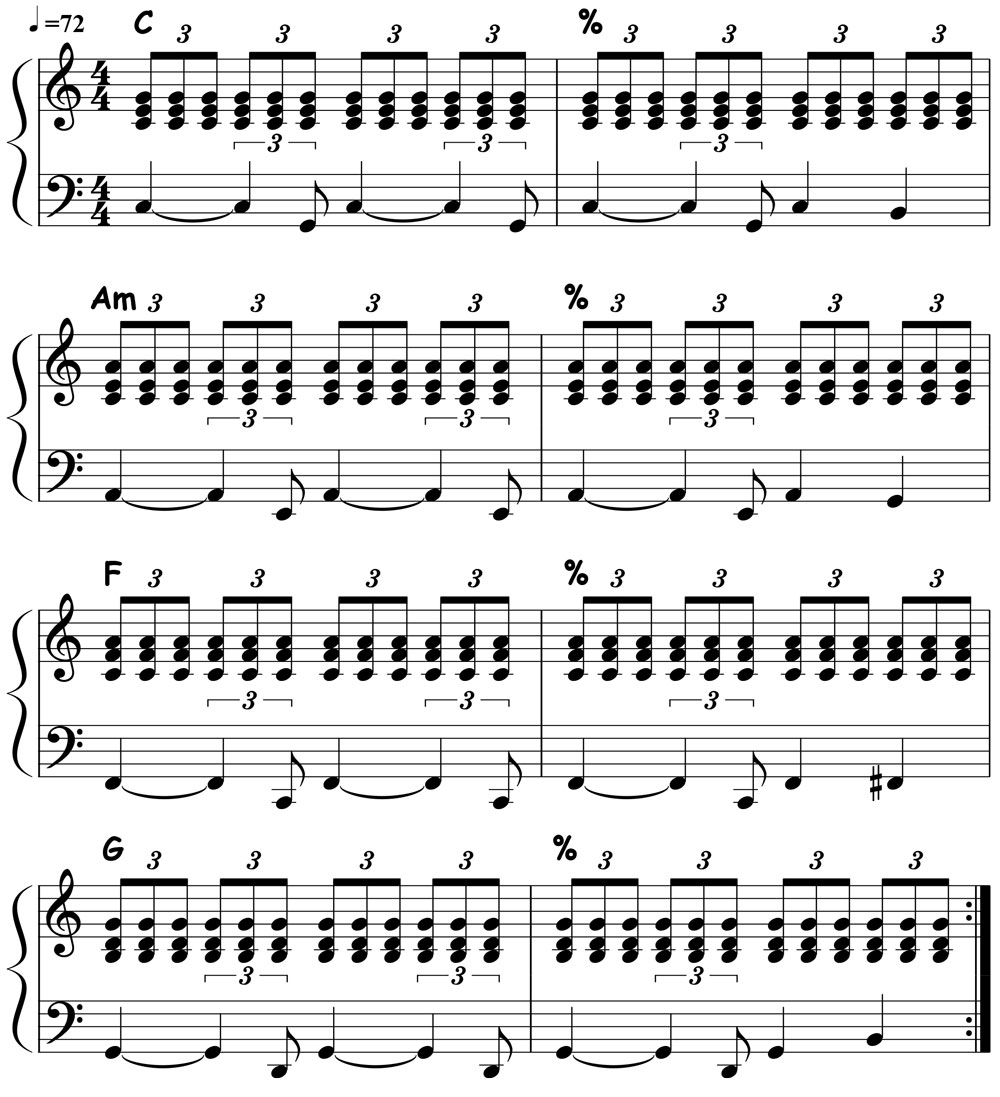
Interpretation & Technique Tips: (1) Shape the phrases so that the dynamics ebb and flow, (2) Use the sustain pedal, but be sure to “un-pedal” with each chord change so that you do not smear and muddy up the sound, (3) Have some momentum going into each chord and bass note, (4) Play the left hand melodically.
back to… Table of Contents
Major 1 6 4 5 Comping Style #3
Key elements: Chord roots connected by passing tones in the left hand with flowing triplet arpeggios in the right hand…
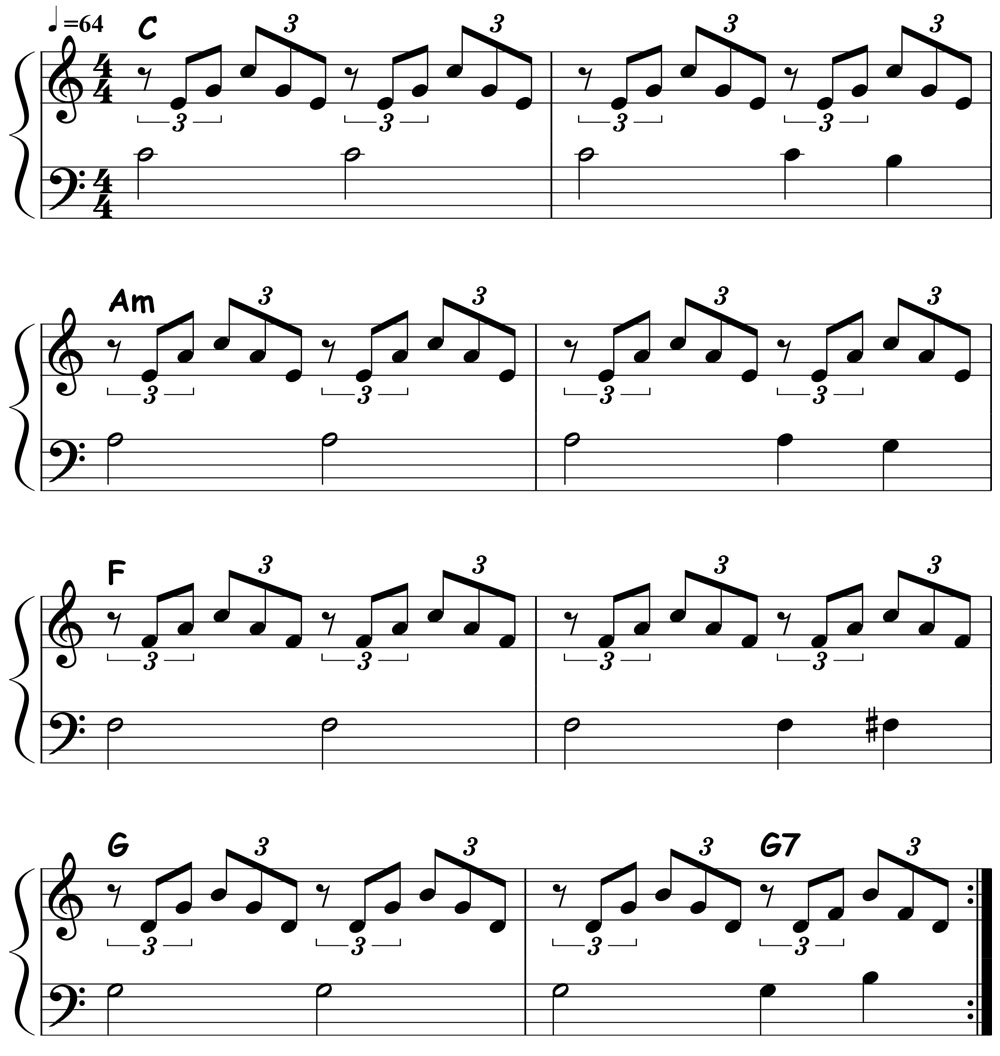
Interpretation & Technique Tip: Think of playing this as if you had a giant ten finger hand with one musical mind!
back to… Table of Contents
Major 1 6 4 5 Comping Style #4
Key elements: Voice-led triads where each triad is played in an alternating broken 2/1 pattern in straight eight notes in the right hand accompanied by chord roots connected by passing tones in the left…
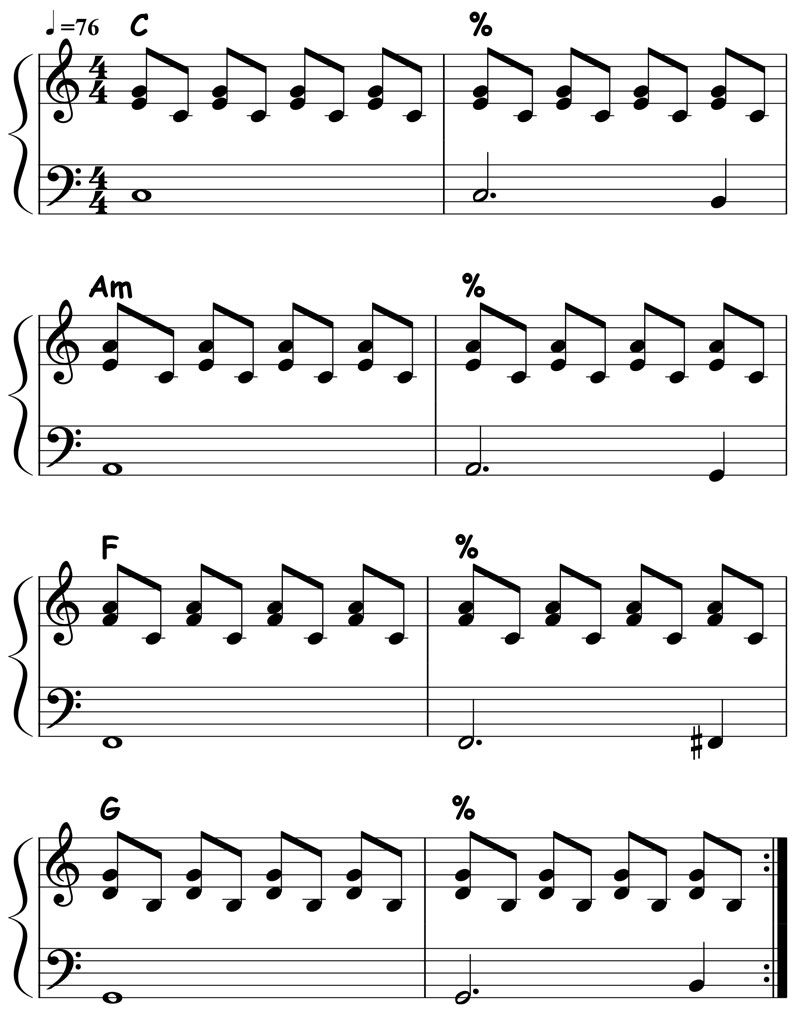
Interpretation & Technique Tips: (1) Consider making the chords on the weak beats an echo of the chord on the strong beat, (2) Bring out the down beat in each duplet while playing the up beat short and subdued, almost at a whisper, (3) Rotation, rotation, rotation in all three axes.
back to… Table of Contents
Major 1 6 4 5 Comping Style #5
Key elements” Two-fisted syncopated rhythm with voice-led triads in the right hand and chord roots in octaves in the left…

Interpretation & Technique Tips: (1) Right Hand: Make the chords played on the weak beats and upbeats an echo of the chords played on the strong beats, (2) Left Hand: Bring out and sustain the first note in each bar while understating the other three.
back to… Table of Contents
Major 1 6 4 5 Comping Style #6
Key elements: An expansion of the harmony for each chord by inserting suspended fourth chords that resolve to the prevailing chord in each bar…
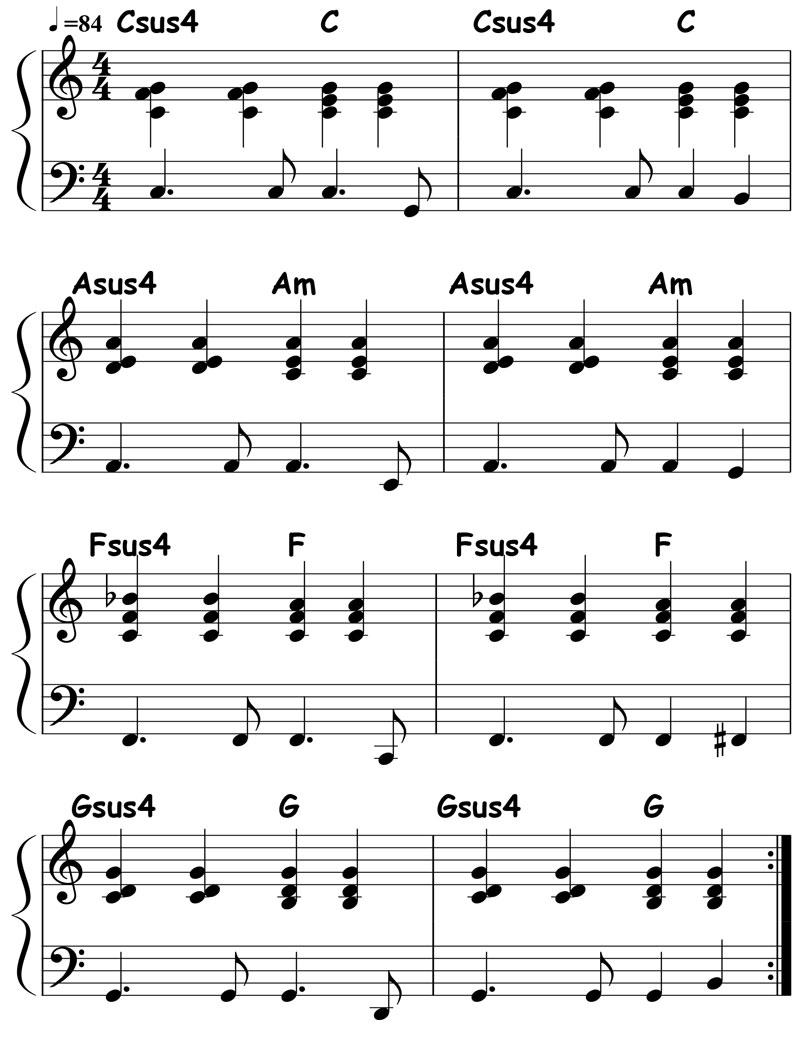
Technique Tips: (1) Play the pickup note (the last note in each bar) as a subdued and smoothly connected embellishment of the note that follows (chord root played on the strong beat).
back to… Table of Contents
Major 1 6 4 5 Comping Style #7
Key elements: Expanding the harmony by inserting add9 chords that resolve to the prevailing chord in each bar…

Interpretation & Technique Tips: Play each pickup note as a smoothly connected embellishment of the note that follows (which happens to be the root of the next chord played on the strong beat, (2) Don’t forget: How you move your body is how the music is going to sound and feel.
back to… Table of Contents
Major 1 6 4 5 Comping Style #8
Key elements: Expanding the harmony by inserting some tasteful harmonic tension (indicated by the “slash” chords) before gently resolving to the prevailing chord in each bar…

Interpretation Tip: Consider “ghosting” the syncopated and weak beat notes in the left hand as understated echoes.
back to… Table of Contents
learn more… Pop/Rock Piano Lessons