Lesson Goal: To understand that expert piano fingering is so much more than knowing which finger goes on which key…
Table of Contents
Prerequisites
Basic music reading… LOVE of music… and the discipline to study and practice.
back to… Table of Contents
Piano Fingering Number convention
The standard convention for communicating Piano Fingering in written music is to number your fingers 1 through 5, as follows…
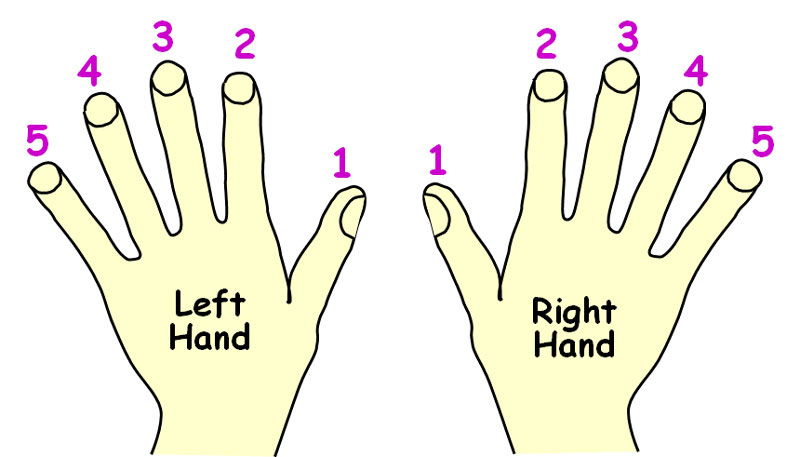
Simply put, your thumbs are “1” and you count to “5” as you work your way out to your pinkies!
This convention is worth knowing for two reasons:
- It will be used throughout our web site whenever the question of fingering comes up.
- It is very commonly used in written music, especially in classical music.
back to… Table of Contents
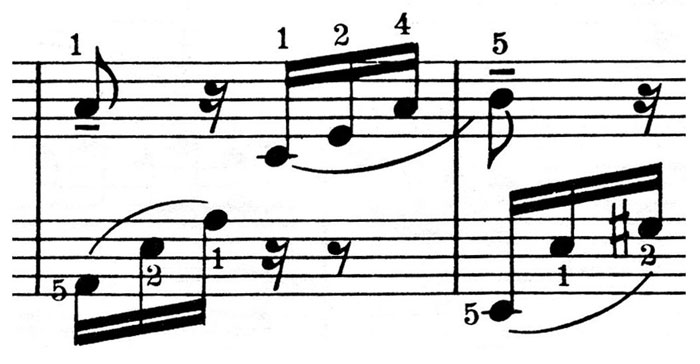
Fingering Example (Clementi Sonatina)

back to… Table of Contents
A Word of Caution about Piano Fingering Numbers
Always take the fingering shown in published music as a suggestion, not a requirement. Use your own judgment regarding what works best for you — based on your awareness of your own body and your knowledge of sound Fingering Principles… always remembering that musicality always goes in the direction of mental and physical ease.
back to… Table of Contents
Fingering Principles
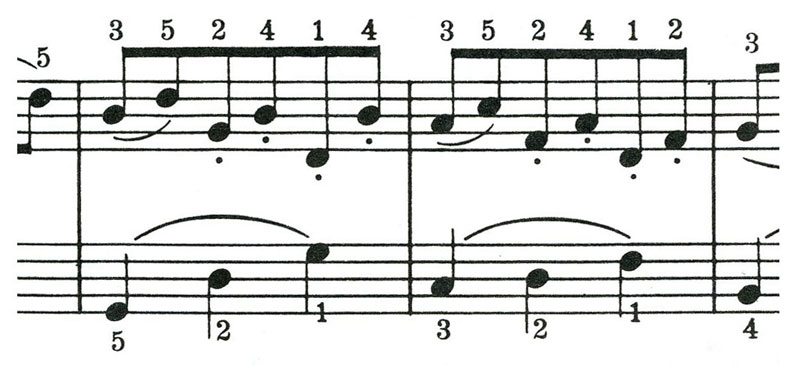
Musical piano fingering is not about following “the rules”, but about applying flexible principles…
- Good fingering is easy fingering–both physically and mentally!
- Choice of fingering should always be based on goals, not rules. Instead of asking “What is the “right” fingering for this passage?” Instead, ask “What fingering makes musical, physical, and logical sense for this passage?”
- You never have to sacrifice physical ease for musical effect. In fact, physical ease and musical effect are inseparable. If it feels good, it will sound good and vice versa!
- Your fingering should make musical, logical, physical sense. It should fit the contours of the music, be easy to remember, suit the anatomy of your hands, and not fight against the natural capabilities of your body.
- Good fingerings are not found by thinking “one note at a time”. Playing is a dynamic, not static, process, where you are always preparing for what comes next. Easy fingerings fit the ebbs, flows, and contours of whole musical phrases, not just individual notes.
- Piano playing should never hurt or feel tense. Any uncomfortable or awkward stretching or scrunching of the hand is a symptom that the fingering is flawed or some other aspect of your technique needs more study.
- Don’t be afraid to use the entire length of the key. In other words, don’t just play the part of the key that is closest to you. Playing farther away can do wonders for freeing your technique and opening up your fingering options.
- The fingering should not confuse your sense of where your body is in relation to the piano. If your fingering causes you to feel unsure of where the keys are, your fingering may be flawed or some other aspect of your technique needs more study.
- The choice of fingering and choreography you adopt mutually influence each other. The solution to a technical problem invites experimenting with both of them.
- Good fingering and good technique are inseparable, but “good fingering” is so much more than just knowing which finger goes on which key. If you want to take your playing to the next level, you must also consider where and how your fingers make contact with the keys.
- Musical fingering is only one of many aspects of musical piano technique. Don’t fall into the trap of thinking that good fingering coupled with finger training will solve all your technical problems. Fluid piano technique rests on a foundation of full body choreography!
back to… Table of Contents
Expert Fingering Practices
Expert fingering is an essential part of expert piano technique, but expert fingering is a lot more than just knowing which finger goes on which key. If you want to take your playing to the next level, you must appreciate two other important factors: where and how your fingers make contact with the keys.
Expert Piano Fingering Practices YouTube
Expert Piano Fingering Practices YouTube Highlights
- Musical piano technique always goes in the direction of physical ease.
- Physical ease is enabled by easy fingering.
- Easy fingering is so much more than knowing which finger goes on which key.
- Don’t be afraid to use the entire length of the key.
- Never allow your fingertips to get welded to the key surface. Keep moving by playfully slide, pull, rock, rotate, and pivot from one musical place to the next.
- WHERE and HOW you contact the keys depends on your musical intentions.
- Playing this way is perfectly natural. All you need to do is trust what your body is trying to tell you!
back to… Table of Contents
Major Scale Fingering
Natural Minor Scale Fingering
Major Triad Arpeggio Fingering
Minor Triad Arpeggio Fingering
learn more… Piano Technique
Discover more from PIANO-OLOGY
Subscribe to get the latest posts sent to your email.