Learn-by-doing studies in how to think about, read, hear, and play Pachelbel’s Canon like an artist…
Learning Goals: To read and play Pachelbel’s Canon in D like a musician, not like a robot.
The ultimate goal is to internalize this beloved piece using all four musical intelligences: ear, intellect, eye, and muscle. In order to get there, we’re going to apply what we already know about time, scales, Solfege, chords, chord progressions, and Roman Numeral Analysis to deeply understand what makes this piece tick in every musical dimension: form, meter, rhythm, key center, tonality, harmony, melody, phrasing, interpretation, technique, and more. Along the way, we’re going to learn priceless lessons in how music works and how to speak the language of music… in a way that will pay huge dividends in all your music making. Let’s go!
Table of Contents
About Pachelbel’s Canon
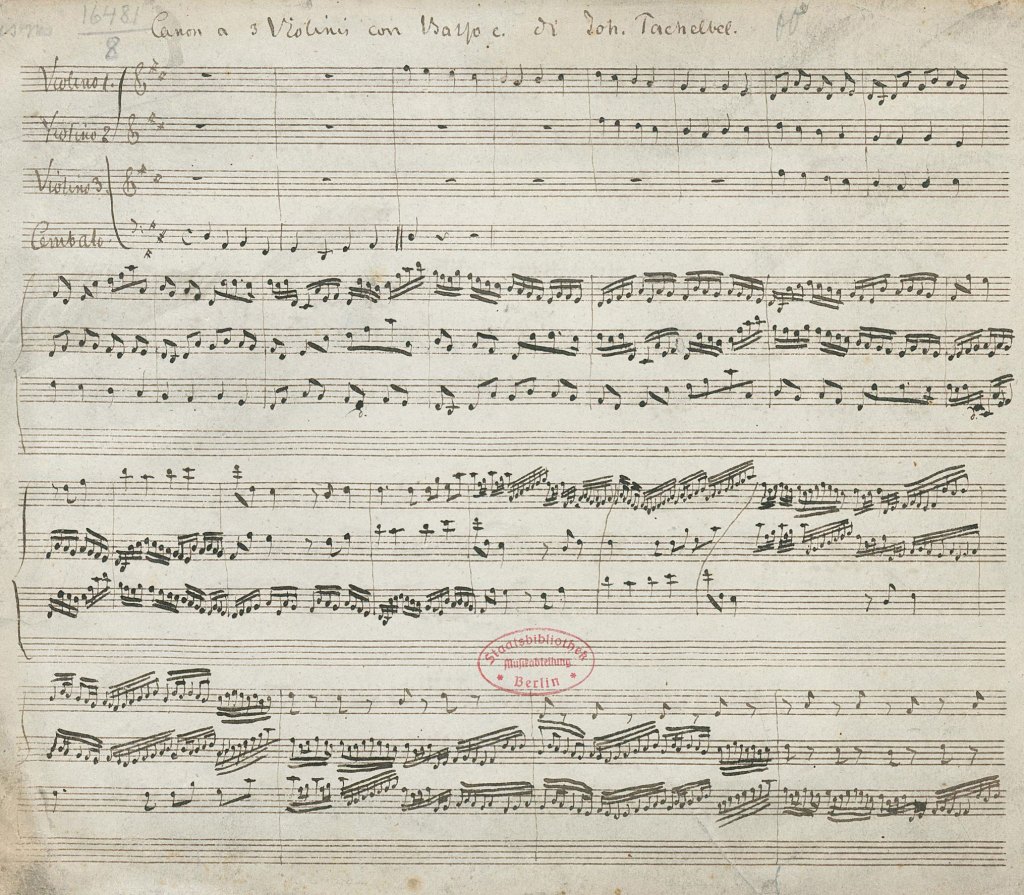
Pachelbel’s Canon in D was originally scored for three violins and basso continuo. (“Bass continuo” typically consists of a bass line played by a cello with accompanying chords played on a harpsichord.) FYI, here’s the first page of the original manuscript…
Ears First! (Various Versions of Pachelbel’s Canon)
Before continuing, I strongly encourage you to listen to a variety of interpretations and arrangements… with special attention to tempo and texture… and mine them for ideas that really grab you. Here are a few renditions for your considerations.
Traditional Rendition
Sidebar: There’s something about those big round warm notes on the cello that resonates both emotionally (and literally) with all of us like no other instrument.
Cello & Harp Rendition
Cello & Piano Rendition
Orchestral Rendition
Another Traditional Rendition
Yes, they are playing it in Db. Does anyone know why might have done so?
Cello & Guitar Rendition
Pachelbel’s Canon Solo Piano Versions
While there is no official piano version of Pachelbel’s Canon, a variety of solo piano arrangements and renditions can be found on the internet… typically played as a theme and variations (rather than a canon) over an arpeggiated left hand.
Before continuing, I encourage you to listen to a few YouTube renditions to get a feel for different interpretations… which, by the way, range between heavy to light, fast and slow, frantic and tranquil. Also feel free to download a variety of scores in order to extract any ideas that you’re not able to figure out by ear.
Courtesy of Lee Galloway
Courtesy of Jacob’s Piano
Courtesy of George Winston
Yes, he’s playing his own variations and in the key of C, not D. If George can make the piece his own, so can you!
Special Note from Frank. In the lessons that follow, I will present a variety of scores gleaned from many sources and MP3s as performed by me. While they all represent my sincere effort to preserve the essence of the original adapted to the nature of the piano, I make no claims of having “the best” or “definitive” version. Take the words, images, and sounds in each lesson as a mere suggestion and starting point, not as the final say. I encourage you to pick, choose, and adapt what I present here to suit your personal taste and to make the piece your own.
Pachelbel’s Canon: Form & Harmony
There’s no single correct and linear way to study a piece of music because so many interacting elements contribute to making a piece tick, but we have to start somewhere. And a great place to start is with a high level view of the form and harmony.
Some useful metaphors. The form and harmony of a piece of music is like a rough sketch for a painting, rough form of a sculpture in clay, or rough outline for a story… for which the details will be added later.
Let’s develop our understanding of the form and harmony in three steps…
Step 1. Play the Chords
Here’s one possible rendition of the form and harmony (our rough draft, so to speak) for Pachelbel’s Canon arranged with the bass line as originally composed in the left hand and block chords connected using voice leading in the right hand…
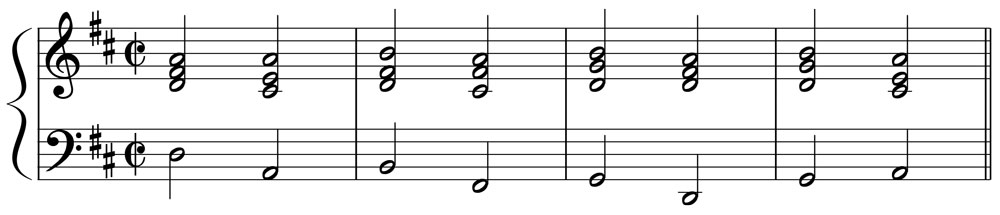
Read, play, listen, and ask: What do you see, think, hear, and feel?
Possible Answers…
- The Form is four bars long.
- The Time Signature is “alla breve”, also called “cut” time… fancy ways to say 2/2 time. In other words, each half note gets the beat.
- The Tonality is D Major (as evidenced by the key signature and chords).
- The Harmonic Rhythm is two chords per measure.
- Each chord naturally flows into the next in what sounds and feels like a natural progression.
- Any other thoughts and feelings? (please comment below)
Step 2. Name the Chords using their Letter Names
Let’s elevate our musical understanding by realizing that these chords have letter names as follows…
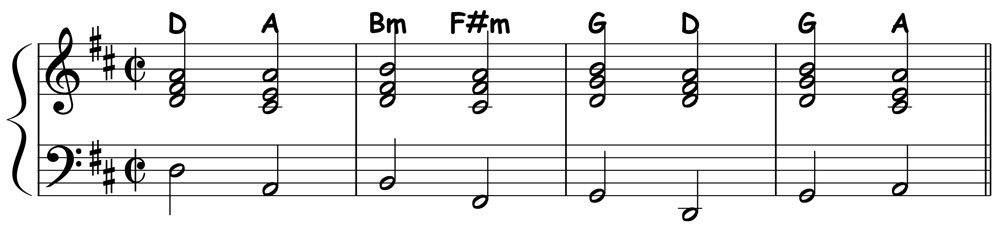
Read, play, listen, and ask: How does this sequence of chords sound and feel?
Possible Answers…
The D chord sounds and feels like home.
All the other chords sound and feel like they want to go somewhere.
Each chord naturally flows into the next chord in what feels like a big circle.
The A chord at “the end” isn’t the end at all, but craves resolution back to the D chord.
Any other thoughts and feelings? (please comment below)
I hope this illustrates the value of knowing your scales (Scales) and chords and chord Progressions (Chords & Chord Progressions) and how such knowledge greatly facilitates your ability to read, internalize, and perform music like a musician… in meaningful chunks… not just by using brute force memorization of seemingly unrelated dots on a page.
Step 3. Name the Chords using Roman Numeral Analysis
Now let’s elevate our musical understanding to the genius level by realizing that each of these chords sounds and feels a certain way. In other words, each chord does something… In other other words, each chord performs a function that can be given a name using Roman Numeral Analysis as follows…
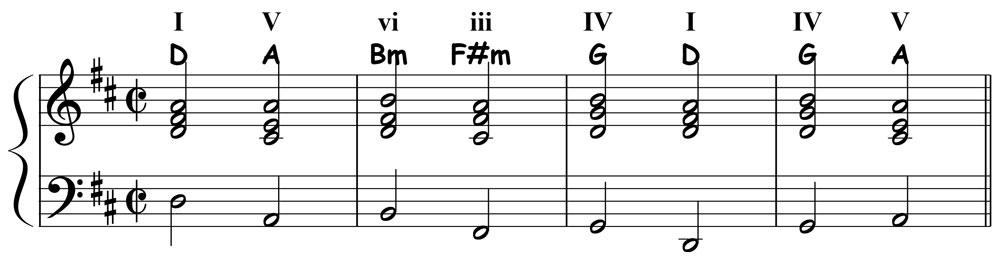
Read, play, listen, and ask: What does each chord do or want to do?
Possible Answers…
- The I chord establishes the key center D and Major Tonality.
- The V chord creates strong harmonic tension that wants to go to another tension chord (in this case to the vi chord) or to resolve back to the I chord.
- The vi chord creates harmonic tension that wants to go somewhere (in this case to the iii chord).
- The iii chord extends harmonic tension and wants to keep going somewhere (in this case to the IV chord).
- The IV chord creates harmonic tension chord that wants to resolve back to the I chord or go to the V chord.
Think of this (and every) chord progression as a kind of map where each chord and it’s placement within the form is a destination along a musical journey… and where each chord does something that you can hear and feel.
The great news is that it takes only a wee bit of knowledge (of scales, chords, and chord progressions) and experience (associating what you are hearing and feeling to such knowledge) to make these connections. Instead of merely “painting-by-number” or trying to memorize a bunch of dots on a page, you will begin to internalize the music using all four musical intelligences: ears, intellect, eyes, and muscles.
Pachelbel’s Canon Bass Line
In a very real sense the foundation for the entire piece is the bass line…
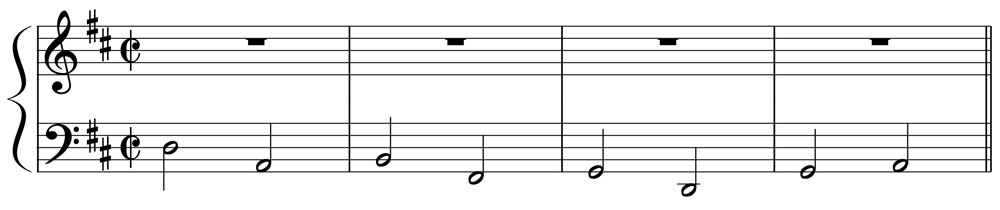
Read, play, and listen until the sound starts to penetrate your mind’s ear. As you do so, it should feel like the music is shifting from outside of you to inside of you. Eventually, it will literally feel like the sound source is inside your head!
Bass Line Technique & Interpretation
Fingering Suggestion…
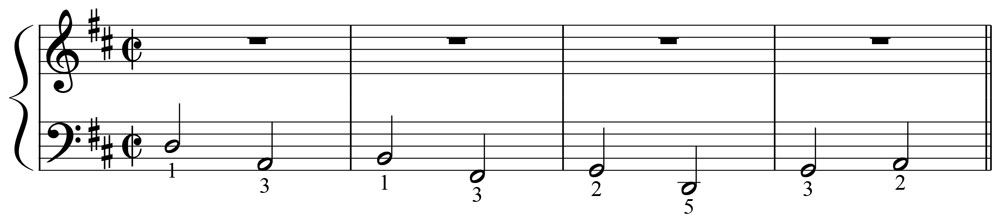
These are not “just” bass notes. They form a four bar long melody in and of themselves that should be played as such, that is, melodically. To that end, (1) Imagine that you are slowly bowing a string as if playing round warm notes on a cello, (2) Make sure your arms and hands use rotation and have some momentum going into each and every note, (3) Keep moving, especially between the notes, (4) Use the sustain pedal to allow each note to resonate with all the other strings.
Bass Line Theory & Ear Training
The theory part is to analyze the bass notes using Solfege as follows…
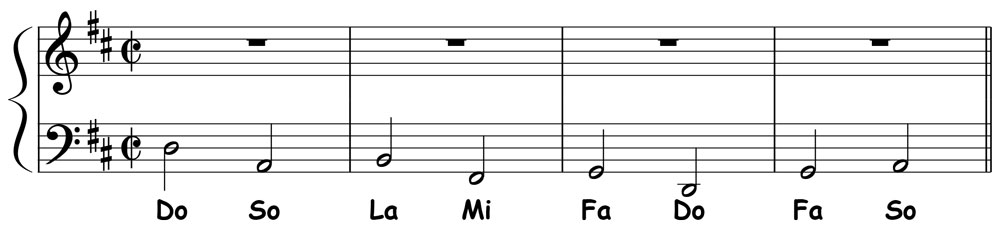
And the ear training part is to play and sing the Solfege syllables out loud…
As we do this, we are transforming our relationship to the music… from merely seeing, thinking, and playing dots on a page to internalizing the unique sound-feeling of each note.
Pachelbel’s Canon Main Theme
One way to start studying the many memorable melodies of Pachelbel’s Canon is to play the main theme over the bass line as follows…

Read, play, and listen until the sound starts to penetrate your mind’s ear. As you do so, it should feel like the music is shifting from outside of you to inside of you. Eventually, it will literally feel like the sound source is inside your head!
Main Theme Technique & Interpretation
Fingering Suggestion…

These are not just a bunch of notes. Both the treble and bass form four bar long melodies in and of themselves that should be played as such, that is, melodically. To that end, (1) Imagine that you are slowly bowing a string as if playing round warm notes on a cello, (2) Make sure your arms and hands use rotation and have some momentum going into each and every note, (3) Keep moving, especially between the notes, (4) Use the sustain pedal to allow each note to resonate with all the other strings.
Main Theme Theory & Ear Training
The theory part is to analyze the melody notes using Solfege as follows…

And the ear training part is to play and sing the Solfege syllables for the melody out loud…
As we do this, we are transforming our relationship to the music… from merely seeing, thinking, and playing dots on a page to internalizing the unique sound-feeling of each note.
Main Theme Harmonic Analysis
Now let’s take our understanding of melody to the genius level… not just for Pachelbel’s Canon, but for all kinds of melodies in general.
To do so, let’s get all the cards on the table: the score, bass line Solfege, chord symbols, roman numeral analysis, and Solfege for the main theme…

And notice that each and every note in the melody is a chord tone… either “the 3” or “the 5” of the prevailing chord. This is not an accident. This is not incidental. This is not a unique feature of Pachelbel’s Canon. THIS connection between melody cannot be overstated and is fundamental to what makes almost every moving and memorable melody really tick!
Takeaway: The most musical melodies tend to be those that strongly outline the harmony. Realizing this will pay HUGE dividends in your reading, ear training, memorization, interpretation, technique, and ability to compose, improvise, and transpose.
Pachelbel’s Canon “Standard Accompaniment”
Special Note. Although we are referring to this an accompaniment, it also works beautifully as an introduction or chorus in and of itself.
“Standard Accompaniment” Played Using Both Hands
The standard way to accompany another instrument is to play the bass line in your left hand and arpeggios in your right hand as follows…
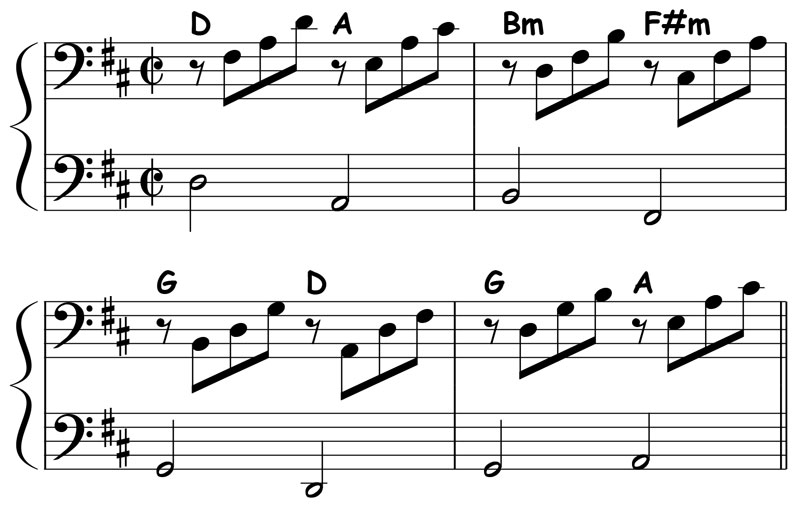
Reading Tip: Don’t just read this as a bunch of notes. Make sure to use your knowledge of music theory to see this as a sequence of chords (in this case, diatonic triads in the key of D Major).
For a lighter and sweeter texture, consider playing the exact same notes above one octave higher as follows…
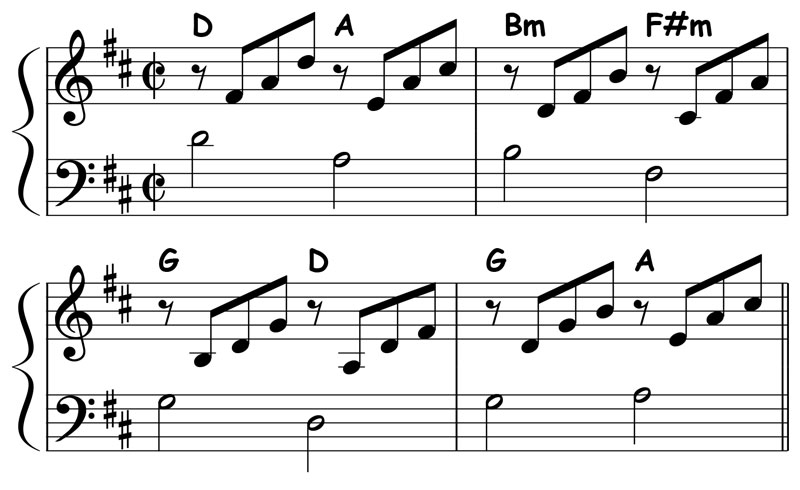
Technique & Interpretation Tips: (1) The arpeggios should be a bit subdued relative to the bass notes, (2) Imagine playing the big round bass notes as if slowly bowing a cello, (3) Be mindful of the characteristic shape of each chord, both mentally and physically, (4) Have some momentum going into each and every note and move your arms and hands in the direction the music is going, (5) Use the sustain pedal to allow the notes in each chord to resonate with the whole piano.
“Standard Accompaniment” Played in Your Left Hand Alone
An essential skill is to play this accompaniment in your left hand alone. Doing so frees up your right hand to play the variety of lovely composed melodies for Pachelbel’s Canon or to improvise your own…

Technique Tip: There’s no need to hold down each bass note while you play each arpeggio. It’s perfectly okay and musical to “cheat” by using the sustain pedal to keep each bass note alive as you play each chord.
Pachelbel’s Canon Meter & Rhythm
Time Signature in the Original Score
It’s instructive to note that the original manuscript was written in common time (indicated by the symbol “C”) as follows…

Interpreting the Time Signature
In order to make things easier to visualize, let’s rewrite the above as follows…

and talk about the implications for interpreting and performing it.
Let’s begin by realizing that, as written Pachelbel, each bass note represents one beat. THIS is a fundamental aspect of what makes this piece of music tick, both literally and figuratively.
Unfortunately, lots of present-day arrangements and performances fail to appreciate this. Quite often, you will see Pachelbel’s Canon written as follows– in common time (4/4 time) where each bass note is two beats long…


IMPORTANT: Rhythmically speaking, this is not the same musical animal as the original manuscript.
Fortunately, some arrangements and performances do appreciate Pachelbel’s original intent. One way to capture this is to rewrite the original as follows– in cut time (2/2 time) where each bass note is one beat long…
To Frank’s artistic sensibilities, the piece is much better interpreted at a slower tempo and in cut time (2/2 meter) as follows…

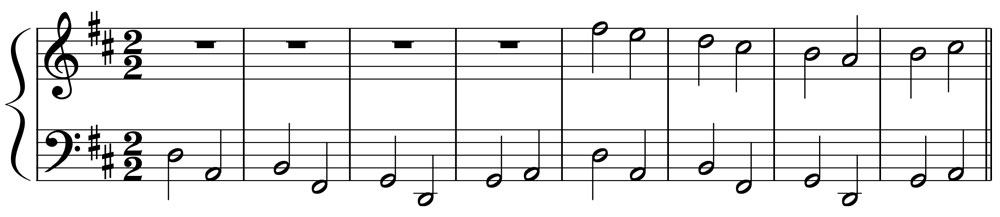
Let’s prove this to ourselves by playing Pachelbel’s Canon two different ways while counting out loud: first, in 4/4 time where each bass note gets two beats… and second, in 2/2 time where each bass note gets one beat…
Please comment below on your experience of how the music sounds and feels when each bass note represents one beat versus two beats.
Takeaway. The way you think about the time signature and count the meter has an enormous effect on how the music sounds and feels.
Pachelbel’s Canon “Alpha” Variation
Reminder: Frank makes no claims of having “the best” or “definitive” versions of Pachelbel’s Canon. In this lesson and those that follow he shares what he considers the most beautiful variations, gleaned from many sources and adapted to the nature of the piano. So, take the words, images, and sounds in each lesson as a mere suggestion and starting point, not as the final say. I encourage you to pick, choose, and adapt what I present here to suit your personal taste and to make the piece your own.
Here’s what Frank calls the “alpha” variation… which consists of the main theme with the “standard” accompaniment…
Reading Tips: (1) Use your knowledge of the D Major Scale to read, think about, hear, and feel everything in meaningful musical chunks, not just a sequence of unrelated notes, (2) Notice that each and every note in the left hand is a chord tone, and (3) Notice that each and every note in the melody is a chord tone, either “the 3” or “the 5” of the prevailing chord.
Listen to Frank demonstrate one way to interpret this (you might notice that he is using agogic accents in the melody)…
Technique & Interpretation Tips: (1) How you imagine the music in your mind’s ear (or not) is how the music is going to sound and feel. So, sing the melody out loud and play it like you are singing it, (2) Don’t try to hold down each bass note while you play each arpeggio. It’s perfectly okay and musical to “cheat” by using the sustain pedal to keep each bass note alive as you play each chord. (3) Imagine playing the big round bass notes as if slowly bowing a cello, (4) The arpeggios should be a bit subdued relative to the bass notes, (5) Have some momentum going into each and every note and move your arms and hands in the direction the music is going, (6) Technique and interpretation are inseparable; How you move your body is how the music is going to sound and feel, (7) Rhythm is not something you count in your head; rhythm is something your feel in your entire body.
Pachelbel’s Canon “Beta” Variation
Reminder: Frank makes no claims of having “the best” or “definitive” versions of Pachelbel’s Canon. In this series of lessons he shares what he considers the most beautiful variations, gleaned from many sources and adapted to the nature of the piano. So, take the words, images, and sounds in these lessons as suggestions and starting points, not as the final say. I encourage you to pick, choose, and adapt what I present here to suit your personal taste and to make the piece your own.
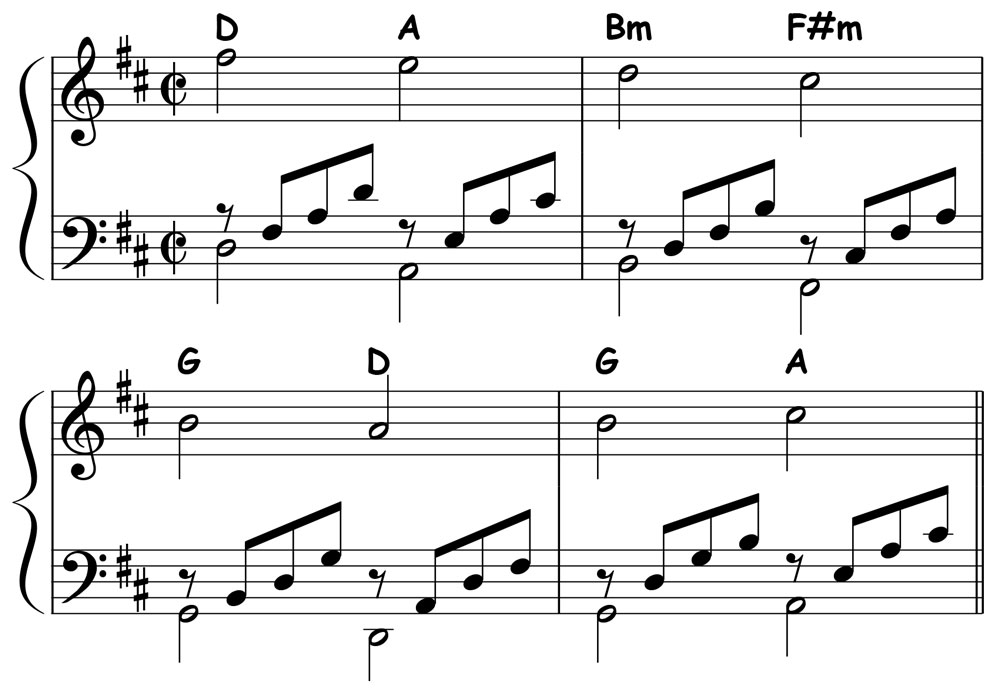
Here’s what Frank calls the “beta” variation… which consists of the main theme harmonized in 3rds along with the “standard” left hand accompaniment…

Reading Tips: (1) Use your knowledge of the D Major Scale to read, think about, hear, and feel everything in meaningful musical chunks, not just a sequence of unrelated notes, (2) Notice that each and every note in the left hand is a chord tone, and (3) Notice that each and every note in the right hand is also a chord tone, either “the 1, “the 3” or “the 5” of the prevailing chord.
Listen to Frank demonstrate one way to interpret this…
Any interest in Frank’s fingering solution?
Do you have your own fingering solution to share?
Technique & Interpretation Tips: (1) Bringing out the top notes in the melody will really make this variation shine, (2) You do this by giving the highest note in each chord more speed going down, (3) Frank knows of two choreography ingredients that can accomplish this: The first is to play each 3rd and the 6th with arm rotation clockwise into the top note as if turning a door knob. The second is to orient the roll attitude of your forearm such that the top note goes to the key bed while the bottom note only partially strokes the key. It’s up to you to mix and match each ingredient to see what works best for you, (4) Of course, all the tips from the previous lessons still apply!
Pachelbel’s Canon “Gamma” Variation
Here’s what Frank calls the “gamma” variation… which consists of almost exclusively of chord tones in quarter notes along with the “standard” left hand accompaniment…
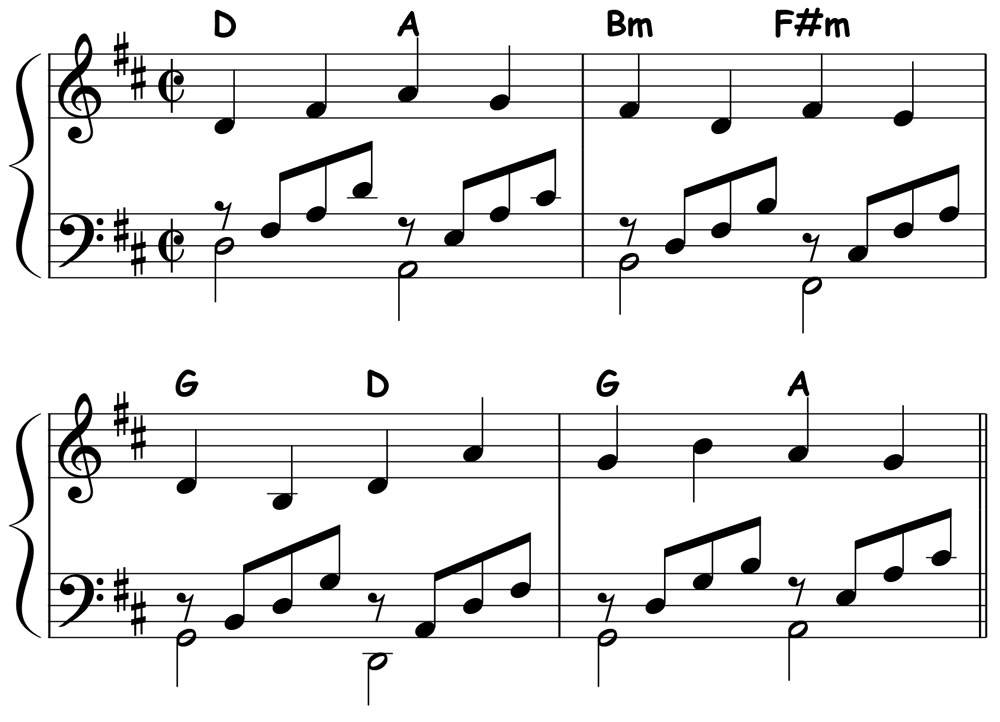
Reading Tips: (1) Thirteen out of the sixteen melody notes is a chord tone, either “the 1, “the 3” or “the 5” of the prevailing chord, (2) The three notes that aren’t are the b7 of the prevailing chord that voice leads exquisitely to a chord tone in the next chord. Such flowing voice leading is a commonly used melodic pattern and something you will learn to recognize by the way it sounds and feels now that that you know that this pattern exists at all.
Ear Training Tip: Solfege the melody, sing it out loud, and play it like you’re singing it…

Listen to Frank demonstrate one way to interpret this…
Technique & Interpretation Tips: (1) Imagine the sounds you want to make in your mind’s ear… and allow your body to play the notes the way you are hearing it, (2) Arm and hand rotation into each and every note, not finger gymnastics, is the key to playing this with freedom and ease, (3) Of course, all the tips from the previous lessons still apply!
Pachelbel’s Canon “Delta” Variation
Any interest?
Pachelbel’s Canon “Zeta” Variation
Any interest?
Pachelbel’s Canon “Epsilon” Variation
Any interest?
Discover more from PIANO-OLOGY
Subscribe to get the latest posts sent to your email.