A rich collection of learn-by-doing lessons in thinking about, hearing, feeling, and playing the many dimensions of musical time…
Table of Contents
Prerequisites
Basic understanding of note and rest durations (whole, half, quarter, eighth notes, etc)… the LOVE of music… and the discipline to study and practice.
back to… Table of Contents
The First Lesson in Musical Time
The first lesson in musical time is that rhythm is not just some abstract intellectual notion inside your brain!
In order to play with good time, you must go beyond counting the time in your head and experience time with your entire body.
Watch Frank show how to cultivate “full body” engagement…
Any interest in a text summary of the highlights?
back to… Table of Contents
Musical Time Never Stops
Did you know that musical time never stops?
It ebbs and flows, cycles up & down, rocks back & forth, sways left & right, and breathes in & out…
Any interest in a text summary of the highlights?
back to… Table of Contents
Pulse & Meter
The concept and experience of a steady, repeating Pulse, akin to your heartbeat, is the most basic dimension of musical time…
The second dimension, Meter, is the concept and experience of organizing pulses into a larger pattern where each pulse is different from the others.
Pulse
First, listen to a steady drumbeat of undifferentiated pulses (Let’s call this ONE-ness)…
Larger Groupings of Pulses
Now let’s play play these pulses by organizing them in groups and by emphasizing the first pulse in each group…
2-ness…
3-ness…
4-ness…
5-ness…
6-ness…
In each case, notice how the difference in emphasis organizes our sense place in the music and establishes certain expectations of what is to come.
X-ness
We can continue with 7-ness, 8-ness, 9-ness, and so on.
More Complex Groupings of Pulses
We can also combine grouping by nesting them inside each other. For example, we could play a 3-ness inside a 2-ness to make a more complex SIX-ness, characteristic of a Tarantella…
We can also combine groupings by linking them together. For example, we could link a 3-ness with a 2-ness to make an interesting 5-ness., as in this famous example…
Meter is the concept and experience of sequences of pulses that are organized in a way that creates a more complex framework upon which sounds can be placed in time.
back to… Table of Contents
Downbeats & Upbeats
Introduction to the critically important concepts of Downbeats and Upbeats…
Downbeats & Upbeats in Action (YouTube)
Any interest in a text summary of the highlights?
back to… Table of Contents
Tempo
Tempo describes how many pulses occur in a given unit of time–normally measured in beats per minute (bpm)…
The notion of tempo is very simple, but there are four points regarding tempo that you may find interesting and useful…
Tempo & the Human Heart Rate
Your heart typically beats about 60-80 times per minute (about once every second). And it just so happens that most musical tempos range from about half that on the very slow side to three or four times that on the very fast side. A coincidence? Or is there some organic relationship between our perception of tempo and the human pulse rate?
Listen to the pulses below and ask yourself how each tempo makes you feel..
30 beats per minute…
60 beats per minute…
120 beats per minute…
240 beats per minute…
Tempo & Emotion
Tempo can have an enormous effect on the emotional impact of a piece. Some lively pieces are begging to be played fast and some reflective pieces are aching to be played slowly. And some pieces are particularly “sensitive” tempo-wise: Going just a few percent faster can make the music feel rushed and just a few percent slower can make the music feel like it’s dragging.
Tempo Markings in Written Music
Some classical pieces come with very specific tempo indications, as seen below…

View such markings as a ballpark suggestion, not a rigid rule. Trust your artistic judgement of what sounds and feels musical.
Tempo Variations
Tempos are not typically intended to be followed with machine-like precision from the first to last note. Subtle tempo variations are an essential part of any artistic and natural-sounding performance.
Commonly used variations:
- A tasteful acceleration and deceleration to outline a musical phrase.
- Left hand plays the accompaniment “in time” while the right hand takes expressive liberty with the melody (known as rubato).
- The intentional increase of tempo to create excitement.
- The intentional decrease of tempo to create a sense of calm.
- The natural slowing down of the tempo to signal the end of a piece.
- Can you thing of some others?
back to… Table of Contents
The Metronome
Why Use a Metronome?
The Metronome can be a valuable tool for discovering and solving a problem with rhythm or technique. If you are playing the right notes, but your music just doesn’t seem to flow, you almost certainly have one or all of the following issues:
- You don’t have a clear mental conception (aural, visuospatial, kinesthetic) of what you want to play.
- Your conception or perception of the rhythm is distorted. In other words, you mistakenly think a note is “here” within the meter when it is really “there”.
- There’s tension or awkwardness in your choreography that is upsetting the physical flow.
But we need to talk about WHEN and HOW to use the metronome (or click track) appropriately.
How to Use a Metronome
Playing along with a metronome can help diagnose a rhythm problem in two ways: (1) By letting you know if you are playing the notes where in the metrical structure you intend to play them, and (2) By highlighting places where a technical insecurity creates a tear in the canvas of time.
That said, use the metronome as needed while keeping the following points in mind:
- A mechanical metronome generates a series of undifferentiated clicks only. In other words, a mechanical metronome does not know and cannot tell you where “the 1” is. An electronic metronome, drum machine, or rhythm track that emphasizes “the 1” solves this problem.
- At extremely slow tempos, it is extremely difficult to anticipate when the next pulse will arrive because the metronome provides no rhythmic cues in-between the pulses. Counting the meter out loud (for example: 1 & 2 & 3 & 4 &…) along with the metronome solves this problem.
- Counting the meter out loud is such a powerful awareness-builder that you should be doing it routinely anyway. So, count the meter out loud while you are learning a new piece and see what you discover!
- When studying and practicing one hand at a time, try clapping time in your lap with your non-playing hand.
- Don’t get “metronome-happy”. For some kinds of music, there is such a thing as playing too straight! While it is okay to play with the metronome in order to diagnose and solve a problem, the metronome and counting are just training wheels that should be abandoned as soon as you understand what you are playing and start to work on developing your interpretation.
- Music as-written can never represent the full expression of music as-performed. Playing with “good time” is measured by the coherence of fully formed musical ideas, not by the exact alignment of isolated events on rigid timeline. Such coherence comes from the unified expression of the entire musical phrase, not from machine-like precision.
- Natural-sounding music breathes and ebbs and flows with each phrase, always sensitive to the larger artistic context.
- Record yourself… always… and listen to the playback immediately. This is the best way to know if your musical intentions were met… and if what you think you heard and felt while you were playing is actually what happened.
The metronome, used appropriately, can be a valuable teacher, but do not let it become a tyrant. Use it as needed to diagnose a blind spot with rhythm or to solve a technical problem, but do not become a slave to the ticker. The reason to be able to play accurately in time is so that you can go beyond robotic precision to play musically and artistically!
back to… Table of Contents
Musical Time Q&A
Q: What is the biggest lesson you’ve learned about the nature of musical time?
A: Musical time is not some abstract mathematical and digital concept. Musical time is analog, never stops, and lives and breathes in the way you MOVE your body!
back to… Table of Contents
A Lesson in Continuity
An illuminating lesson in how the way we think about the meter profoundly influences our sense of rhythm…
back to… Table of Contents
Time Signatures
The Time Signature, written immediately after the key signature, typically written as one number above another tells you two things…
- The top number tells you how many beats (pulses) are in a measure.
- The bottom number tell you which type of note gets the beat (pulse).
Let’s learn by example–by seeing the most commonly used time signatures in action on music you’re already familiar with.
2/4 Time Signature
The 2/4 time signature tells us that there are two quarter notes per measure and that each quarter note gets one beat… typical of many marches, for example, the theme from Hogan’s Heroes…

Listen to Frank model how to play while counting the meter out loud…
3/4 Time Signature
The 3/4 Time Signature tells us that there are three quarter notes per measure and that each quarter note gets one beat… typical of waltzes and minuets as in Bach’s “Minuet in G”…

Listen to Frank model how to play while counting the meter out loud…
It is often appropriate–depending on the tempo and division of the beats into sub-beats–to also count the “ands” or upbeats. Here, for example is how you might count in order to include the 8th notes…
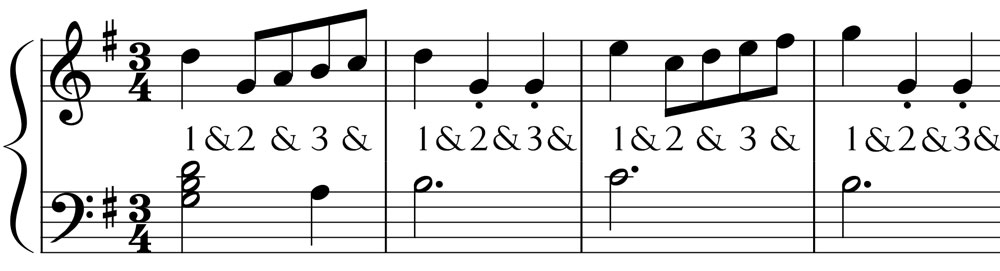
Listen to Frank model how to play while counting the meter out loud…
4/4 Time Signature
The 4/4 time signature tells us that there are four quarter notes per measure and that each quarter note gets one beat… typical of much pop music as in “The Sound of Silence”…

Listen to Frank model how to play while counting the meter out loud…
It is often appropriate, depending on the tempo and division of the beats to also count the “ands” or upbeats. Here, for example is how you might count in order to include the 8th notes…

Listen to Frank model how to play while counting the meter out loud…
6/8 Time Signature
The 6/8 time signature tells us that there are six eighth notes per measure and that each eighth note gets one beat… typical, for example, in an Irish Jig…

Listen to Frank model how to play while counting the meter out loud…
By the way, a wide variety of time signatures is possible: 2/2, 3/8, 5/4, 6/4, 7/4, 9/8, 10/8, 12/8 and more!
back to… Table of Contents
1/4 Time Signature
Lesson Goal: To internalize 1/4 meter in three ways: counting out loud, clapping your hands, and playing along…
1/4 Time Signature Study (Count Out Loud)
How to read, think, and feel the 1/4 time signature by counting out loud with a metronome in 1/4, 1/8th, triplet 1/8th, and 1/16th notes…
How to Count 1/4 Meter in 1/4 Notes
Practice goals: To synchronize your counting with the metronome, to develop the sense that “1” feels like home, and to develop a feeling for beats smaller than quarter notes.

Listen to Frank model how to count this with a metronome @ 100 beats per minute…
Aim to count 8 bars at a time in one continuous breath without accenting any notes.
How to Count 1/4 Meter in 1/8th Notes
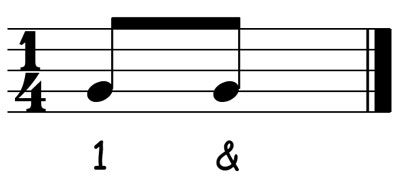
Listen to Frank model how to count this with a metronome @ 88 beats per minute…
It’s not enough to passively listen to these. In order to deeply internalize the rhythms, you must actively count out loud with a metronome.
How to Count 1/4 Meter in 1/8th Note Triplets

Listen to Frank model how to count this with a metronome @ 60 beats per minute…
Record yourself, listen to the playback immediately, and be absolutely honest about what you hear and feel.
How to Count 1/4 Meter in 1/16th Notes

Listen to Frank model how to count this with a metronome @ 60 beats per minute…
Practice Idea: Doing this while taking a walk–synchronizing your stride and counting aloud with the metronome (using a smartphone app).
1/4 Time Signature Study (Clap Your Hands)
How to “think”, hear, feel, and express a regular pulse using both sides of your musical brain and body…
In this video, we’re going to internalize a repeating pulse by clapping our hands in our laps in a very disciplined way–in three different patterns–with the metronome at various tempos (from very slow to very fast), and while counting the meter out loud.
How to Do These Studies
- Play with a metronome. Doing so keeps you absolutely honest about when the pulses occur and what the tempo is. (because the metronome never lies.)
- Count the meter out loud. Doing so synchronizes your mental conception with your physical execution, keeps the time flowing in the otherwise silent and empty gap between clicks, helps you to anticipate when the next downbeat is coming, and transfers your sense of time from the outside of you (the metronome clicks) to the inside of you (your internal musical clock).
- Play at various tempos. From very slow to very fast. Doing so exposes any misconceptions in your sense of time and any imperfections in your technique. Frank suggests starting at 60 beats per minute, then working your way up to keep pushing your limits!
- Single source your intentions. The impulse that verbalizes the count should be the very same impulse that triggers the physical motion. Saying “1” and clapping are not two separate events that you try to synchronize. No. Saying “1” and your downward gesture should be a single unified events triggered by a single musical impulse.
- No flams. When your left and right side play together, they must play perfectly together, not one slightly before or after the other. This is closely related to the single source idea above. Perfect coordination between your left and right sides. Not two separate events that just happen to occur at the same time, but a single full body expression.
- Play with musical technique. Playing with good technique is impossible without a deep sense of rhythm that flows from you core outward. You’re on the right track when your arms and hands express the rhythm in cycles of natural, flowing motions that never stop. (see: Time Never Stops).
About the Lesson Design
Clap your hands in your lap along with a metronome at various tempos (suggested tempos: 60, 100, 140, up to 180 beats per minute) while counting the meter out loud (1 & 1 & 1 & 1 & 1 &…) in three musical patterns:
- Hands together on every downbeat.
- Downbeats left, upbeats right
- Downbeats right, upbeats left.
Pattern #1. Hands together on every downbeat…
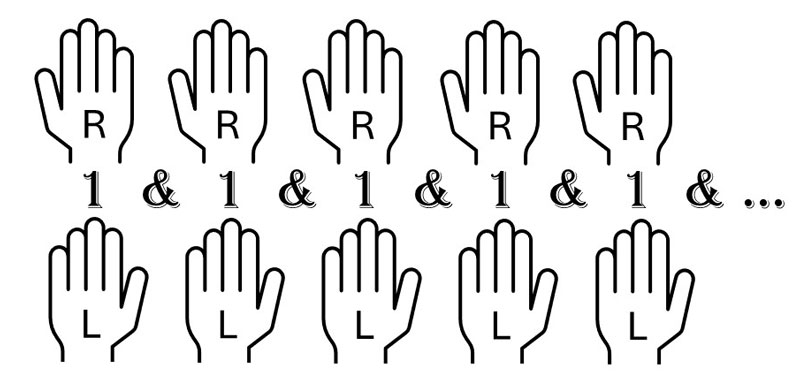
Any interest in stereo play along MP3s? (Frank will be happy to produce these to be played wearing headphones so that you can clearly hear and feel which side is playing when)
Pattern #2. Downbeats left, upbeats right…
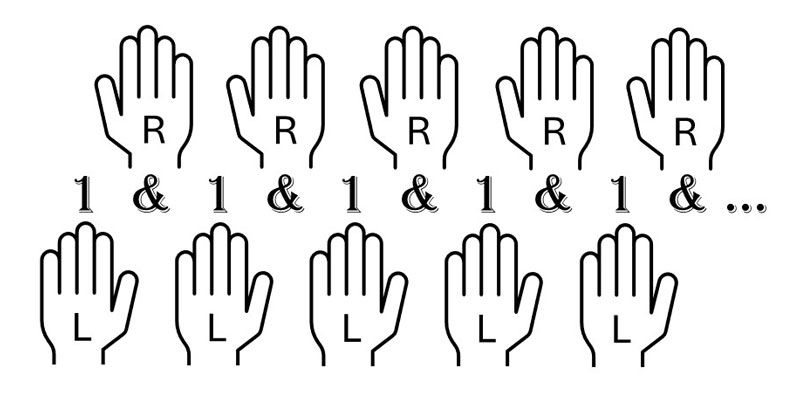
Pattern #3. Downbeats right, upbeats left…

YouTube Video
Watch Frank model how to do this study…
1/4 Time Signature Study (Play Along)
A play along study for practicing how to “think”, hear, feel, and express a regular pulse and to coordinate both sides of your brain and body…
The audio files (MP3s) here will make sense only if played in stereo (the left hand is panned left and right hand is panned right).
Pattern #1. Hands Together on Every Downbeat…

Listen to a sample @ 120 beats per minute…
Practice Idea: As you play along, experiment playing with different fingers, articulations, and choreographies!
Pattern #2. Downbeats left, upbeats right…

Listen to a sample @ 120 beats per minute…
Pattern #3. Downbeats Right, Upbeats Left
Notice that this is a the mirror image of pattern #2…
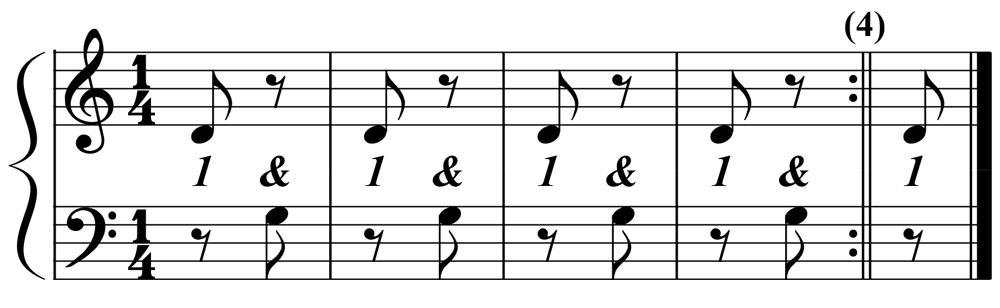
Listen to a sample @ 120 beats per minute…
back to… Table of Contents
2/4 Time Signature
Lesson Goal: To internalize 2/4 meter in three ways: counting out loud, clapping your hands, and playing along…
2/4 Time Signature Study (Count Out Loud)
How to read, think, and feel the 2/4 time signature by counting out loud with a metronome in 1/4, 1/8th, triplet 1/8th, and 1/16th notes…
Three big practice goals: To synchronize your counting with the metronome, to develop the sense that “1” feels like home, and to develop a feeling for beats smaller than quarter notes.
How to Count 2/4 Meter in 1/4 Notes

Listen to Frank model how to count this with a metronome @ 100 beats per minute…
Aim to count 8 bars at a time in one continuous breath without accenting any notes.
How to Count 2/4 Meter in 1/8th Notes

Listen to Frank model how to count this with a metronome @ 88 beats per minute…
It’s not enough to passively listen to these. In order to deeply internalize the rhythms, you must actively count out loud with a metronome.
How to Count 2/4 Meter in 1/8th Note Triplets

Listen to Frank model how to count this with a metronome @ 60 beats per minute…
Record yourself, listen to the playback immediately, and be absolutely honest about what you hear and feel.
How to Count 2/4 Meter in 1/16th Notes

Listen to Frank model how to count this with a metronome @ 60 beats per minute…
Practice Idea: Doing this while taking a walk–synchronizing your stride and counting aloud with the metronome (using a smartphone app).
2/4 Time Signature Study (Clap Your Hands)
Lesson Goal: To “think”, hear, feel, and express one thing happening on one side of your body while two things are happening on the other side…
Lesson Design
Clap your hands in your lap along with a metronome at various tempos (suggested tempos: 60, 100, 140, up to 180 beats per minute) while counting the meter out loud (1 & 2 & 1 & 2 & 2 &…) in three musical patterns…
- hands together in 1/4 notes.
- 1/2 notes left, 1/4 notes right.
- 1/2 notes right, 1/4 notes left.
Pattern #1: Hands Together in 1/4 Notes…
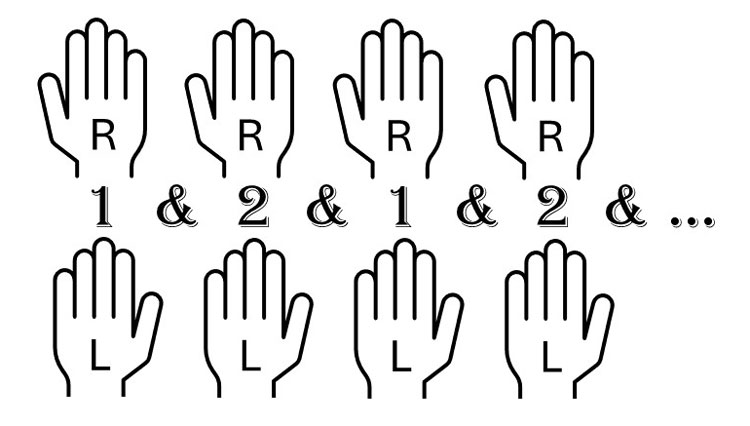
Any interest in stereo play along MP3s?
Pattern #2: Half Notes left, 1/4Notes Right…

Pattern #3. Half Notes Right, 1/4 Notes Left…
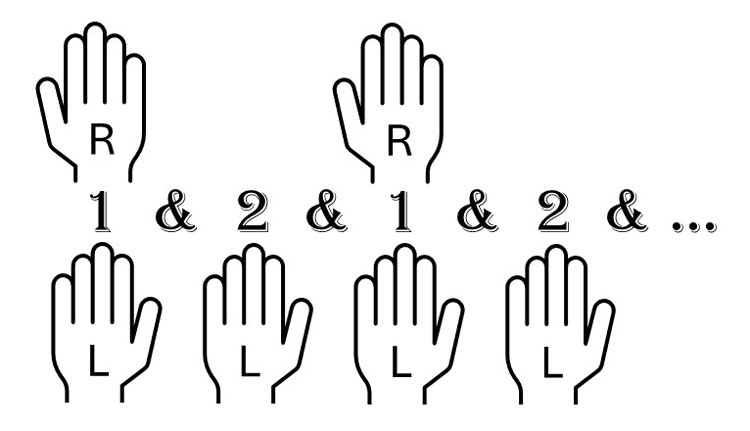
YouTube Demonstration
Watch Frank model how to do this study…
2/4 Time Signature Study (Play Along)
Lesson goal: To “think”, hear, feel, and express the rhythm pattern of two things happening on one side of your body while one thing is happening on the other side…
The audio files (MP3s) here will make sense only if played in stereo (the left hand is panned left and right hand is panned right).
Pattern #1: Left hand plays 1/2 notes, right hand plays 1/4 notes…
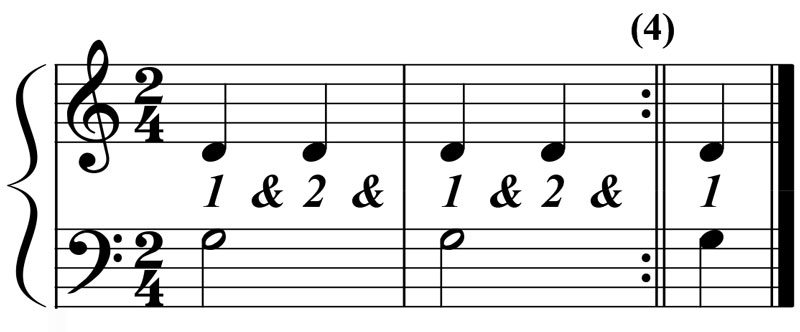
Listen to a sample at 120 beats per minute…
Practice Idea: Experiment by playing with different fingers, articulations, and choreographies!
Pattern #2: Right hand plays 1/2 notes, Left hand plays 1/4 notes…
Notice that this is a the mirror image of pattern #1…

Listen to a sample at 120 beats per minute…
back to… Table of Contents
3/4 Time Signature
Lesson Goal: To internalize 3/4 meter in three ways: counting out loud, clapping your hands, and playing along…
3/4 Time Signature Study (Count Out Loud)
Three big practice goals: To synchronize your counting with the metronome, to develop the sense that “1” feels like home, and to develop a feeling for beats smaller than quarter notes.
How to Count 3/4 Meter in 1/4 Notes
How to read, think, and feel 3/4 time by counting out loud with a metronome in 1/4, 1/8th, triplet 1/8th, and 1/16th notes…

Listen to Frank model how to count this with a metronome @ 100 beats per minute…
Aim to count 4 bars at a time in one continuous breath without accenting any notes.
How to Count 3/4 Meter in 1/8th Notes
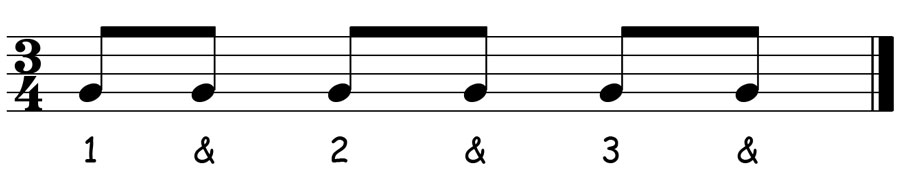
Listen to Frank model how to count this with a metronome @ 88 beats per minute…
It’s not enough to passively listen to these. In order to deeply internalize the rhythms, you must actively count out loud with a metronome.
How to Count 3/4 Meter in 1/8th Note Triplets

Listen to Frank model how to count this with a metronome @ 60 beats per minute…
Record yourself, listen to the playback immediately, and be absolutely honest about what you hear and feel.
How to Count 3/4 Meter in 1/16th Notes

Listen to Frank model how to count this with a metronome @ 60 beats per minute…
Practice Idea: Doing this while taking a walk–synchronizing your stride and counting aloud with the metronome (using a smartphone app).
3/4 Time Signature Study (Clap Your Hands)
Lesson goal: To “think”, hear, feel, and express one thing happening on one side of your body while three things are happening on the other side…
Lesson Design
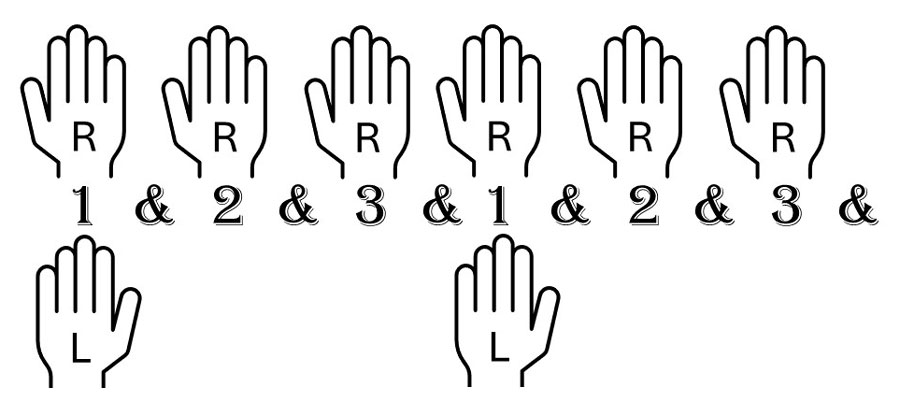
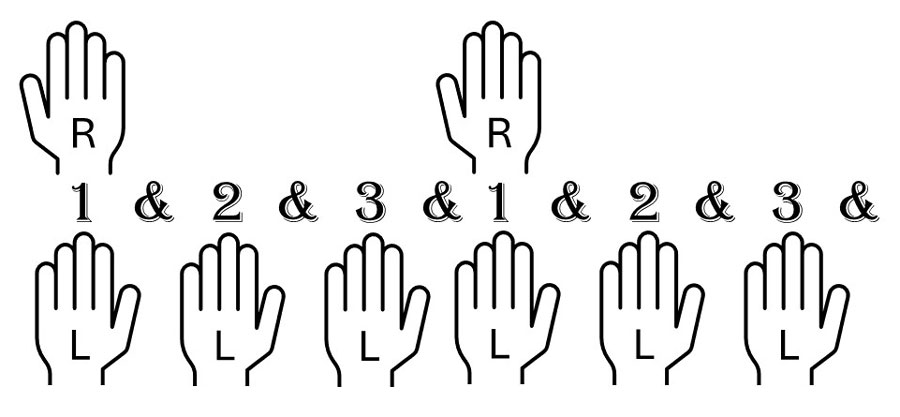
Clap your hands in your lap along with a metronome at various tempos (suggested tempos: 60, 100, 140, up to 180 beats per minute) while counting the meter out loud (1 & 2 & 3 & 1 & 2 & 3 &…) in three musical patterns:
Pattern #1: Hands Together in 1/4 Notes…
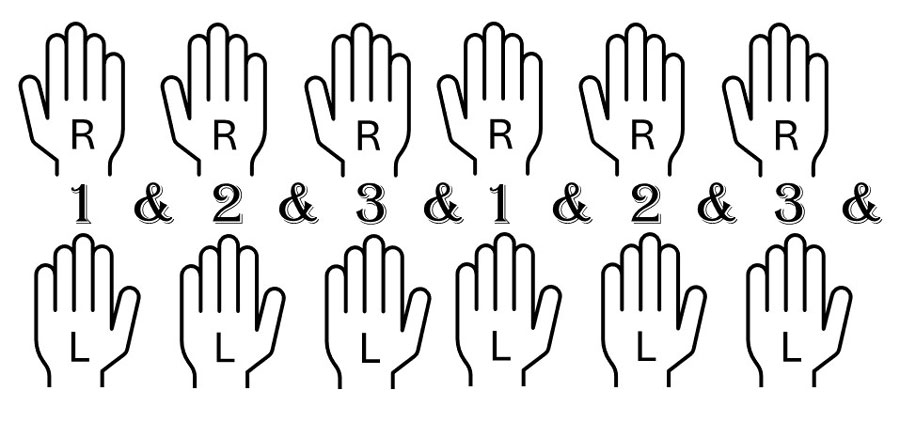
Any interest in stereo play along MP3s?
Pattern #2: Dotted 1/2 notes left, 1/4 notes right…
Pattern #3. Dotted 1/2 notes right, 1/4 notes left…
YouTube Demonstration
Watch Frank model how to do this study…
3/4 Time Signature Study (Play Along)
Lesson goal: To “think”, hear, feel, and express the rhythm pattern of three things happening on one side of your body while one thing is happening on the other side…
The audio files (MP3s) here will make sense only if played in stereo (the left hand is panned left and right hand is panned right).
Pattern #1: Left hand plays dotted 1/2 notes, right hand plays 1/4 notes…

Listen to a sample @ 120 beats per minute…
Practice Idea: Experiment by playing with different fingers, articulations, and choreographies!
Pattern #1: Left hand plays 1/4 notes, right hand plays dotted 1/2 notes…
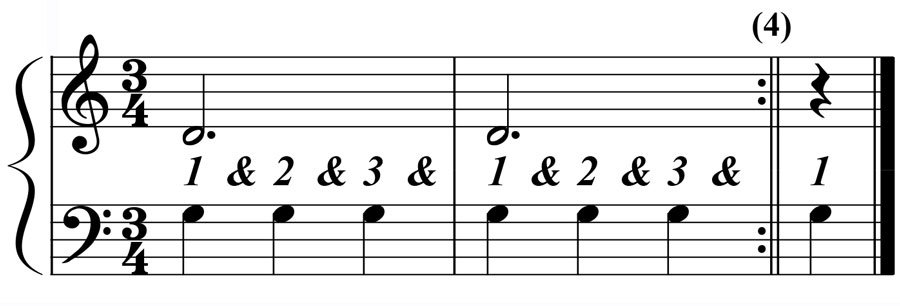
Listen to a sample @ 120 beats per minute…
back to… Table of Contents
4/4 Time Signature
Lesson Goal: To internalize 4/4 meter in three ways: counting out loud, clapping your hands, and playing along…
4/4 Time Signature Study (Count Out Loud)
How to read, think, and feel 4/4 time by counting out loud with a metronome in 1/4, 1/8th, triplet 1/8th, and 1/16th notes…
Three big practice goals: To synchronize your counting with the metronome, to develop the sense that “1” feels like home, and to develop a feeling for beats smaller than quarter notes.
How to Count 4/4 Meter in 1/4 Notes

Listen to Frank model how to count this with a metronome @ 100 beats per minute…
Aim to count 4 bars at a time in one continuous breath without accenting any notes.
How to Count 4/4 Meter in 1/8th Notes

Listen to Frank model how to count this with a metronome @ 88 beats per minute…
It’s not enough to passively listen to these. In order to deeply internalize the rhythms, you must actively count out loud with a metronome.
How to Count 4/4 Meter in 1/8th Note Triplets
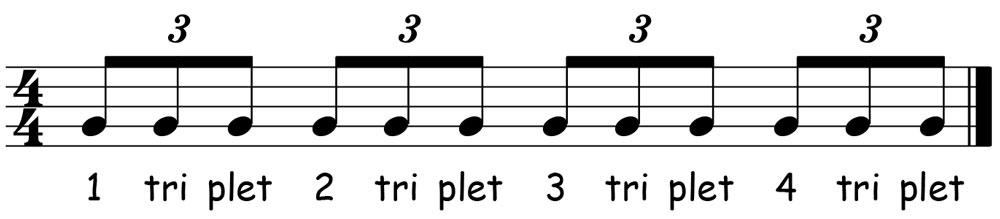
Listen to Frank model how to count this with a metronome @ 60 beats per minute…
Record yourself, listen to the playback immediately, and be absolutely honest about what you hear and feel.
How to Count 4/4 Meter in 1/16th Notes

Listen to Frank model how to count this with a metronome @ 60 beats per minute…
Practice Idea: Doing this while taking a walk–synchronizing your stride and counting aloud with the metronome (using a smartphone app).
How to read, think, and feel 4/4 time by counting out loud with a metronome in 1/4, 1/8th, triplet 1/8th, and 1/16th notes…
4/4 Time Signature Study (Clap Your Hands)
Any interest?
Any interest?
back to… Table of Contents
6/8 Time Signature
Any interest?
back to… Table of Contents
Paradiddles (The Importance of Chunking)
A lesson in the profound value of chunking in order to simplify both the mental and physical expression of a complex musical idea!
Watch Frank model how to do these studies in the YouTube video below.
Paradiddle #1. Left-Right-Left-Left, Right-Left-Right-Right

The key to success is not to think of this as eight separate events that must be coordinated, but as two four-note chunks where Chunk 1 = L R L L & Chunk 2 = R L R R.
Idea: Consider giving Chunk 1 a name like “Left Special’ and chunk 2 a name like “Right Special”
Paradiddle #2. Right-Left-Right-Right, Left-Right-Left-Left
Notice that this is a mirror image of the above…

The key to success is not to think of this as eight separate events that must be coordinated, but as two four-note chunks where Chunk 1 = L R L L & Chunk 2 = R L R R.
Idea: Consider giving Chunk 1 a name like “Right Special’ and chunk 2 a name like “Left Special”
Watch Frank model one way to study-practice the patterns above…
back to… Table of Contents
Musical Time: Micro-Lessons
A rich collection of short & sweet insights to help you think about Musical Time like an artist and human being, not like a computer…
Developing a deep sense of musical time
isn’t about counting numbers in your head;
it’s about feeling motion in your entire body.
Rhythm, even without pitches,
is a musical LANGUAGE
in and of itself.
Musical time is not some
abstract mathematical concept…
Musical time lives and breathes
in the way you MOVE your body!
Musical RHYTHM &
Musical TECHNIQUE
are INSEPARABLE!
Rhythm is just as important
as the notes you play.
Playing “with good time”
is not about robotic precision,
but about learning how to dance.
Musical time is a very DELICATE FABRIC…
Any attempt to fight its natural flow
will tear the threads.
Musical Rhythm always flows outward…
from your torso, through your shoulders,
through your arms, through your hands,
and into your fingers.
Rhythm should feel NATURAL…
ebbing, flowing, breathing
with each musical phrase.
Musical Rhythm is not achieved
by machine-like precision,
but by fluid CHOREOGRAPHY!
TIME NEVER STOPS…
Time keeps flowing…
even in-between the notes.
Don’t try to keep time with your fingers…
Express the time with your entire body
and let your fingers go along for the ride.
You cannot MAKE musical time happen…
You can only ALLOW musical time to happen.
Musical rhythm has the power
to MOVE people…
literally and figuratively…
transforming your audience
from passive listeners
into active participants.
Please let Frank know if you’d like to get this lesson (and other micro-lessons) as a PDF or set of MP3s.
Click Tracks (MP3s)
Downloadable click tracks in various meters and tempos to help you tighten up your rhythm (Each Zip file contains 31 MP3s, each 2:00 minutes in duration, with tempos ranging from 60 beats per minute (bpm) to 180 bpm in 4 bpm increments)…
Listen to a short sample in 4/4 Time @ 120 bpm…
4/4 Meter…
3/4 Meter…
Would anyone like Frank to upload other meters and tempos?
back to… Table of Contents
Discover more from PIANO-OLOGY
Subscribe to get the latest posts sent to your email.