A deep dive into the theory and ear training for the Modes of the C Major Scale…
Table of Contents
Prerequisites
Basic music reading… LOVE of music… and the discipline to study and practice.
back to… Table of Contents
Scales & Modes
Unfortunately, the terms scale and mode have been tossed around so carelessly that the practical point of studying them becomes lost in theoretical quibbling.
learn more… Modes (Wikipedia)
Rather than wear you out with abstract definitions, a course in music history, and fussing about half-steps and whole-steps, let’s learn the modes of the C Major Scale directly and talk about what’s important to understand as we go along.
Modes of the C Major Scale
It’s sometimes helpful to organize our musical minds by thinking of and hearing the major scale as being comprised of seven modes, each mode a “scale” that starts one of the seven main scale tones as follows…
One way to name each mode is by its starting note, as follows…
C Mode = C-D-E-F-G-A-B-C
D Mode = D-E-F-G-A-B-C-D
E Mode = E-F-G-A-B-C-D-E
F Mode = F-G-A-B-C-D-E-F
G Mode = G-A-B-C-D-E-F-G
A Mode = A-B-C-D-E-F-G-A
B Mode = B-C-D-E-F-G-A-B
Let’s take a closer look at each mode one by one and see what we discover…
C Mode of the C Major Scale
The “C mode” of the C Major Scale (also called the 1st or Ionian mode) is simply the C Major Scale you already know ordered C-D-E-F-G-A-B-C…

Don’t get hung up on the names of each mode. What matters is how you internalize the patterns–by ear, intellect, eye, and muscle–with the clear understanding of which note is the key center Do.
D Mode of the C Major Scale
The “D mode” of the C Major Scale (also called the 2nd or Dorian mode) orders the notes as D-E-F-G-A-B-C-D…
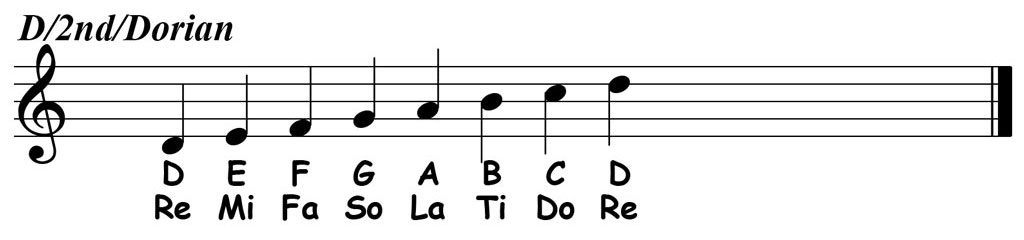
Important: Although it uses the exact same pitches, the D mode of the C Major scale is NOT the same musical animal as the D Dorian Scale that defines D Dorian tonality.
E Mode of the C Major Scale
The “E mode” of the C Major Scale (also called the 3rd or Phrygian mode) orders the notes as E-F-G-A-B-C-D-E…
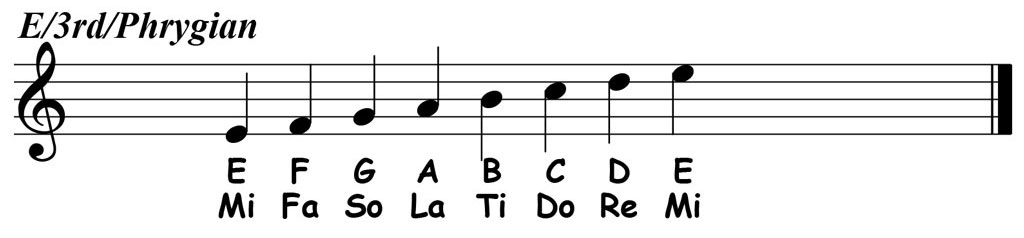
Important: Although it uses the exact same pitches, the E mode of the C Major scale is NOT the same musical animal as the E Phrygian scale that defines E Phrygian tonality.
F Mode of the C Major Scale
The “F mode” of the C Major Scale (also called the 4th or Lydian mode) orders the notes as F-G-A-B-C-D-E-F…

Important: Although it uses the exact same pitches, the F mode of the C Major scale is NOT the same musical animal as the F Lydian scale that defines F Lydian tonality.
G Mode of the C Major Scale
The “G mode” (also called the 5th or Mixolydian mode) orders the notes in the C Major Scale as G-A-B-C-D-E-F-G…
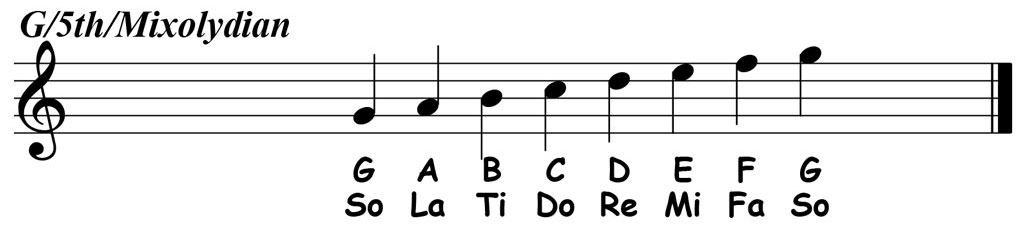
Important: Although it uses the exact same pitches, the G mode of the C Major scale is NOT the same musical animal as the G Mixolydian Scale that defines G Mixolydian tonality.
A Mode of the C Major Scale
The “A mode” (also called the 6th or Aeolian mode) orders the notes of the C Major Scale as A-B-C-D-E-F-G-A…
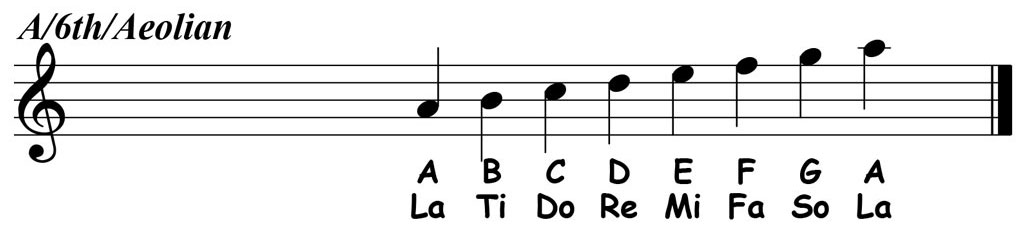
Important: Although it uses the exact same pitches, the A mode of the C Major scale is NOT the same musical animal as the A Natural Minor Scale that defines A Minor Tonality.
B Mode of the C Major Scale
The “B mode”(also called the 6th or Locrian mode) orders the notes of the C Major Scale as B-C-D-E-F-G-A-B…
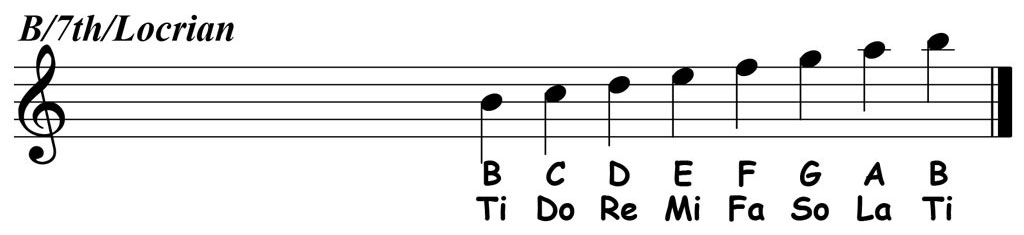
Important: Although it uses the exact same pitches, the B mode of the C Major scale is NOT the same musical animal as the B Locrian scale that defines B Locrian tonality or any other usage of the B Locrian Scale.
Putting it All Together

C Major Scale Mode-Triad Pairings
The most common way that modes are used in composition and improvisation is to match each mode of the scale with the diatonic triad that defines the mode harmonically. So, an effective and musical way to get these modes into your ears, intellect, eyes, and muscles is to play each mode over the triad that defines the primary chord tones in that mode as follows…

Frank’s rendition @ 88 beats per minute…
Advice: Don’t try to count or memorize the sequence of half-steps and whole steps for each mode. Simply learn each one directly using what you already know about the parent major scale.
learn more…
Please let Frank know if you’d like to see this very same lesson for other major keys!
Discover more from PIANO-OLOGY
Subscribe to get the latest posts sent to your email.