Lesson Goal: To quickly internalize the Minor Triads in all spellings… by ear, intellect, eye, and muscle…
Table of Contents
Prerequisites
Basic music reading skills… basic scale, chord, and chord progression theory… basic technique… the LOVE of music… and the discipline to study and practice.
back to… Table of Contents
Minor Chord Wiki
learn more: Minor Chord (Wikipedia)
FYI, triad is just a fancy name for a three-note chord.
back to… Table of Contents
C Minor Triad Theory & Ear Training
- Chord symbol: Cmin, Cm, Cm, C-, or c
- Chord structure: 1-b3-5
- Character: consonant, sad, heavy, brooding.


back to… Table of Contents
C Minor Triad & C Major Triad Compared
An effective way to internalize the sound-feeling of a minor chord is to listen to its major counterpart side-by-side…
Listen to the C Minor Triad (C-Eb-G)…
Listen to the C Major Triad (C-E-G)…
back to… Table of Contents
Common Uses for Minor Triads
- i chord in a Minor or Dorian tonality.
- iv chord in a minor tonality.
- vi chord in a major tonality.
- ii chord in a major tonality.
- iii chord in a major tonality.
back to… Table of Contents
Chord Symbols, Spellings, & Keyboard Layouts, All Keys
Frank’s advice: Skip all the counting half-steps nonsense touted by almost every music theory “expert” and simply learn to spell each chord just as you spell any three-letter word in English. For example, you spell cat C-A-T and dog D-O-G. Likewise, you spell a C minor chord C-Eb-G and D minor chord D-F-A.
Here are the chord symbols, spellings, and keyboard layouts for all the major triads…
C Minor
- Chord Symbol: Cm or C-
- Spelling: C-Eb-G
- Common Usage: i chord in C minor or C dorian, iv chord in F minor, vi chord in Eb major, ii chord in Bb major, iii chord in Ab major.

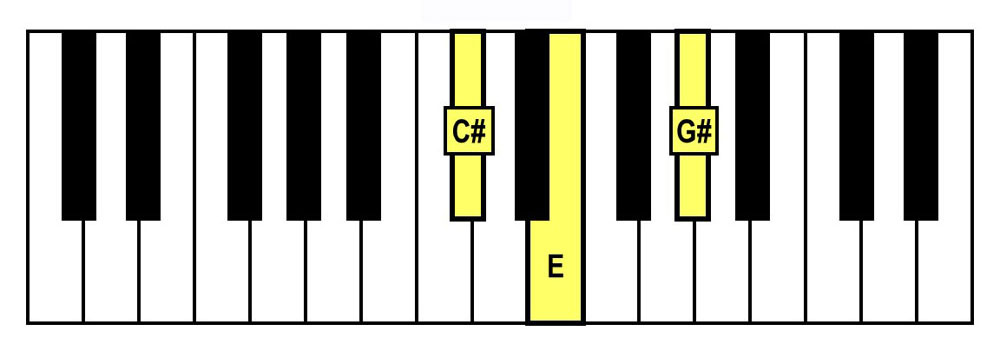
C Sharp Minor
- Chord Symbol: C#m or C#-
- Spelling: C#-E-G#
- Common Usage: i chord in C# minor, vi chord in E major, ii chord in B major, iii chord in A major.
D Minor
- Chord Symbol: Dm or D-
- Spelling: D-F-A
- Common Usage: i chord in D minor or D dorian, vi chord in F major, ii chord in C major, iii chord in Bb major.

E Flat Minor
- Chord Symbol: Ebm or Eb-
- Spelling: Eb-Gb-Bb
- Common Usage: i chord in Eb minor or Eb dorian, vi chord in Gb major, ii chord in Db major.

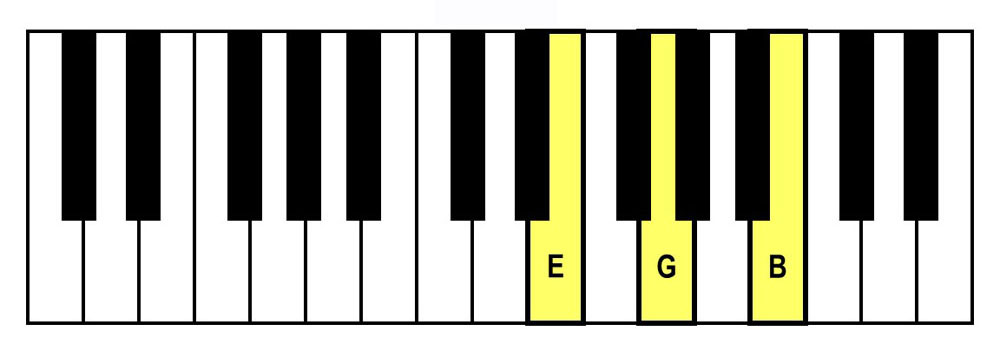
E Minor
- Chord Symbol: Em or E-
- Spelling: E-G-B
- Common Usage: i chord in E minor or E dorian, vi chord in G major, ii chord in D major, iii chord in C major.
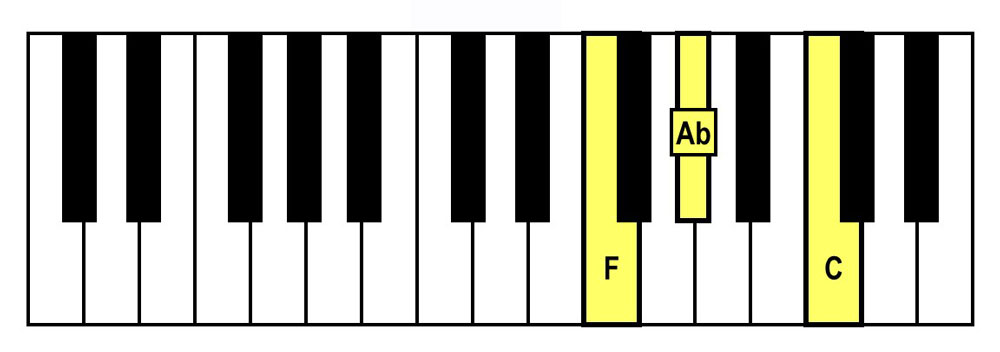
F Minor
- Chord Symbol: Fm or F-
- Spelling: F-Ab-C
- Common Usage: i chord in F minor or F dorian, vi chord in Ab major, ii chord in Eb major, iii chord in Db major.
F Sharp Minor
- Chord Symbol: F#m or F#-
- Spelling: F#-A-C#
- Common Usage: i chord in F# minor, vi chord in A major, ii chord in E major, iii chord in D major.

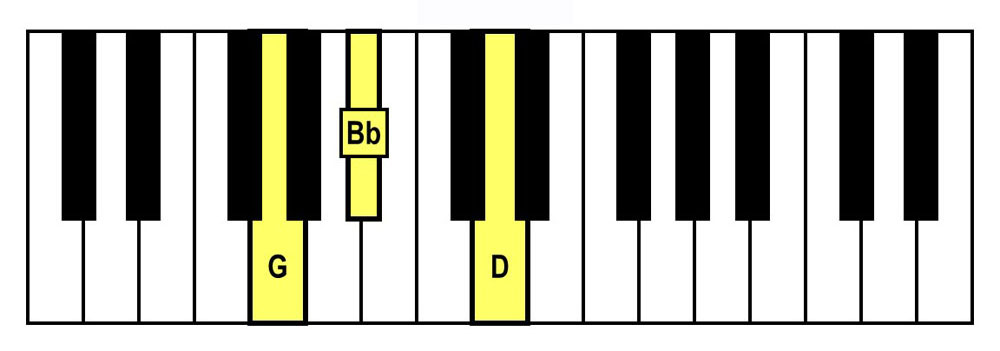
G Minor
- Chord Symbol: Gm or G-
- Spelling: G-Bb-D
- Common Usage: i chord in G minor or G dorian, vi chord in Bb major, ii chord in F major, iii chord in Eb major.
G Sharp Minor
- Chord Symbol: G#m or G#-
- Spelling: G#-B-D#
- Common Usage: i chord in G# minor, vi chord in B major, iii chord in E major.

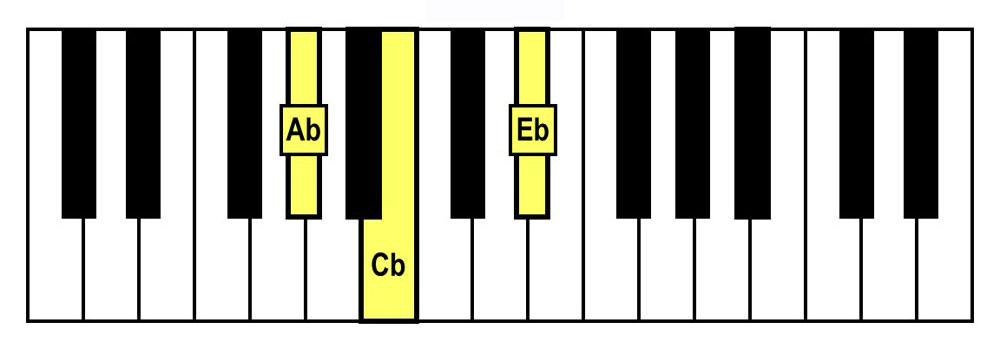
A Flat Minor
- Chord Symbol: Abm or Ab-
- Spelling: Ab-Cb-Eb
- Common Usage: ii chord in Gb major.
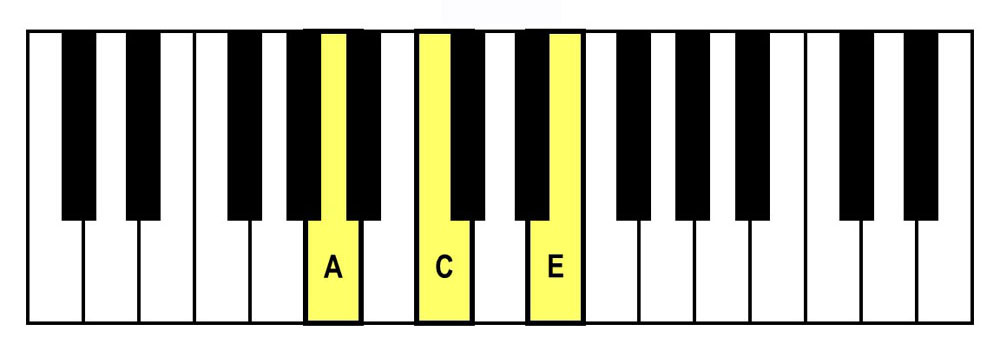
A Minor
- Chord Symbol: Am or A-
- Spelling: A-C-E
- Common Usage: i chord in A minor or A dorian, vi chord in C major, ii chord in G major, iii chord in F major.
B Flat Minor
- Chord Symbol: Bbm or Bb-
- Spelling: Bb-Db-F
- Common Usage: i chord in Bb minor or Bb dorian, vi chord in Db major, ii chord in Ab major, iii chord in Gb major.

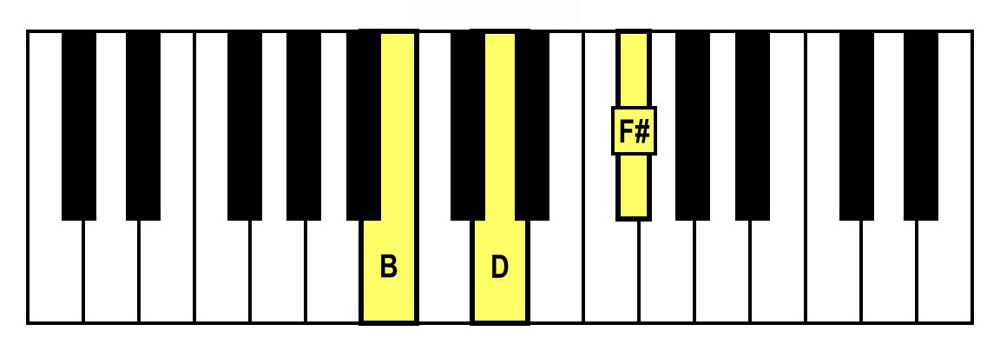
B Minor
- Chord Symbol: Bm or B-
- Spelling: B-D-F#m
- Common Usage: i chord in B minor or B dorian, vi chord in D major, ii chord in A major, iii chord in G major.
back to… Table of Contents
Minor Triad Names & Spellings (Flashcards)
Lesson Goal: To quickly learn to spell the Minor Chords just as you spell any three-letter word in English…
back to… Table of Contents
Minor Triad Practice, All Keys
Lesson Goal: To build confidence reading, visualizing, playing, and hearing the big 12 minor triads in root position as arpeggios & block chords…
Practice Pattern #1: Root Position Minor Triads played melodically and harmonically, arranged chromatically ascending…

Listen to a sample @ 120 beats per minute…
Minor Triad Practice (MP3 Play Along Tracks in All Keys)
The benefits of playing along with a click track at various tempos cannot be overstated: very slowly at first to have enough time to “think about everything”, then fast enough to be forced to “play without thinking”.
Major Triads Practice, All Keys @ 60 bpm…
Major Triads Practice, All Keys @ 80 bpm…
Major Triads Practice, All Keys @ 100 bpm…
Major Triads Practice, All Keys @ 120 bpm…
Major Triads Practice, All Keys @ 140 bpm…
Major Triads Practice, All Keys @ 160 bpm…
Major Triads Practice, All Keys @ 180 bpm…
For a donation to the website (Donations Page) Frank would be happy to send you his personal collection of zip files that include high-res PDFs of the scores and MP3 play along practice tracks for the entire Piano-ology study aids library. This includes all practice tracks for scales, chords, and chord progressions produced to date.
back to… Table of Contents
Minor Triad Ear Training (MP3s)
Dozens of downloadable MP3s compressed into a single *.zip file… designed to help you recognize the sound-feeling of each of the four main triad types: major, minor, diminished, and augmented.
Simply download, unzip, create a playlist, set to random play, and do ear training any time and anywhere: while doing the dishes, taking a walk, or driving your car!
Each mp3 follows the same sequence:
- A random triad is played.
- Identify it by type: major, minor, diminished, augmented.
- After a short pause, the correct answer is given.
Listen to an example:
Study Notes:
(1) Successful ear training is not the fruit of trying to hear something. It is about being receptive to the sound/feeling you are experiencing and then associating that sound/feeling with something you already know–in this case the name of each triad type.
(2) Don’t get too carried away with this. Do just enough to get the gist for how each triad type sounds and feels. You will get lots more experience when we study the usage of triads in real music.
back to… Table of Contents
learn more… Chords & Chord Progressions
Discover more from PIANO-OLOGY
Subscribe to get the latest posts sent to your email.