Lesson Goal: To quickly internalize the Minor Blues Scale in all keys… by ear, intellect, eye, and muscle…
Table of Contents
Prerequisites
Basic music reading skills… the LOVE of music… and the discipline to study and practice.
back to… Table of Contents
Blues Scale Wiki
Learn more: Blues Scale (Wikipedia)
back to… Table of Contents
Why Learn the Minor Blues Scale?
Because it’s used used in a wide variety of music all around the world: folk, pop, rock, bluegrass, country, and jazz.
back to… Table of Contents
Minor Blues Scale Theory
- Scale Structure (Scale Degrees): 1-b3-4-#4/b5-5-b7-1.
- Scale Structure (Solfege): Do-Me-Fa-Fi/Se-So-Te-Do.
Minor Blues Scale Theory in the Key of C
As the name says, the Minor Blues Scale, the blues scale that most people are familiar with… has a minor, bluesy quality… and only six notes (yet another existence proof that scales are not made up of “half steps” and “whole steps”).
The notes Me, Fi/Se, and Te are called blue notes, which create that delicious “bluesy” sound you immediately hear and feel!
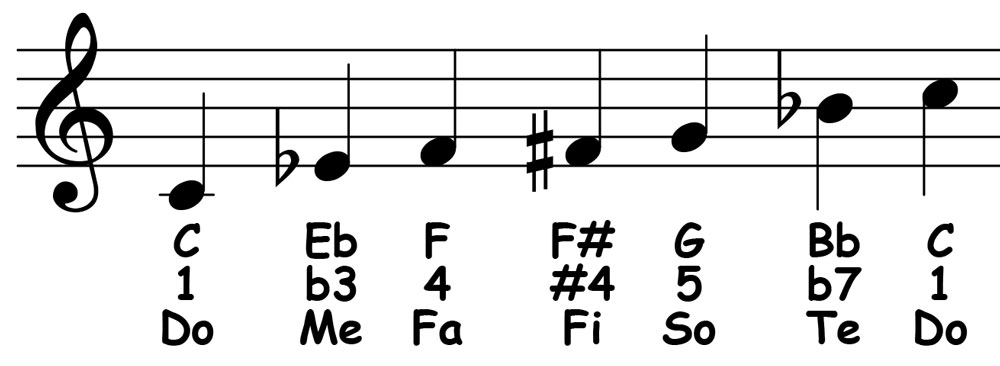
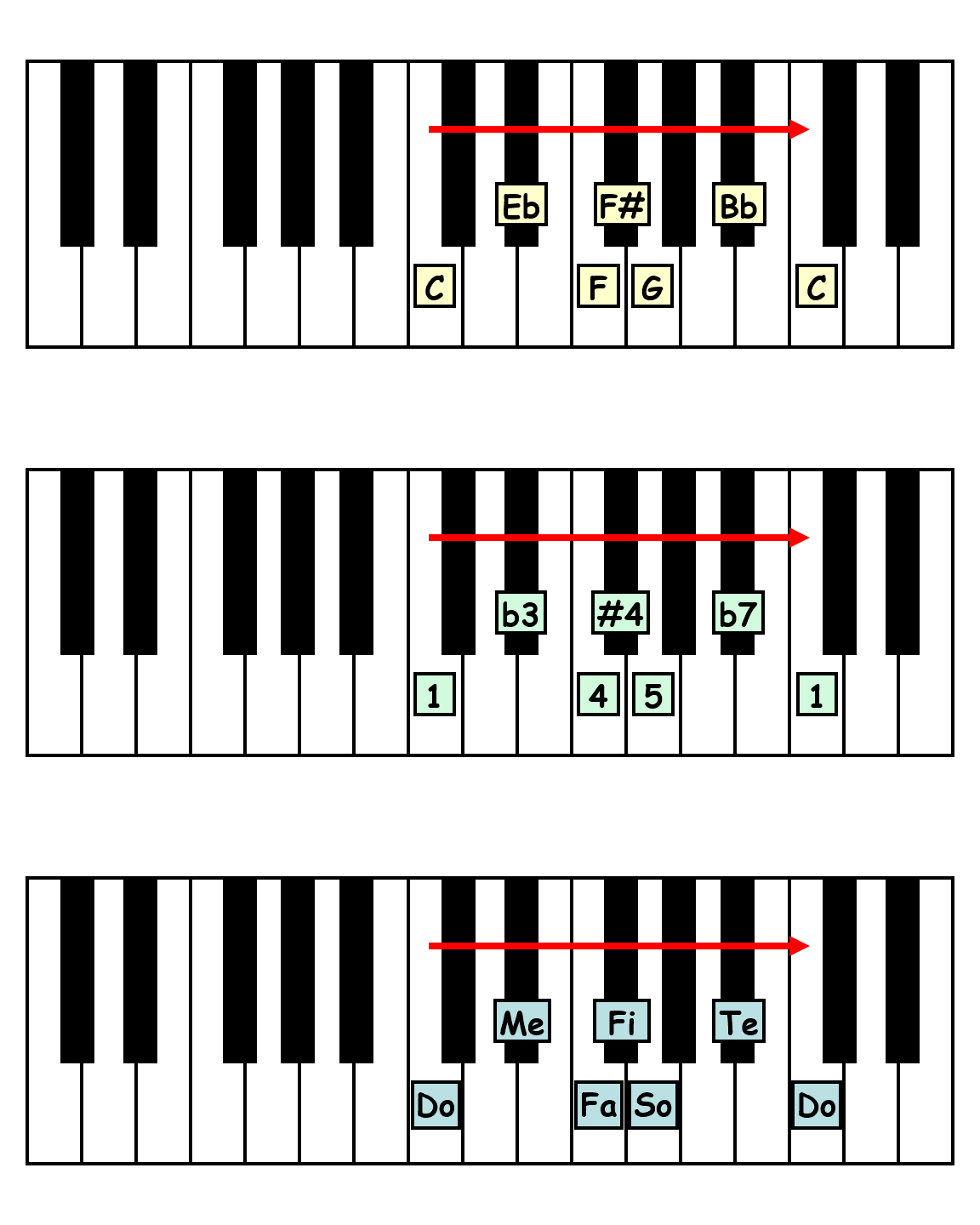
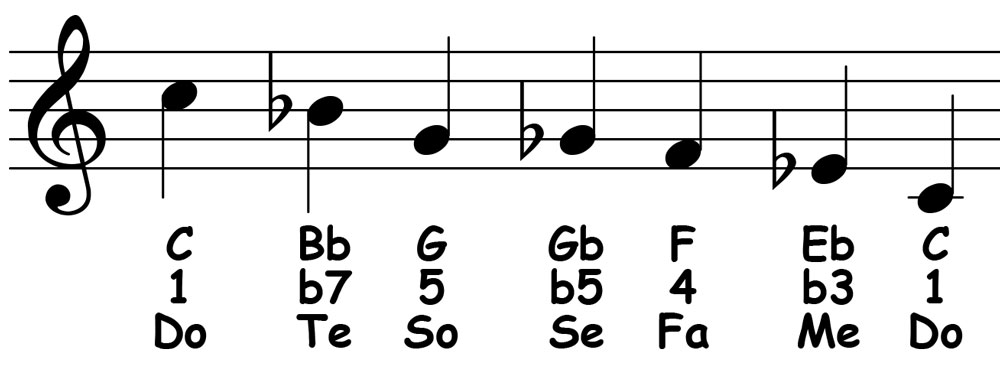
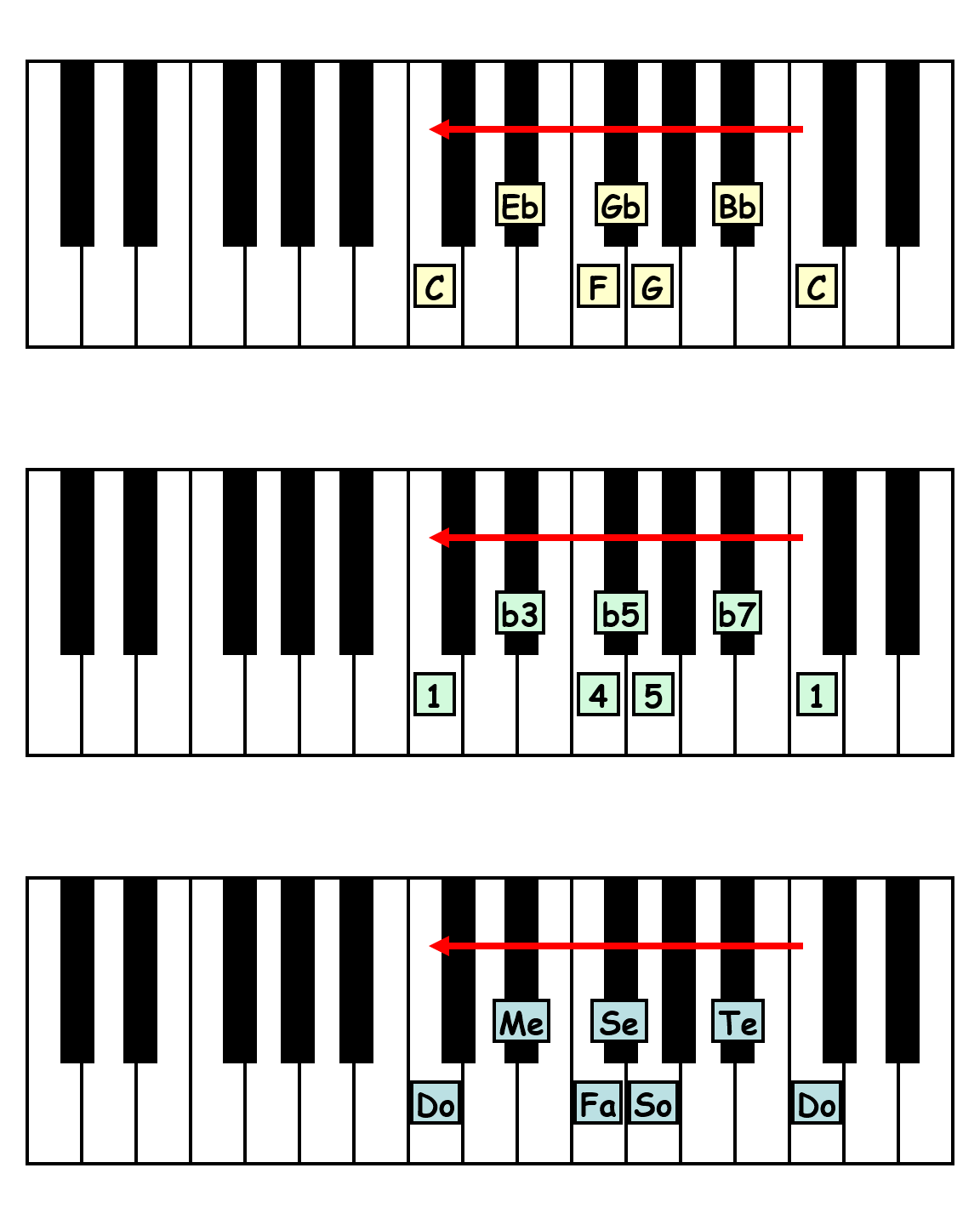
Don’t fuss over whether F#/Fi/Fa sharp should be called Gb/Se/So flat or vice versa. These are all just names that you will eventually abandon like training wheels. At the end of the day, it’s the the sound, feeling, function, and physical mapping on your instrument that matter!
back to… Table of Contents
C Minor Blues Scale Compared to the C Minor Pentatonic Scale
Notice that the C Minor Blues Scale uses all five notes from the C Minor Pentatonic Scale. The only difference is the additional blue note F#(Fi). Don’t try to “memorize” this fact, but do realize how much certain scale types have in common, how learning one kind of scale helps you to learn others, and how the addition or subtraction of even just one note can profoundly change the character of a scale.

Play and listen to C Minor Pentatonic Scale…
[insert audio]
Play and listen to C Minor Blues…
[insert audio]
back to… Table of Contents
Solfege Ear Training
Reading, playing, and singing the Solfege Syllables out loud is an extremely effective way to tune up your ears and to internalize the unique sound-feeling of each note in the scale with respect to the key center Do. Make sure to do this slowly enough for the unique sound-feeling of each Solfege Syllable to make a meaningful impression on your mind’s ear.
C Minor Blues: Linear, Ascending…

C Minor Blues: Linear, Descending…

C Minor Blues: Do-X-Do, Ascending…

C Minor Blues: Do-X-Do, Descending…

Note: We could sing lots more musical patterns, but a more effective and efficient approach (the 80-20 Principle) is to get your ear training material directly from the music that YOU want to play!
back to… Table of Contents
Minor Blues Scale Theory & ear Training, All Keys
The 80-20 Principle teaches us that learning the Minor Blues Scale in all keys comes with diminishing returns. A better used of your precious time and energy to study and practice it only in keys you expect to play in. Suggested keys: Eb, Bb, F, C, G, D, A, E.
back to… Table of Contents
learn more… Blues Piano Lessons
Discover more from PIANO-OLOGY
Subscribe to get the latest posts sent to your email.