Lesson Goal: To quickly internalize the Minor 1 5 1 Chord Progression (i-V-i) in all keys… by ear, intellect, eye, and muscle…
Table of Contents
Prerequisites
Basic music reading… the LOVE of music… and the discipline to study and practice.
back to… Table of Contents
Chord Progressions Wiki
learn more… Chord Progressions (Wikipedia)
back to… Table of Contents
Why Study the Minor 1 5 1 Chord Progression?
Studying the Minor 1 5 1 Chord Progression (i-V-i) , done right, is essential to understanding the harmonic tension and release formula that makes an incredible amount of music tick. Doing so…
- Prepares you to recognize chords when you hear them.
- Prepares you to recognize chords when you see them in written music.
- Elevates your music reading from “painting-by-number” to deep understanding.
- Enables you to internalize music based on meaningful patterns, not brute force note by note memorization.
- Deepens your visuospatial awareness of the keyboard.
- Develops your piano technique.
- Expands your ability to play by ear.
- Broadens your chord vocabulary for composition and improvisation.
- Enables you to transpose like a pro.
back to… Table of Contents
Minor 1 5 1 Chord Progression in C Minor
Using the i-V7-i Chord Progression in the key of C Minor as an example, we are going to integrate reading, roman numeral analysis, solfege, and ear training…
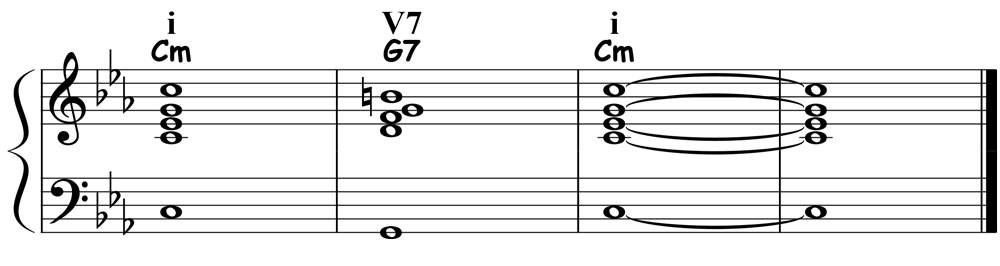
Simply listen and be receptive to the sound-feeling of each chord as a whole, and notice:
- The Cm chord (i) establishes the minor-ness and home key.
- The G7 chord (V7) creates harmonic tension.
- That tension is released with the return back to the Cm chord (i).
Minor 1 5 1 Chord Progression: Solfege Ear Training
Important: It is absolutely essential that you sing all of these studies out loud and at your own pace, a pace that allows you to sustain each note long enough to make an impression on your mind’s ear. If you can’t sing them, you don’t know them! Singing out loud is a very effective way to get musical sounds into your mind’s ear. Singing is an active process that excites many sensory and memory and motor pathways in your brain. This broad-based activation leads to much faster and deeper learning than passive listening alone.
Listen to Frank model how to do the following ear training studies in order to maximize learning…
Play the Chords & Sing the Bass Line…
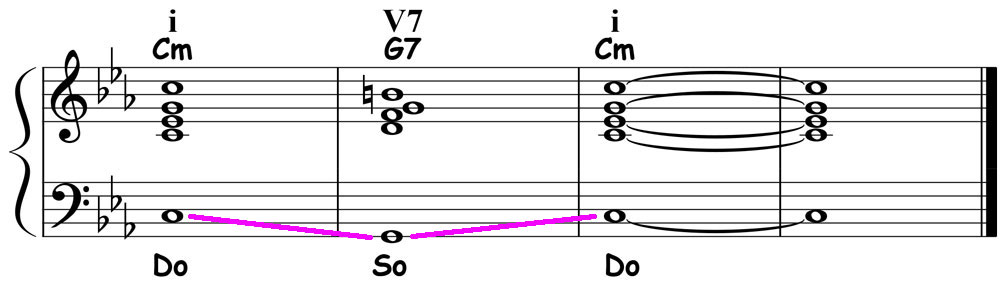
Be receptive to how each and every note sounds and feels with respect to the key center Do.
Sing each Chord as an Arpeggio…
Singing the chord tones as arpeggios is great ear training.
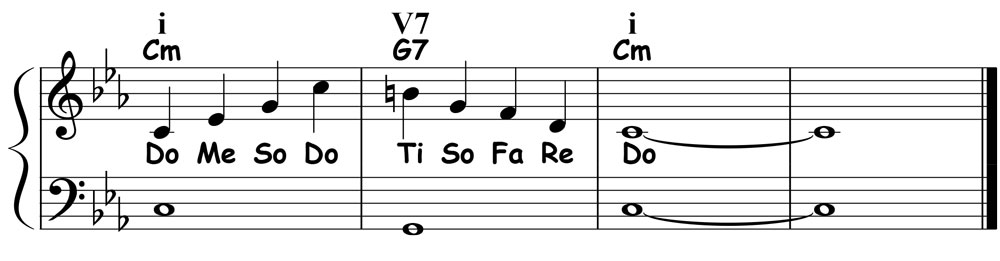
It’s absolutely essential that you sing all these studies out loud and at your own pace, a pace that allows you to sustain each note long enough to make an impression on your mind’s ear. If you can’t sing them, you don’t know them!
Sing the “Do-Re-Do” Voice…
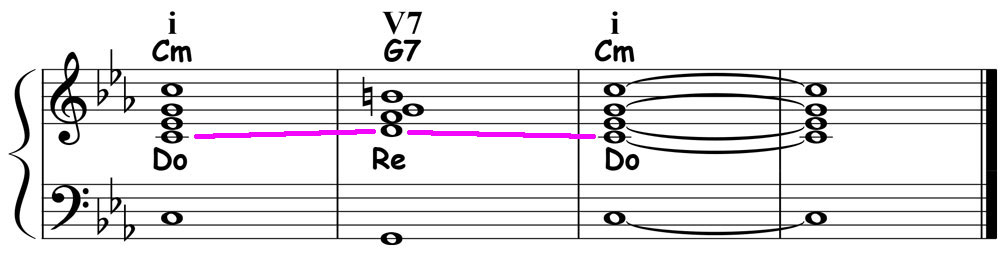
Notice the very strong pull that Re has to resolve to Do.
Sing the “Me-Fa-Me” Voice…

Notice the very strong pull that Fa has to resolve Me.
Sing the “So-So-So” Voice…
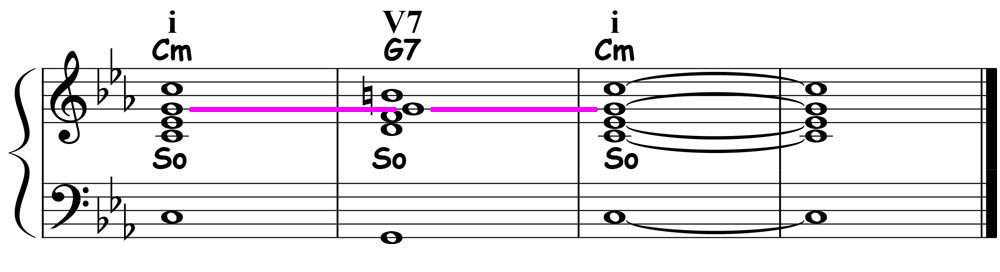
Notice that G (So) is common to both chords.
Sing the “Do-Ti-Do” Voice…
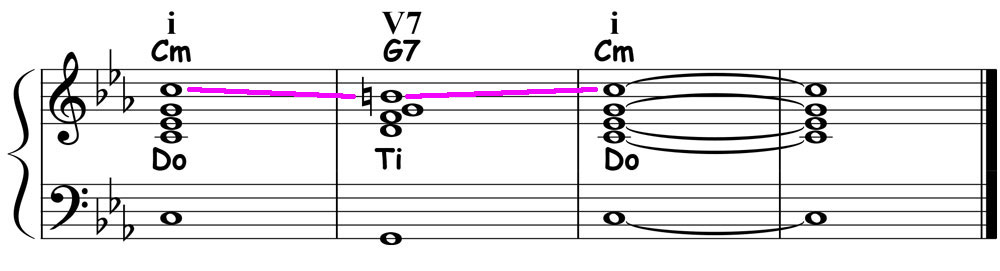
Notice the very strong pull that Ti has to resolve back to Do. This is a particularly strong attraction, so strong that B (Ti) is referred to as the leading tone, because it so strongly leads the ear back to the tonic C (Do).
Minor 1 5 1 Practice, All Keys
Lesson Goal: To build confidence reading, visualizing, playing, and hearing the minor 1-5-1 chord progression (i-V-i) for the big 12 minor keys…
Using the three basic block chord voicings with voice leading, arranged chromatically ascending…


Minor 1 5 1 Play Along Tracks, All Keys (MP3s)
The benefits of playing along with a click track at various tempos cannot be overstated: very slowly at first (60-80 bpm) to have enough time to “think about everything”, then fast enough (60-180 bpm) to be forced to “play without thinking”.
Minor 1 5 1 Practice, All Keys @ 60 bpm…
Minor 1 5 1 Practice, All Keys @ 80 bpm…
Minor 1 5 1 Practice, All Keys @ 100 bpm…
Minor 1 5 1 Practice, All Keys @ 120 bpm…
Minor 1 5 1 Practice, All Keys @ 140 bpm…
Minor 1 5 1 Practice, All Keys @ 160 bpm…
Minor 1 5 1 Practice, All Keys @ 180 bpm…
For a donation to the website (Donations Page) Frank would be happy to send you his personal collection of zip files that include high-res PDFs of the scores and MP3 play along practice tracks for the entire Piano-ology study aids library. This includes all practice tracks for scales, chords, and chord progressions produced to date.
back to… Table of Contents
learn more… Chords & Chord Progressions
Discover more from PIANO-OLOGY
Subscribe to get the latest posts sent to your email.