Lesson Goal: To quickly internalize the concept of Key Signatures and to apply it to reading music in all keys…
Table of Content
Prerequisites
Basic music reading skills… the LOVE of music… and the discipline to study and practice.
back to… Table of Contents
Key Signature Wiki
Learn more: Key Signature (Wikipedia)
back to… Table of Contents
What is a Key Signature?
A Key Signature is a collection of sharps or flats (or none at all) that comes immediately after the clef that tells you the default set of sharps or flats for the notes in the score. It’s a shorthand way to communicate the possible key center and tonality in written music without cluttering up the entire score with sharps & flats.
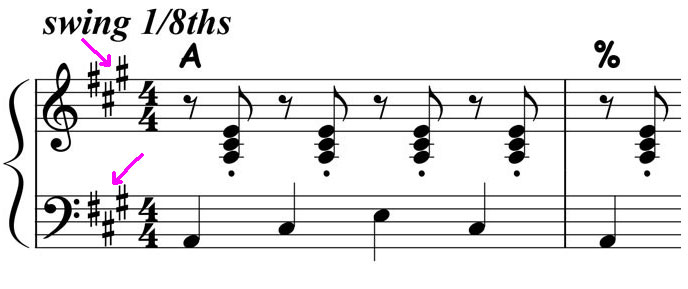
The key signature for this country piano swing pattern has three sharps…
This key signature for the Theme from Cheers has two flats…

Important: The Key Signature alone will not tell you the key center (Do) and tonality. The harmony and nature of the melody that follow are also necessary information. Major, Minor, Modal, and other tonalities are possible. For most kinds of music–classical, jazz, blues, country, pop, and rock–the most commonly-used tonalities are Major, Minor, Mixolydian, & Dorian… as you will study more below…
back to… Table of Contents
Key Signatures for the “Sharp” Keys
One way to think about key signatures for the “sharp” keys (keys signatures that use sharps) is to organize them as follows…

Four “Sharp” Key Signature Patterns
- As you add each sharp, you keep the sharps that are already there.
- The order of sharps is F#-C#-G#-D#-A#-E#-
- Each new sharp is a Perfect 5th above/Perfect 4th below the last sharp.
- The last sharp is always Ti of the Major Key.
back to… Table of Contents
Key Signatures for the “Flat” Keys
One way to think about the key signatures for the “flat” keys (keys signatures that use flats) is to organize them as follows…

Four “Flat” Key Signature Patterns
- As you add each flat, you keep the flats that are already there.
- The order of flats is Bb-Eb-Ab-Db-Gb-Cb-Fb.
- Each new flat is a Perfect 4th above/Perfect 5th below the last flat.
- The last flat is always Fa of the Major Key.
back to… Table of Contents
The Concept of Relative Keys
Tonalities/Keys that share the same key signature are called Relative Keys.
For example: G Major, E Minor, D Mixolydian, and A Dorian are all relative keys because they share the exact same key signature (F#).
And so, an essential reading skill is to know what key centers and tonalities are possible given a particular key signature.
Relative Key Signatures Practice (Flashcards)
Lesson Goal: To quickly learn the Key Signatures for the four most commonly used tonalities: Major, Minor, Mixolydian, and Dorian…

back to… Table of Contents
Discover more from PIANO-OLOGY
Subscribe to get the latest posts sent to your email.