Lesson Goal: To quickly internalize the tasty ingredients that make Swing Rhythm really cook…
Table of Contents
Prerequisites
None.
back to… Table of Contents
Swing Music Wiki
learn more: Swing Music Wikipedia
Fundamental Aspects of Swing Rhythm
First Lesson in Swing Rhythm: Groove
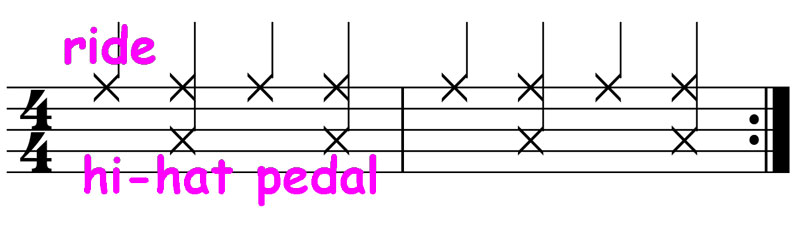
The fundamental groove, the rhythmic scaffolding upon which we are going to learn to Swing, is created by deeply emphasizing the backbeats (2 and 4) in 4/4 time…
Listen to Frank demonstrate the concept and how this sounds and feels…
And listen to how this sounds and feels in its most basic form on the drums… all four downbeats played on the ride cymbal and backbeats played by stepping on the hi-hats…
Second Lesson in Swing Rhythm: Bounce
The second essential ingredient of swing is that each pair of 1/8th notes is not typically played “straight”. It is common practice to “swing” the 1/8ths by playing the first 1/8th note longer than the second and shortening the second 1/8th accordingly. Doing so adds what might be called “bounce”.
Let’s compare straight time to swing time first by listening to “straight” 8ths at 80 bpm…

Now, listen to one way that you might “swing” the 1/8th notes at 80 bpm…

By the way, did you notice how impossible it is to count the offbeats?
Third Lesson in Swing Rhythm: Degrees of Bounce
What you are about to experience are five degrees of “bounce” within each pair of 1/8th notes.
Starting from a pure shuffle (where the first note in each beat is precisely twice as long as the second note), we are going to progressively “straighten” the rhythm by playing the first note progressively shorter (and the second note progressively longer) until both notes are the same duration (in other words, straight 1/8th notes). The goal here is to hear, feel, and appreciate the trend as the rhythm straightens out and to realize that swing can be found anywhere in this range between shuffle and straight.
Shuffle Rhythm
We begin with the shuffle, notated exactly as follows…

Sidebar: Some people use the terms Shuffle and Swing interchangeably. This is not true. Shuffle is just a special case of swing as is proven by the straighter than shuffle rhythms that follow.
Slightly Straighter than a Shuffle…
Moderately Straighter than a Shuffle…
Significantly Straighter than a Shuffle…
Straight 1/8ths
Fourth Lesson in Swing Rhythm: Syncopation
Now let’s explore another essential swing ingredient: the strategic placement of accents on offbeats (called syncopation).
In order to get the feel for this syncopation, let’s play swing 1/8th notes in three different ways…
First, without any accents…

Second, with accents on the downbeats…

And third, with accents on the offbeats…

Sidebar: You will hear some people suggest that swing requires you to accent all the offbeats. This is simply not true. While emphasizing offbeats is indeed a defining feature of swing, it may also be appropriate to emphsize downbeats or to play with no accents at all. It all depends on the nature of the phrase you are playing and your musical intentions.
Fifth Lesson in Swing Rhythm: Notation
Because the amount of bounce used when playing swing is not describable by counting numbers and is impossible to capture using conventional music notation, it is common practice to write swing 1/8th notes as straight 1/8th notes as follows…
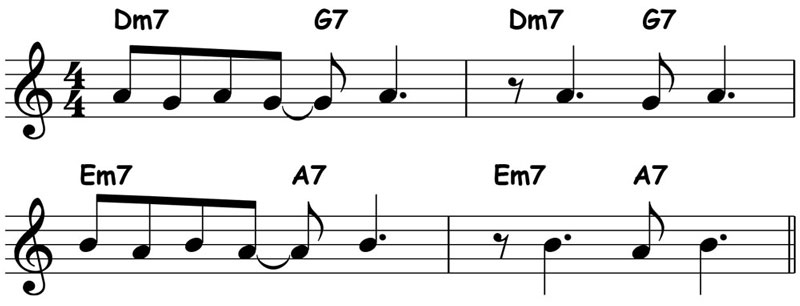
It is simply assumed that the performer knows that the 1/8th notes must typically be swung, not played straight as written. It is up to the performer to decide how to express that swing in their own style.
Sixth Lesson in Swing Rhythm: Scatting
Instead of counting the time, it far more musical to scat the rhythm using whatever syllables suit the occasion.
Here’s a pattern for your consideration…

Listen to Frank model how this might be done…
Swing Rhythm Summary
There are at least four huge takeaways regarding swing rhythm:
- The backbone of the swing groove is established by heavily emphasizing the backbeats 2 and 4 within the 4/4 meter.
- Figuring out how much to bounce the 1/8th notes is not a math problem. It’s all about the experience of how things sound and feel.
- There are no hard and fast rules about where accents belong, although it’s essential to include plenty of offbeat accents (known as syncopation).
- Swing is not just about note durations and syncopation. It’s also about the length and complexity of the rhythmic motives… about using expressive articulations (legato, staccato, portato)… about incorporating meaningful silences (rests)… about playing on, before, or behind the beat… about shaping each phrase dynamically (loud and soft)… and about using rhythmic element other than 1/8 notes (such as triplets)… not to mention mixing and matching all the above at a variety of tempos.
All these factors conspire to create a phenomenal variety of swing music–all depending on the tune, the player(s), the tempo, the mood in the room, and more. Pretty cool, huh?
back to… Table of Contents
Swing Rhythm Practice Tracks (MP3s)
Downloadable drum tracks at a variety of tempos using the most basic pattern… for jamming along and tightening up your Jazz Swing Rhythm…
Basic Swing Drums Pattern
The most basic swing drum pattern consists of relentless 1/4 notes played on the ride cymbal with, with hi-hat steps on the back beats 2 and 4…
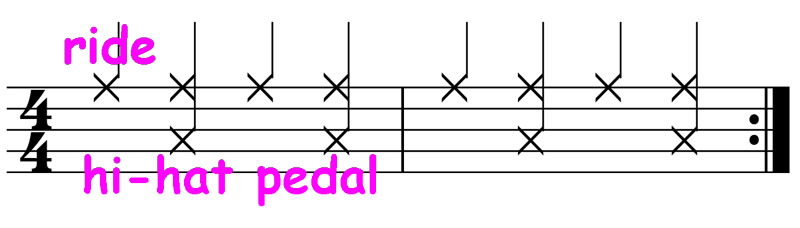
Listen to a sample at 160 bpm…
Downloadable Zip File containing 10 MP3s, each long enough to wear you out, tempos from 90 to 160 beats per minute in 10 bpm increments…
back to… Table of Contents
learn more… Jazz Piano Lessons
Discover more from PIANO-OLOGY
Subscribe to get the latest posts sent to your email.
Thanks for the speech at the bottom of this lesson. Yes, swing is pretty cool. I look forward to the day I incorporate pitch, rhythm, note duration, articulation, and dynamics naturally in my playing.
Thanks for the positive feedback, anonymous friend. Please let me know what other topics interest you and how I might be of further assistance. Cheers!