Lesson Goal: To quickly internalize common practice Major Chord Voicings in all spellings… by ear, intellect, eye, and muscle…
Table of Contents
Prerequisites
Basic music reading skills… the LOVE of music… and the discipline to study and practice.
back to… Table of Contents
Study, Practice, & Performance Tips
- Your goal is not to merely memorize this, but to study and practice it until you internalize it using all four musical intelligences: ears, intellect, eyes, and muscles.
- Every time you practice something, you are programming your brain. So always play accurately.
- Practice with a Click Track or a Rhythm Track. Doing so will give you immediate feedback on any rhythmic misconceptions or places where your timing gets sloppy.
- Record Yourself. Always. Listen to the playback immediately. And ask yourself: Is that what you intended to play?”
- If anything feels tense or awkward, stop immediately and experiment with alternative fingerings or choreography.
- Play this in other keys you expect to play in. By the way, once you see the patterns (which is guaranteed if you know your scales and chords) finding the notes in other keys will be a piece of cake!
- If you feel stuck or overwhelmed, realize that anything can and will be mastered if you slow things down or break things down to small enough pieces.
- All of this might sound like a lot of work, but it’s not nearly as much as you think. Because even though it takes time to talk about all these things, in practice they can all be done simultaneously!
back to… Table of Contents
“Basic” C Major 7th Chord Voicing
Let’s begin our exploration of common practice Major 7th Chord Voicings with the most basic arrangement of notes: Root (1) in the left hand and stacked thirds (1-b-5-7) in the right…


“Think” about this as C Major Triad with the color tone “7” added.
Any interest in a score and MP3 play along tracks for this major chord voicing in all keys? (and for all the voicings below, too)
back to… Table of Contents
“Left Hand Block” C Major 7th Chord Voicing
An essential skill is to play the basic voicing for a C Major 7th chord voicing in your left hand in block form as follows…
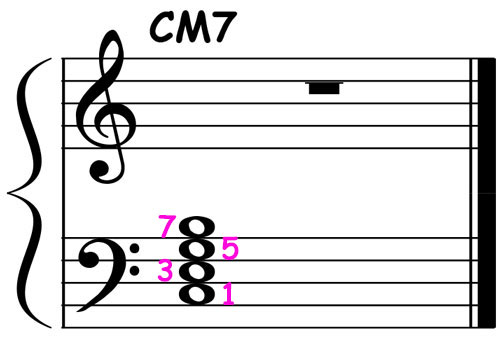
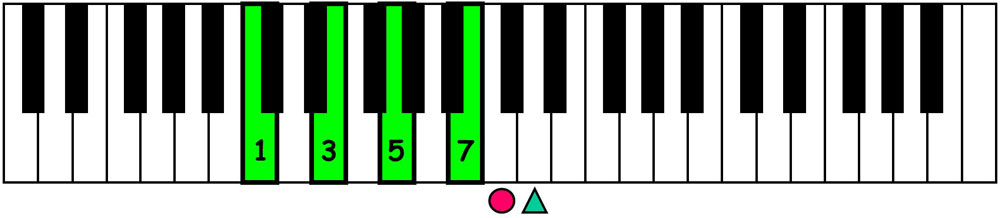
Playing the chord in your left hand frees your right hand to play a melody or improvise.
back to… Table of Contents
“Left Hand 1-7” C Major 7th Chord Voicing
A sparse, light, open texture is achieved by simply playing the root and 7 of the major 7th chord in your left hand as follows…
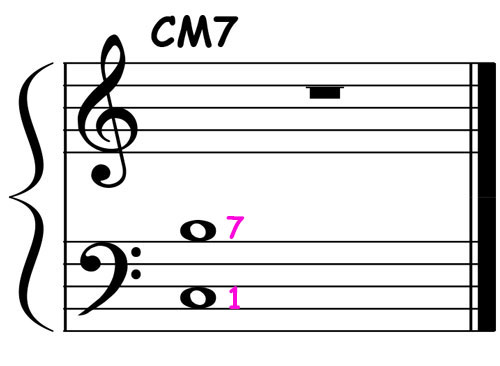

Doing so provides lots of space and freedom for your right hand to add “the 3” and to solo without being hamstrung by any particular voicing.
back to… Table of Contents
“Triad over Root” C Major 7th Chord Voicing
A standard voicing for a Major 7th Chord is to play the root in your left hand and the triad formed by the 3, 5, and 7 in your right…
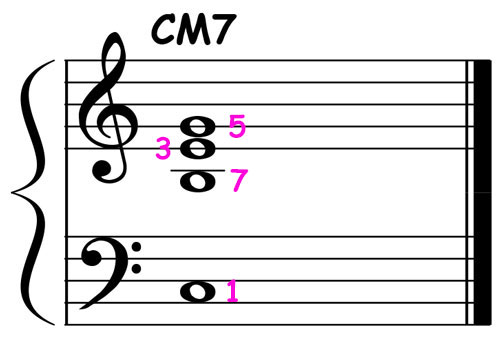
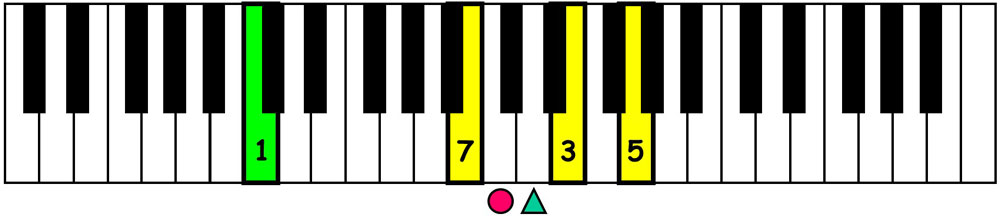
One might think of this CM7 voicing as Em/C, where Em is the minor triad (E-G-B) built on “the 3” of the C chord.
“Root Plus Definitive Tones” CM7 Chord Voicing
A standard way to voice a Major 7th chord is to play the root plus the two definitive tones (3 & 7) as follows…


This open voicing can be played as an arpeggio in your left hand when soloing or played two-handed (Root left, 3 & 7 right) when comping.
An alternate way to voice the CM7 chord is with the root in the bass and the definitive tones (7, 3) as follows…

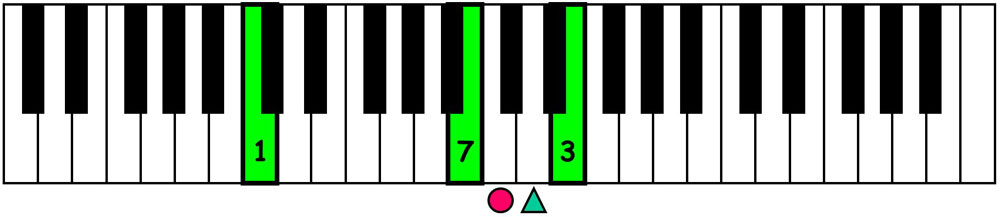
This open voicing can be played as an arpeggio in your left hand when soloing or played two-handed (Root left, 3 & 7 right) when comping.
back to… Table of Contents
“Add 9” C Major 7th Chord Voicing
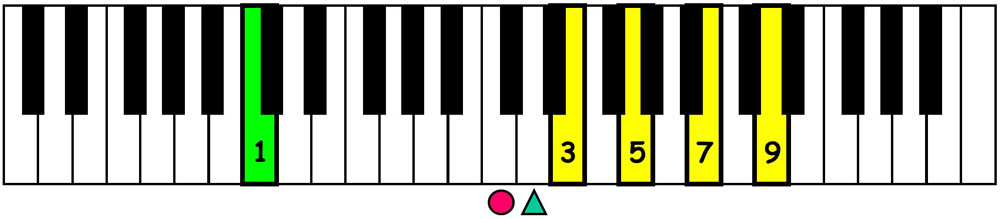
A standard way to jazzify your Major 7th chords is to add “the 9″.
In the interest of physical ease and musicality, play the root “1” in your left hand, drop “the 1” from your right hand and play “the 9” instead as follows…

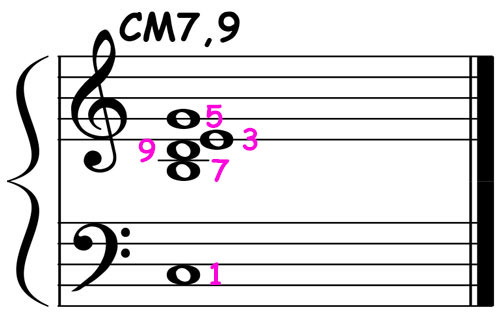
Another useful “add 9” voicing puts “the 7” at the bottom in your right hand as follows…

back to… Table of Contents
“Definitive Tones over Perfect 5th” CM7 Chord Voicing
Notice that both hands play perfect 5ths…


back to… Table of Contents
“Major 6/9” Chord Voicing
The Major 6/9 Chord is a colorful, mellower, less dissonant alternative to the Major 7th Chord…

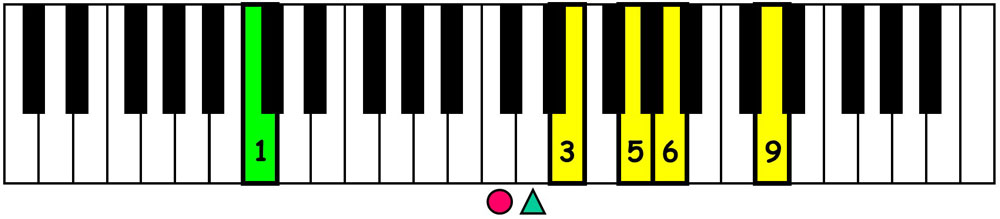
The major 6/9 chord sounds and feels just right as the tonic (I) chord in many jazz ballads and slow Latin tunes…
back to… Table of Contents
“add 9, add 13” C Major 7th Chord Voicing
For a very open and hip sound, try this two-fisted voicing in perfect 4ths with three notes in each hand…
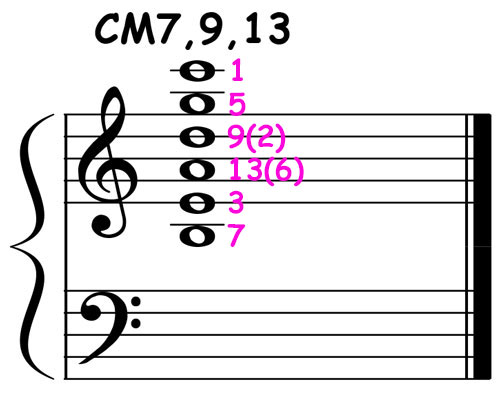

It may seem intimidating at first, but the pattern is quite simple if you think top down rather than bottom up: Put the root on top and work your way down in perfect 4ths. Notice that it includes every note in the major scale except the highly dissonant “4”…
back to… Table of Contents
“Lydian Scale-Chord” C Major 7th Chord Voicing
Don’t try to name this tasty voicing. Just think of it as a basic C Major 7 in your left hand with a D Major Triad (all color tones) in your right…
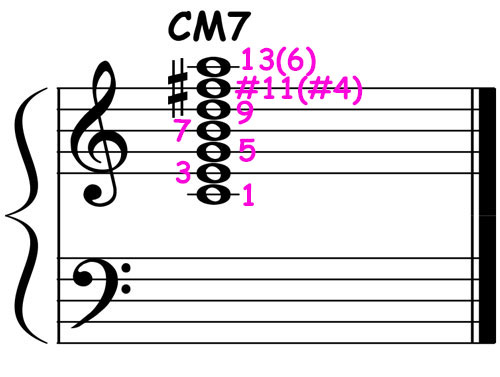

This voicing is a pretty way to end a tune, playing ad lib with the color tones in a high register…
Listen to Frank improvise and explain how one might play a Lydian Scale-Chord at the end of Jazz tune in C Major…
back to… Table of Contents
learn more… Jazz Piano Lessons
Discover more from PIANO-OLOGY
Subscribe to get the latest posts sent to your email.
the homework sounds like it going to be a ….major project
Ha! Vg! Some serious studying to be sure, Dave, but definitely worth every heartbeat of effort! Let me know how it goes and if you need any help. By the way, thanks a million for the likes!