Lesson Goal: To add a variety of tasty Dominant 7th Chord Voicings to your bag… by ear, intellect, eye, and muscle…
Table of Contents
“Basic” C7 Chord Voicing
Let’s begin our exploration of commonly-used chord voicings for a Dominant 7th Chord with the most basic arrangement of notes: Root (1) in the left hand and stacked thirds (1-3-5-b7) in the right…


back to… Table of Contents
“Left hand Block” C7 Voicing
An essential skill is to play a C Dominant 7th chord in your left hand in block form as follows…
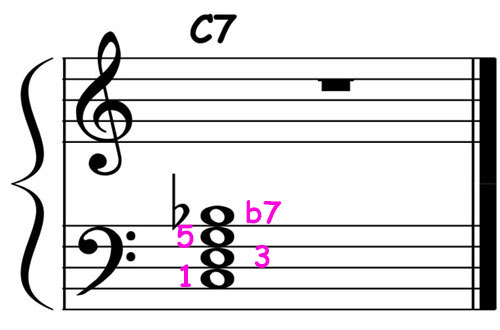
Playing the chord in your left hand frees your right hand to play a melody or improvise.
back to… Table of Contents
“Left Hand 1-b7” C7 Voicing
A sparse, light, open texture is achieved by simply playing the root and b7 of the dominant 7th chord in your left hand as follows…


Doing so provides lots of space and freedom for your right hand to add “the 3” and to solo without being hamstrung by any particular voicing.
back to… Table of Contents
“Triad over Root” C7 Voicing
A standard voicing for a Dominant 7th Chord is to play the root in your left hand and the triad formed by the 3, 5, and b7 in your right…


One might think of this C7 voicing as Edim/C, where Edim is the diminished triad (E-G-Bb) built on “the 3” of the C chord…
back to… Table of Contents
“Root plus Definitive Tones” C7 Voicing
“Root plus Definitive Tones” Variation #1
A standard way to voice a Dominant 7th chord is to play the root plus the two definitive tones (3 & b7) as follows…

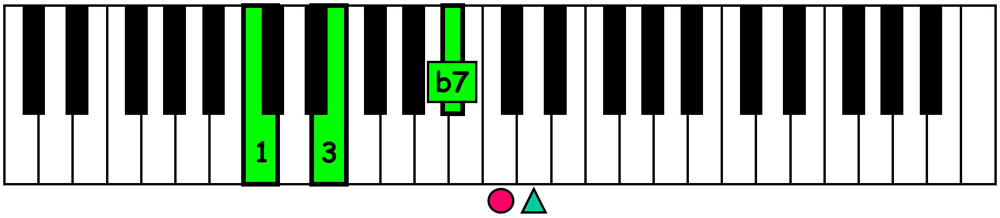
This open voicing can be played as an arpeggio in your left hand when soloing or played two-handed (Root left, 3 & b7 right) when comping.
“Root plus Definitive Tones” Variation #2
An alternate way to voice the C7 chord is with the root in the bass and the definitive tones (b7, 3) as follows…

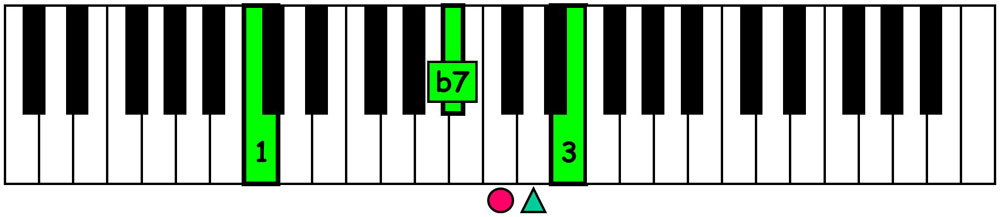
This open voicing can be played as an arpeggio in your left hand when soloing or played two-handed (Root left, 3 & b7 right) when comping.
back to… Table of Contents
“Add 9” C7 Voicing
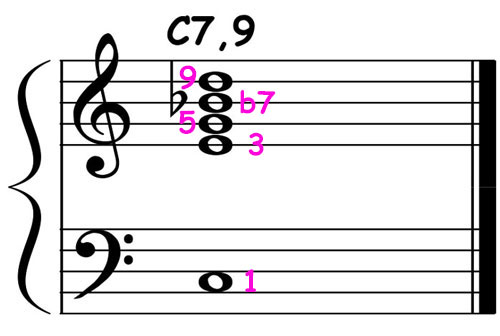
A standard way to jazzify your Dominant 7th chords is to add “the 9″ to the chord voicing.
“Add 9” Variation #1
In the interest of physical ease and musicality, play the root “1” in your left hand, drop “the 1” from your right hand and play “the 9” instead as follows…
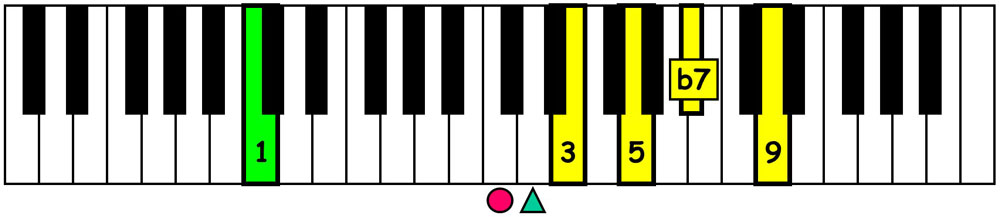
“Add 9” Variation #2
Another useful “add 9” voicing puts “the b7” at the bottom in your right hand as follows…


back to… Table of Contents
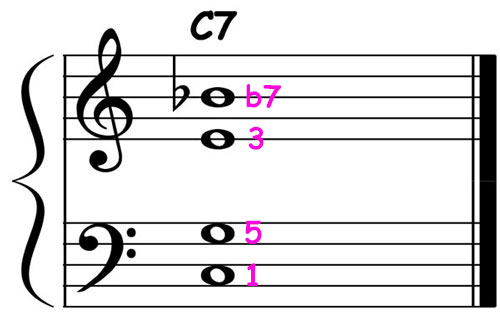
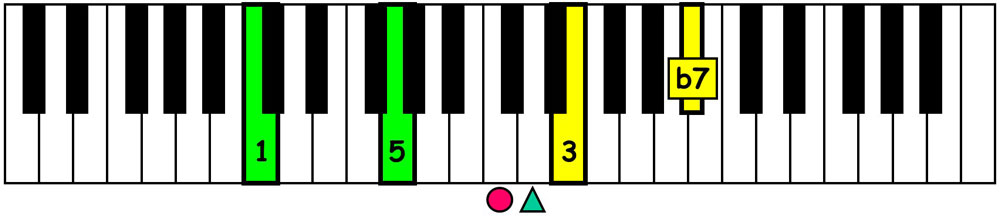
“Definitive Tones over Perfect 5th” C7 Voicing
For a full, simple, and open sound, voice the Dominant 7th Chord as a perfect 5th in the left hand and the Tritone formed by the definitive tones (3, b7) in the right…
back to… Table of Contents
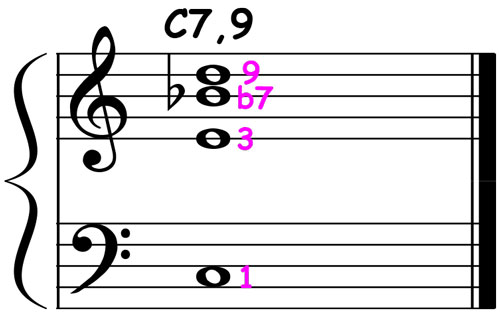
“Add 9, Drop 5” C7 Chord Voicing
A must have Dominant 7th Chord voicing for Jazz Blues is to drop “the 5” and play the two definitive tones (3, b7) plus “the 9″…

back to… Table of Contents
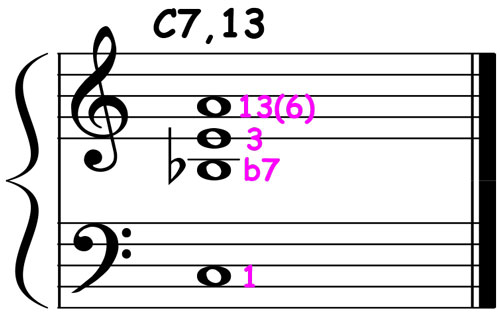
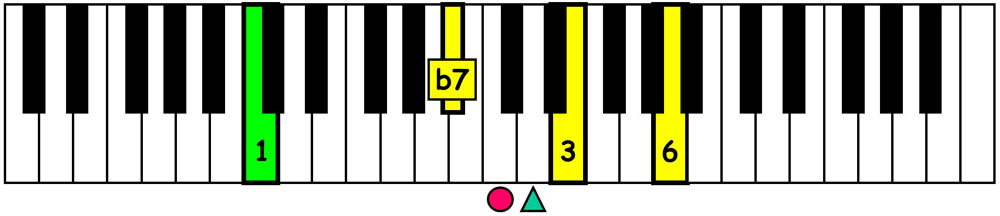
“Add 13, Drop 5” C7 Voicing
For an open, “fourthy” sound that works great in Jazz Blues, play the two definitive tones (3, b7), add “the 13”, and drop “the 5″…
back to… Table of Contents
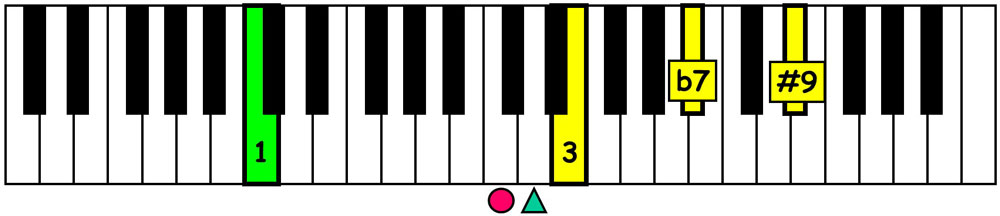
“add #9, Drop 5” C7 Voicing
For a dissonant, edgy sound, play the definitive tones (3, b7), add “the #9”, and drop “the 5″…
Notice that “sharp 9” is the very same note as “flat 3”. The distinctive major-minor harmonic tension between the natural 3 (major sound) and flat 3 (minor sound) gives this voicing some real teeth in down and dirty Blues, Rock, and Funk contexts or as a colorful V7 chord in a tonal minor context…

back to… Table of Contents
“Killer Joe” C7 Chord Voicing
The super-hip voicing for a Dominant 7th Chord made famous in Benny Golson’s “Killer Joe”.
Some might call this an “add 9, add 13” chord voicing, but don’t quibble about the name. It’s the pattern that matters: Just start with “the 1” on top and go down in 4ths until you get to “the b7″…
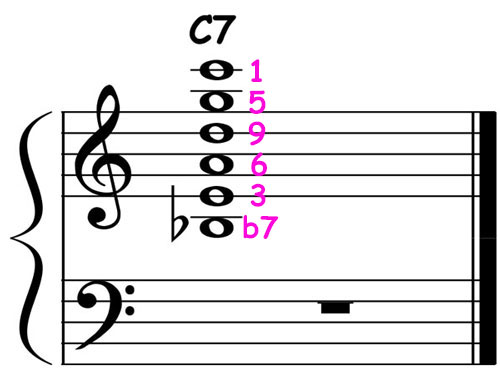

Don’t get hung up on whether to call D a “2” or a “9 or A a ”5″ or “13”. These are just numbers that you will soon abandon like training wheels!
back to… Table of Contents
learn more… Jazz Piano Lessons
Discover more from PIANO-OLOGY
Subscribe to get the latest posts sent to your email.