Lesson Goal: To internalize some authentic comping and soloing vocabulary for “Chameleon”… by ear, intellect, eye, and muscle…
Table of Contents
Prerequisites
Basic music reading skills… basic scale, chord, and chord progression theory… basic technique… the LOVE of music… and the discipline to study and practice.
back to… Table of Contents
Study, Practice, & Performance Tips
- All of this might sound like a lot of work, but it’s not nearly as much as you think. Because even though it takes time to talk about all these things, in practice they can all be done simultaneously!
- Your goal is not to merely memorize this, but to study and practice it until you internalize it using all four musical intelligences: ears, intellect, eyes, and muscles.
- Every time you practice something, you are programming your brain. So always play accurately.
- Practice with a Click Track or a Rhythm Track. Doing so will give you immediate feedback on any rhythmic misconceptions or places where your timing gets sloppy.
- Record Yourself. Always. Listen to the playback immediately. And ask yourself: Is that what you intended to play?”
- If anything feels tense or awkward, stop immediately and experiment with alternative fingerings or choreography.
- Play this in other keys you expect to play in. By the way, once you see the patterns (which is guaranteed if you know your scales and chords) finding the notes in other keys will be a piece of cake!
- If you feel stuck or overwhelmed, realize that anything can and will be mastered if you slow things down or break things down to small enough pieces.
back to… Table of Content
“Chameleon” Lead Sheet
This extended form for “Chameleon”, the super funky two-chord jazz-rock fusion classic by Herbie Hancock, is just several 8-bar sections stitched together. The really tricky part is being able to play the quirky, syncopated bass line!

back to… Table of Contents
Original “Chameleon” Recording (Herbie Hancock)
back to… Table of Contents
Form
Form = 8 bars, which can be played as two 4-bar phrases, which can be further broken into two 2-bar phrases…
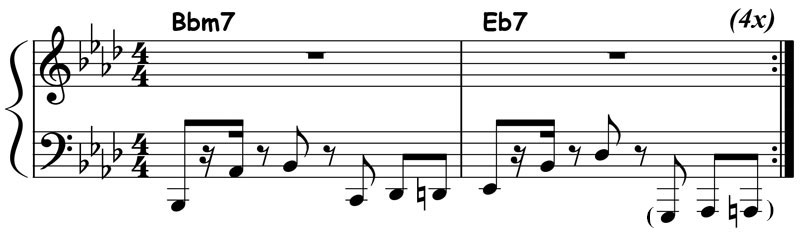
back to… Table of Contents
Meter & Feel
4/4 Time, count out loud “1 2 3 4” or “1 & 2 & 3 & 4 &”, feel the funk in the 1/16th notes!
back to… Table of Contents
Tonality & Useful Scales
There are at three useful scales in Bb Dorian tonality: Bb Dorian, Bb Minor Pentatonic, and Bb Minor Blues.
Listen to Frank Model how you might do ear training for these scales…
Bb Dorian…
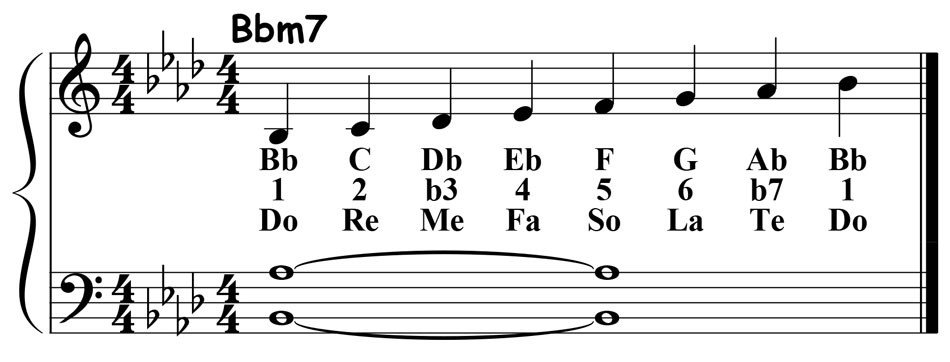
Would anyone like to hear Frank improvise using the Bb Dorian Scale?
Bb Minor Pentatonic…
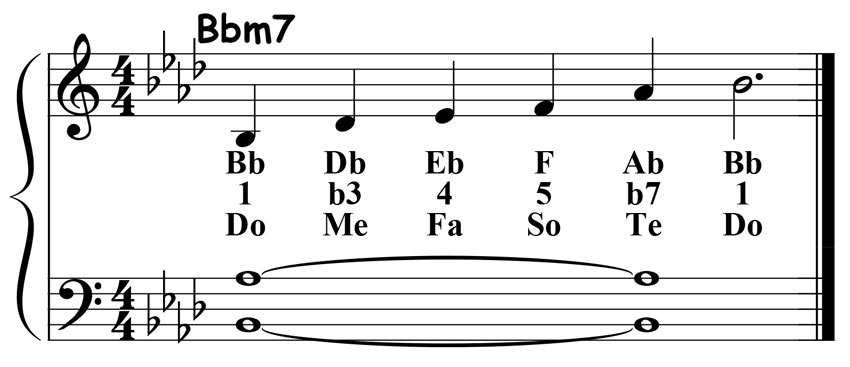
Would anyone like to hear Frank improvise using the Bb Minor Pentatonic Scale?
Bb Minor Blues…
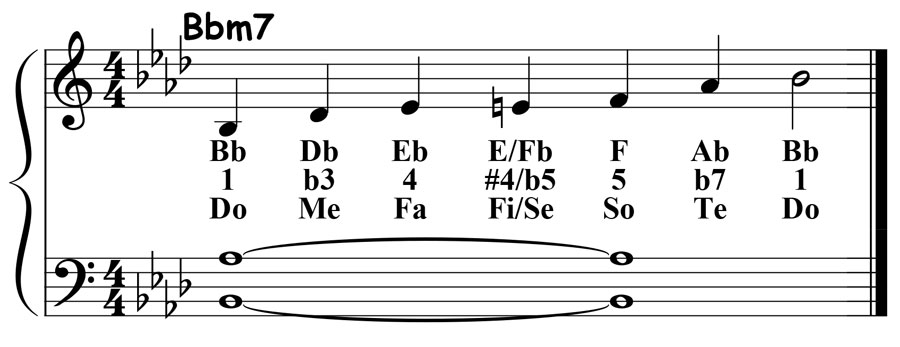
Would anyone like to hear Frank improvise using the Bb Minor Blues Scale?
back to… Table of Contents
Harmony
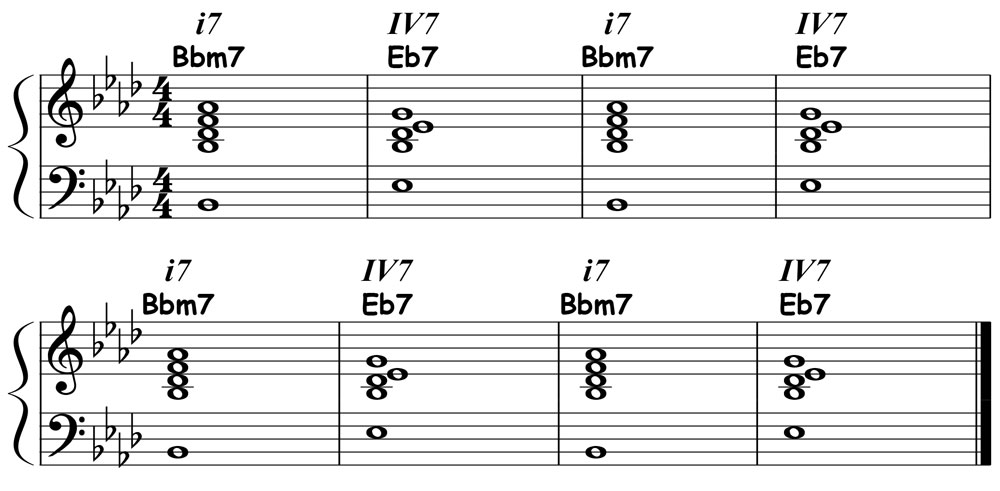
Bbm7 = i7 (harmonic home base), Eb7=IV7 (harmonically away from home)
back to… Table of Contents
“Chameleon” Comping Ideas
Hint: It’s all about the groove!
Chord Voicings #1
Rootless, Left Hand only, definitive tones (3 & 7)…

Chord Voicings #2
Rootless, Left Hand only, color tones (9 & 13) added…

Chord Voicings #3
Two fisted, color tones (9 & 13) added, some notes doubled for emphasis and melodic motion…

back to… Table of Contents
“Chameleon” Riffing
Don’t underestimate the musical value of short, simple ideas that repeat over the form…
back to… Table of Contents
Mindset
back to… Table of Contents
Play the Idea!
back to… Table of Contents
Frank’s Synth Solo
Recorded live with the band “Chameleon” in 2001…
That’s also Frank comping on electric piano just before the solo.
back to… Table of Contents
Your Turn to Improvise
Download the following bass and drum practice track recorded by Frank…
(Yes, Frank is neither a bass player nor a drummer!)
back to… Table of Contents
Improvisation Tips
- Think, hear, feel, and play in 8-bar choruses and 4-bar phrases.
- The “feel” is a funky Rock Beat 1 & 2 & 3 & 4 & 1 & 2 & 3 & 4 &
- Tonality: Bb Dorian
- Useful Scales: Dorian, Minor Blues, Minor Pentatonic
- Don’t get scale happy.
- Commit to playing coherent IDEAS.
- Realize that rhythm is as important as the notes.
- Vocabulary Sources: Rock, Jazz, Blues
- Borrow ideas from the head (the original melody).
- Cop ideas from other players.
- It’s not all about playing leads. It’s often about creative and tasteful comping, too!
- Don’t just think… FEEL & LISTEN!
- Experiment like a child playing with building blocks.
- Take your shoes off!
back to… Table of Contents
Please let Frank know if there is something else you’d like to see or understand.
learn more… Jazz Piano Lessons
Discover more from PIANO-OLOGY
Subscribe to get the latest posts sent to your email.
Would be lovely to see the names of chords for comping ideas…
Thanks so much for the lovely suggestion, Gernot. Such engagement is really important to me… and made this lesson so much better!
It is done.
In fact, you inspired me to add more than just the chord names, because the real magic is in the particular way they are voiced.
So I included the score, chord names, chord structure (numbers), and an audio snippet so you can hear the voicings clearly.
All the best to you in music and life.
Wow Frank – highly appreciated 👍 That will keep me busy & enjoying the lesson even more. Thanks for your wishes which I am more than happy to return !
Music to my ears, Gernot!