Lesson Goal: To quickly internalize the commonly used Intervals that every musician needs to know in all spellings… by ear, intellect, eye, and muscle…
Table of Contents
Prerequisites
Basic music reading skills… the LOVE of music and the discipline to study and practice.
back to… Table of Contents
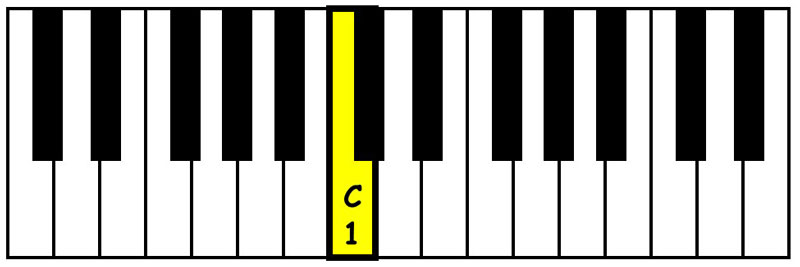
Perfect Unison
A Perfect Unison (usually just called a Unison) occurs when two or more voices sing or play the exact same note in the same register. It is called perfect because it is highly consonant.
- Chord symbol: P1
- Chord structure = 1-1
- Character: perfect consonance

back to… Table of Contents
Minor 2nd
The Minor Second spans two letters (for example: C-Db) and two physical piano keys.
- Chord symbol: m2
- Chord Structure = 1-b2
- Character: extreme dissonance


Minor 2nd Practice Tracks
[insert score & MP3s]
back to… Table of Contents
Major 2nd
The Major Second spans two letters (for example: C-D) and three physical piano keys.
- Chord symbol: M2
- Chord structure = 1-2
- Character: Moderately Dissonant


back to… Table of Contents
Minor 3rd
The Minor Third spans three letters (for example, C-D-Eb) and four physical piano keys.
- Chord symbol: m3
- Chord structure= 1-b3
- Character: dark consonance


Minor 3rds, All Spellings: Practice Tracks (MP3s)
Played both melodically and harmonically, and arranged chromatically ascending…
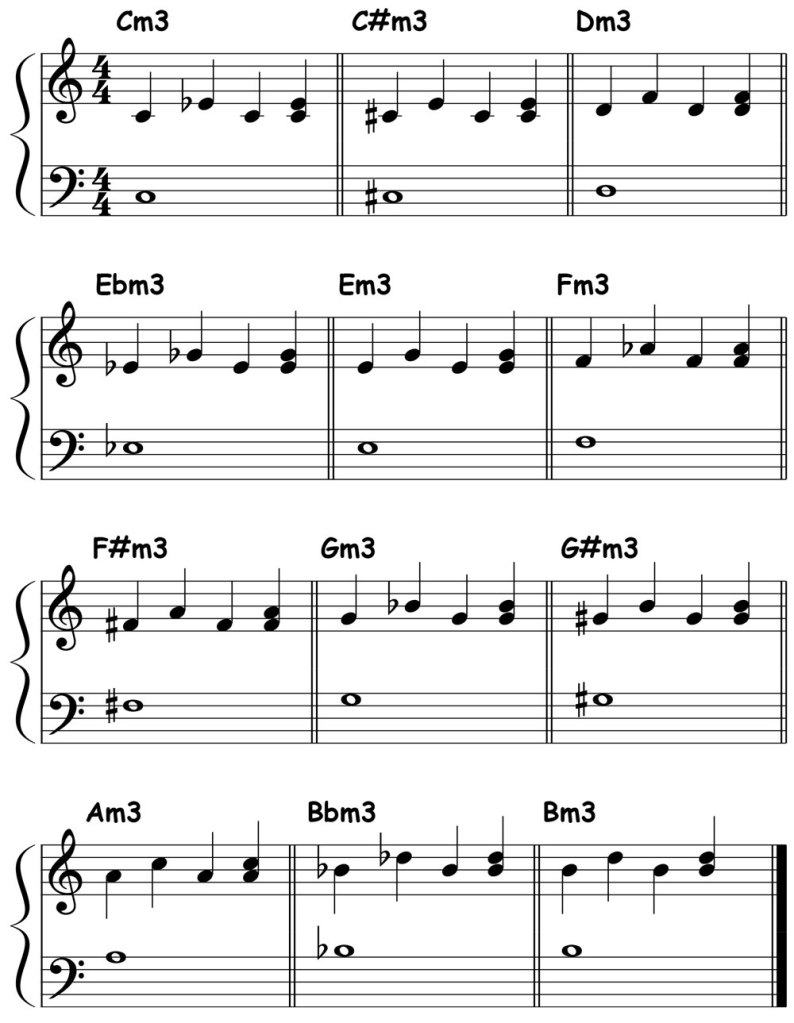
Listen to a sample @ 120 beats per minute…
Play along Tracks Of the score above with a two bar count off @ 60, 80, 100, 120, 140, 160, & 180 beats per minutes…
Playing along at a variety of tempos–from very slow to very fast–is a highly effective way to discover and tighten up every loose screw in your technique and rhythm!
back to… Table of Contents
Major 3rd
The Major Third spans three letters (for example, C-D-E) and five physical piano keys.
- Chord symbol: M3
- Chord structure = 1-3
- Character: consonant and bright


Major 3rds: Practice tracks (MP3s)
Lesson Goal: To build confidence reading, visualizing, playing, and hearing the big 12 Major 3rds…
Played both melodically and harmonically, and arranged chromatically ascending…
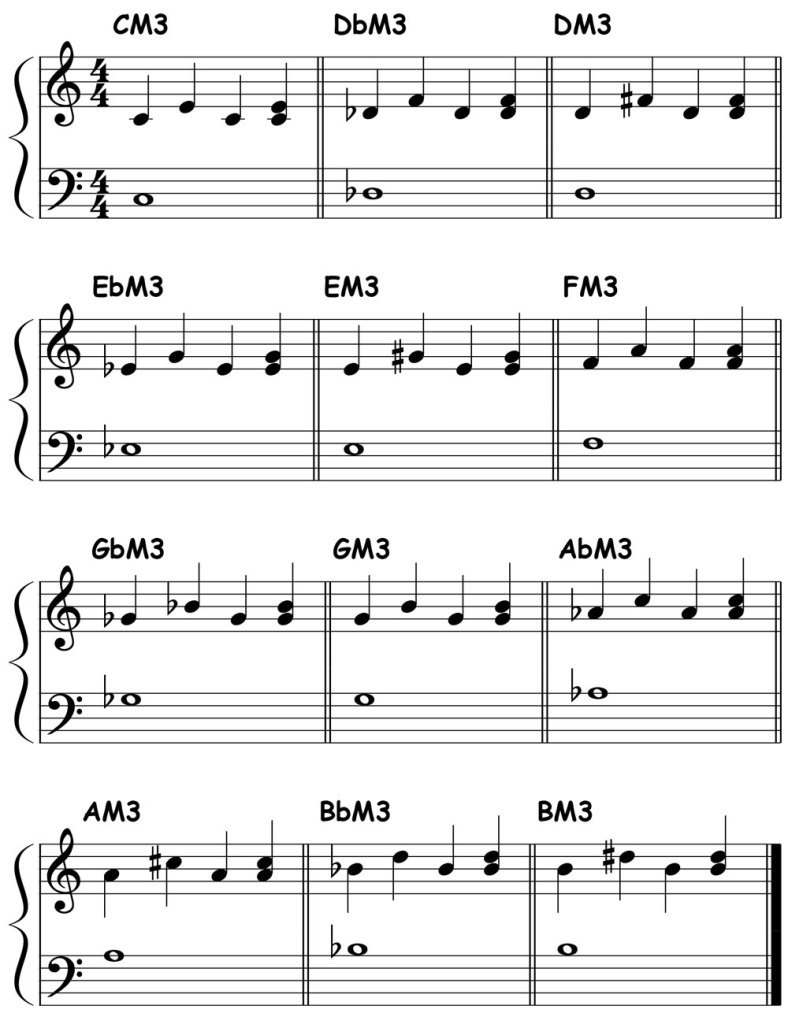
Listen to a sample @ 120 beats per minute…
Of the score above with a two bar count off @ 60, 80, 100, 120, 140, 160, & 180 beats per minutes…
Playing along at a variety of tempos–from very slow to very fast–is a highly effective way to discover and tighten up every loose screw in your technique and rhythm!
back to… Table of Contents
Major 3rds & Minor 3rds: Names & Spellings (Flashcards)
Lesson Goal: To quickly learn the letter names & spellings for commonly used Major 3rds & Minor 3rds…
Perfect 4th
The Perfect Fourth spans four letters (for example, C-D-E-F) and six physical piano keys. It is called perfect because it is highly consonant.
- Chord symbol: P4
- Chord structure: 1-4
- Character: consonant, but unstable


back to… Table of Contents
Augmented 4th
The Augmented Fourth spans four letters (for example, C-D-E-F#) and seven physical keys. It is called augmented because it is one physical key “larger” than a perfect 4th.
- Chord symbol: A4
- Chord structure: 1-#4
- Character: extremely dissonant, highly unstable, craves resolution


Note: The Augmented Fourth is also called a Tritone because it spans three whole tones. By the way, the Diminished Fifth is also a Tritone. The difference between an A4 and d5 is purely theoretical. Both intervals share the exact same physical notes but have different letter names. The naming conventions will become clear in later studies of chords and chord progressions.
back to… Table of Contents
Diminished 5th
The Diminished Fifth spans five letters (for example, C-D-E-F-Gb) and seven physical piano keys. It is called diminished because it is one physical key “smaller” than a perfect 5th.
- Chord symbol: d5
- Chord structure: 1-b5
- Character: extremely dissonant, highly unstable, craves resolution.


Note: The Diminished Fifth is also called a Tritone because it spans three whole tones. By the way, the Augmented Fourth is also a Tritone. The difference between an A4 and d5 is purely theoretical. Both intervals share the exact same physical notes but have different letter names. The naming conventions will become clear in later studies of chords and chord progressions.
back to… Table of Contents
Perfect 5th
The Perfect Fifth spans five letter names (for example, C-D-E-F-G) and eight physical piano keys. It is called perfect because it is highly consonant.
- Chord symbol: P5
- Chord structure: 1-5
- Character: highly consonant and stable.


Perfect 5ths: Names & Spellings (Flashcards)
Lesson Goal: To quickly learn the letter names & spellings for commonly used Perfect 5ths…
Perfect 5ths: Play Along Practice Tracks (MP3s)
Lesson Goal: To internalize all the Perfect 5ths… by ear, intellect, eye, and muscle…
Here are all perfect 5ths, played boh melodically and harmonically, and arranged chromatically ascending…
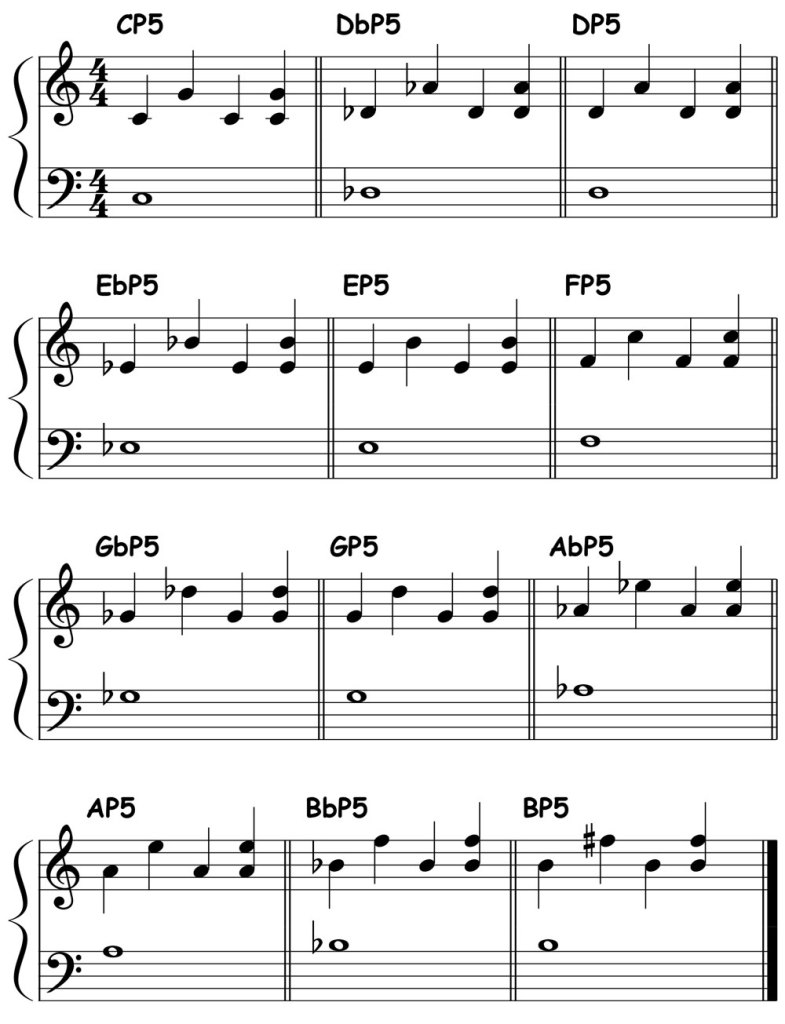
Listen to a sample @ 120 beats per minute…
Of the score above with a two bar count off @ 60, 80, 100, 120, 140, 160, & 180 beats per minutes…
Playing along at a variety of tempos–from very slow to very fast–is a highly effective way to discover and tighten up every loose screw in your technique and rhythm!
back to… Table of Contents
Augmented 5th
The Augmented Fifth spans five letters (for example, C-D-E-F-G#) and nine physical piano keys. It is called augmented because it is one physical key “larger” than a perfect fifth.
- Chord symbol: A5
- Chord structure: 1-#5
- Character: moderately dissonant, dreamy.


back to… Table of Contents
Minor 6th
The Minor Sixth spans six letters (for example, C-D-E-F-G-Ab) and nine physical piano keys.
- Chord symbol: C6
- Chord structure: 1-b6
- Character: consonant, mildy unstable.


back to… Table of Contents
Major 6th
The Major Sixth span six letters (for example, C-D-E-F-G-A) and ten physical piano keys.
- Chord symbol: M6
- Chord structure: 1-6
- Character: consonant, mildly unstable.


back to… Table of Contents
Minor 7th
The Minor Seventh spans seven letter names (for example, C-D-E-F-G-A-Bb) and eleven physical piano keys.
- Chord symbol: m7
- Chord structure: 1-b7
- Character: dissonant, unstable.


back to… Table of Contents
Major 7th
The Major Seventh spans seven letter names (for example, C-D-E-F-G-A-B) and twelve physical piano keys.
- Chord symbol: M7
- Chord structure: 1-7
- Character: dissonant, unstable.


back to… Table of Contents
Perfect Octave (8ve)
The Perfect Octave (usually just called an Octave) spans eight letter names (C-D-E-F-G-A-B-C) and thirteen physical pain keys. It is called an Octave because it span eights letter names and perfect because it is highly consonant and is harmonically equivalent to a perfect unison.
- Chord symbol: P8
- Chord structure: 1-8
- Character: extremely consonant and stable.


back to… Table of Contents
Intervals Larger than an Octave
Intervals larger than an octave, sometimes called compound intervals, are commonly used to describe chord structures that theoretically span beyond one octave (for example: 9ths, 10ths, 11ths, 13ths). But don’t worry about compound intervals for the moment. We will have plenty of exposure and when we study chord structure and specific examples commonly used in jazz harmony.
back to… Table of Contents
Interval Ear Training (MP3s)
Lesson Goal: To recognize the sound-feeling of the following intervals: unison, minor 2nd, major 2nd, minor 3rd, major 3rd, perfect 4th, tritone, perfect 5th, minor 6th, major 6th, minor 7th, major 7, and octave…
Important Note from Frank: Don’t get too carried away with this. Do just enough to get the gist for how each interval type sounds and feels. You will get lots more experience when we study the usage of intervals in context–as part of a melody or chord progression in real music.
Ear Training Files: Ascending Intervals
This downloadable study consists of dozens of MP3s compressed into a single *.zip file. Simply download, unzip, create a playlist, set to random play, and do ear training on the run!
Each mp3 follows the same sequence:
- Two random notes are played, one after the other in ascending order.
- Identify the interval.
- After a short pause, the correct answer is given.
Listen to an example…
Ear Training Files: Descending Intervals (MP3s)
This downloadable study consists of dozens of MP3s compressed into a single *.zip file. Simply download, unzip, create a playlist, set to random play, and do ear training on the run!
Each mp3 follows the same sequence:
- Two random notes are played, one after the other in descending order.
- Identify the interval.
- After a short pause, the correct answer is given.
Listen to an example…
As you do these, keep the following in mind:
Unlike absolute pitch, relative pitch does not require any special talent. Relative pitch awareness is a learnable skill, available to anyone willing to study and practice the right things the right way.
Successful ear training is not the fruit of trying to hear something. It is about being receptive to the sound/feeling you are experiencing and then associating that sound/feeling with something you already know–in this case the name of each interval.
About these Ear Training Files
This is not Solfege ear training. Do not try to force yourself to hear the intervals as part of a scale or melody. So, don’t try to find the interval by singing up or down a scale. And don’t use the widely prescribed first two notes in a melody.
- Method #1: Sing up a musical scale until you reach the interval of interest. For example, to learn the sound of a perfect fifth, sing the first five notes (Do-Re-Mi-Fa-So) of the major scale. The first and last notes form a perfect fifth.
- Method #2: Sing the first notes of a familiar tune that starts with the interval of interest. For example, to learn the sound of a perfect fifth, sing the first few notes of “Twinkle, Twinkle”.
But there are two fundamental problems with the “sing up the scale” and “sound likes the beginning of…” methods:
- They are incomplete, because they teach intervals only in a very specific context, ignoring all other possible contexts.
- They are misleading, because there is a danger that this will turn into [context-dependent] Solfege training, not [context-independent] interval training.
The correct, general-purpose way to study intervals is independent of context–because the goal is to hear the unique sound/feeling of each pair of notes independently of any key center and independently of which notes come before or after.
back to… Table of Contents
learn more… Chords & Chord Progressions
Discover more from PIANO-OLOGY
Subscribe to get the latest posts sent to your email.
Hi Frank (and my best regards to Fred and Ethel)
I am still learning with you.
(I think) theres a typo in the minor sixth/ A5 interval. It says it spans 9 keys. But the interval is 8 hops from C to Gsharp
apart from that its magic
aaoo!
Thanks so much for the engagement, positive feedback, and for pointing that out, Dave.
My intent with the use of the word “span” was three-fold:
1. To include the notes on both ends of the interval because it cultivates the appropriate way to visualize the layout on the keyboard.
2. To avoid using the term “half step” which is just an abstraction. (Aren’t they all just “steps” or “hops” just like you suggested?
3. To encourage learning each interval directly by its visio-spatial layout, not by using the widely-socialized crutch of counting up or down in “half-steps”.
A side comment: I could not tell you how many half steps a major 6th or sharp 9 has and don’t want to because it does not help me in performance.
All that said, your feedback is important… Perhaps I should eliminate the “span” idea completely? Or perhaps I should just explicitly state that it includes both notes? Whaddayathink, man?
BTW, your nod to Fred and Ethel made me smile out loud!
Thanks and peace, brother.