A rich collection of short and sweet lessons that will demystify the process of music composition and teach you tons about how music works…
Using a simple lead sheet composed by Frank especially for this study, we’re going to analyze what makes the piece tick and then we’re going to transform it using a variety of commonly used and easy to understand musical ideas. Along the way, we’re going to discovery how an amazing amount of music can be created by using just a small number of simple musical patterns–patterns you’ll see time and time again in all kinds of music. Let’s go!
Table of Contents
The Lead Sheet
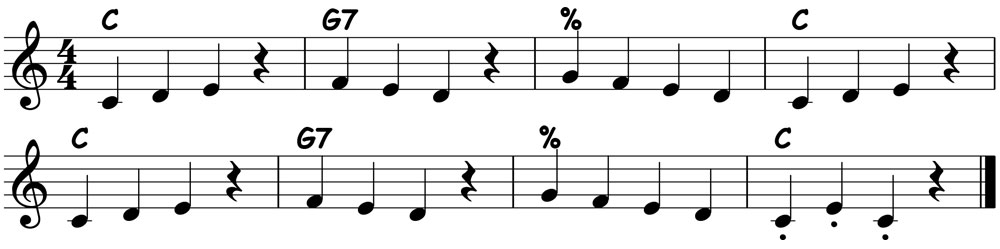
Here’s a simple song composed by Frank that will be used as the basis for case study of common practice composition ideas…
back to… Table of Contents
Reading the Lead Sheet
Music Composition requires musical literacy–the ability to read music as more than just a sequence of meaningless symbols and dots on a page. Reading music like a musician requires that we deeply understand how a piece is structured in at least four way: Key Center & Tonality, Meter, Form & Melody, and Form & Harmony.
Key Center & Tonality
At lest five things tell us that this piece is in the key of C Major: 1) The key signature has no sharps or flats, 2) The song starts and ends on a C Major Triad, 3) The melody emphasizes the notes in a C Major Triad (C, E, G), 4) The melody starts and ends on the note C, and 5) The note C sounds and feels stable and resolved…

Play and sing the melody out loud to see if your ears agree with the analysis…
Meter
The time signature (4/4) indicates that each quarter note receives one beat, creating an underlying feeling of four-ness in each measure…
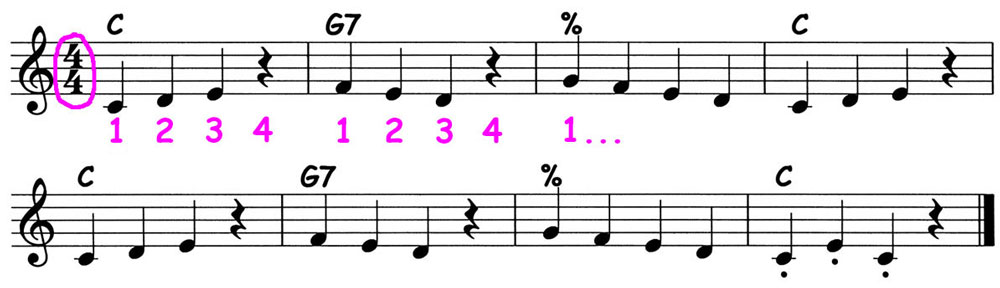
Count out loud as you play in order to deeply internalize the feel…
Form & Melody
The form is eight bars long, and the melody is broken into two almost identical 4-bar Phrases. The only difference between the two phrases is the last three notes (more on this in the next lesson)…
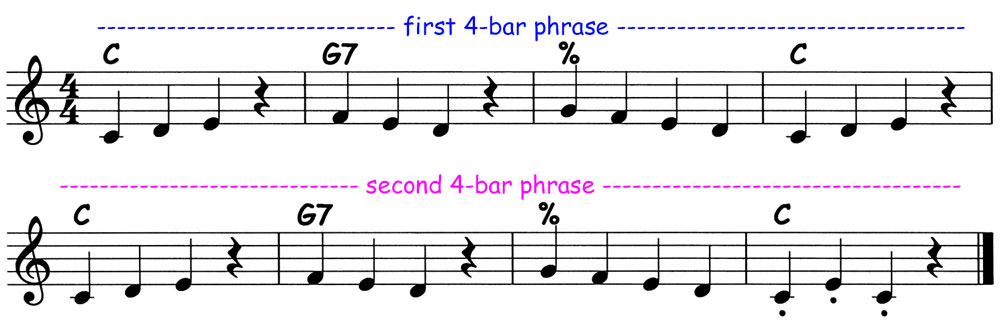
Play and sing along to internalize the idea that the melody in this 8-bar piece consists of two coherent and interrelated 4-bar phrases…
Form & Harmony
The C chord establishes the home key and major-ness of the piece and the G7 chord provides harmonic tension that craves resolution back to the C chord in two harmonically identical four-bar phrases.

Sing and play the melody while playing a C chord and G7 chord in your left hand–feeling how the harmonic tension is created and then released in each four-bar phrase…
back to… Table of Contents
Melodic Analysis
A key to understanding music composition to to realize that a pleasing and memorable melody is never some random sequence of pitches…
In this lesson, we are going to explore five musical elements that work together to make any good melody tick: Solfege, phrase length, melodic contour, rhythm, and harmonic outlining.
Solfege
Let’s use Solfege to analyze our C Major melody in functional melodic-harmonic terms…

One way to hear and feel the melodic-harmonic function of each note is to play and sing the Solfege syllables out loud.
As you play and sing, notice the following:
- C(Do) establishes the key center.
- E(Mi) establishes the major-ness of the piece.
- D(Re) creates melodic and harmonic tension.
- G(So) is common to both chords.
- E(Mi) in bar 4 leaves the melody “hanging”.
- C(Do) in bar 8 is a full resolution of the melody.
[would anyone like Frank sing and explain the above in an audio file?]
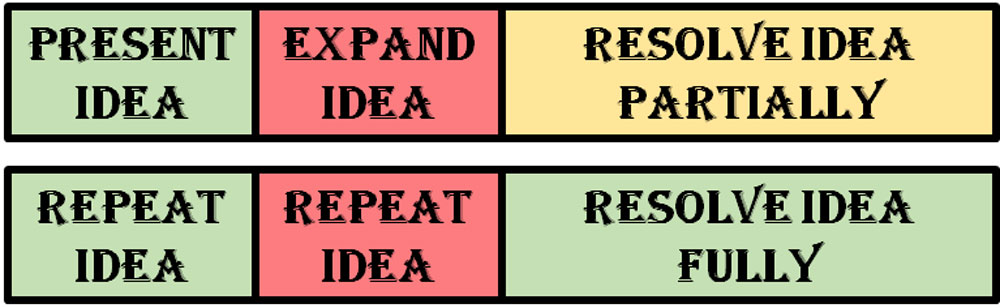
It also critically important to zoom out and profoundly understand what’s happening here, because it illustrates a standard 8-bar formula used in countless classical, ragtime, jazz, country, and pop melodies where bar 1 presents an idea, bar 2 expands the idea, bars 3 & 4 partially resolve the idea, bar 5 repeats bar 1, bar 6 repeats bar 2, and bars 7 & 8 resolve fully resolved the idea…
Phrase Length
The entire form is eight bars long, which consists of two rhythmically and harmonically identical 4-bar phrases (purple), which are further subdivided into two 2-bar sub-phrases (green). One might go one step deeper to include two similar 1-bar sub-sub-phrases (red)…

Melodic Contour

The ability to think, hear, and feel a melody as having a shape–a contour that can be expressed as a sequence of doodled lines–is crucial to our comprehension as music readers and fluency as improvisers. The lengths, rises and falls, and starts and stops of these doodled lines is an appropriate way to organize our melodic thoughts because these contours create directional expectations in the listener’s ear.
Listen to Frank “sing the doodles”…
Rhythm
Rhythm is no less important than the notes. Rhythm is a powerful organizing force because it creates an expectation in the listener’s ear about what will happen in the future… expectations that can be met or pleasantly surprised.
Don’t just read the following. Scat by saying “duh, duh, duh -” or in order to feel the rhythmic “glue” that gives this melody coherence…

Let’s count and feel the meter by hand clapping while “playing” the rhythm with our voices…
Harmonic Outlining
Time and time again, you are going to discover that it’s impossible to talk about melody without a deep understanding of harmony.
To illustrate the point, here’s our melody with the chord tones in the melody circled…

and notice three things:
- 19 of the 26 notes are chord tones!
- Most of the chord tones fall on strong beats (1&3)!
- The non-chord tones fall on weak beats (2&4)!
This illustrates how melody, harmony, and meter are intimately related and highlights a powerful organizing pattern in all kinds of music: the importance of outlining the harmony by playing chord tones on strong beats. (This is not an unbendable rule, but
Let’s mess around by playing the chords and singing the melody to hear and feel how they work together…
Conceiving music in the large scale structures above is essential for meaningful composition, improvisation, and the artistic interpretation of written music.
Always “think”, hear, and feel in meaningful, coherent phrases–not just individual notes. Individual notes matter, but they matter only within the larger context.
Scale-wise conceptions of melody are typically too limited and restrictive. It is far more appropriate to conceive of melodies in harmonic terms. And so, knowing the chords helps you understand what makes the melody tick.
back to… Table of Contents
Harmonic Analysis
When it comes to music composition, the importance of deep harmonic comprehension and harmonic ear training cannot be overstated!
Such understanding knows which chords establish the key and tonality, which chords create tension, and where each chord belongs in the overall form.
So, let’s strip away the melody from our lead sheet and play the harmony as simple block chords in the right hand and a single bass note in the left hand…

Absorb the general sound/feeling of each chord and notice that…
- The C (I) chord establishes the home key and major-ness of the piece.
- The G7 (V7) chord creates harmonic tension that craves resolution back to the C chord.
Conceived graphically, the harmonic structure functions like this…

… a bread & butter pattern that you will see time and time again in almost every kind of music!
Solfege Ear Training
It is not enough to merely listen. If you want internalize these sound-feelings, you must SING OUT LOUD! Sing the bass notes, individual chord voices, and arpeggios–slowly enough for the unique sound-feeling of each note to seep into your mind’s ear…
Sing the Bass Notes…
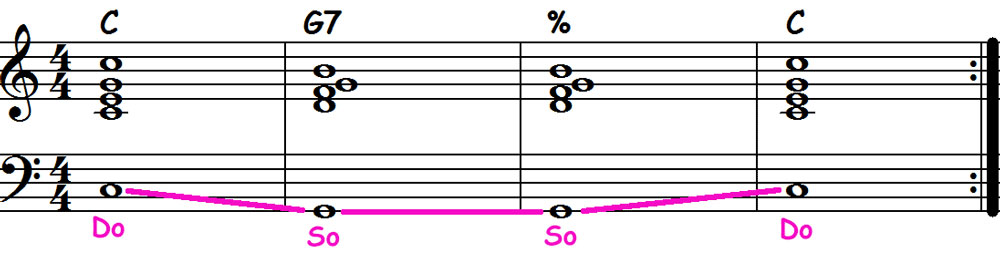
Listen to Frank model how you might sing this…
Do you hear and feel the harmonic tension created by G(So) and how G(So) wants to resolve back to C(Do)?
Sing the “Do-Re-Do” Voice…
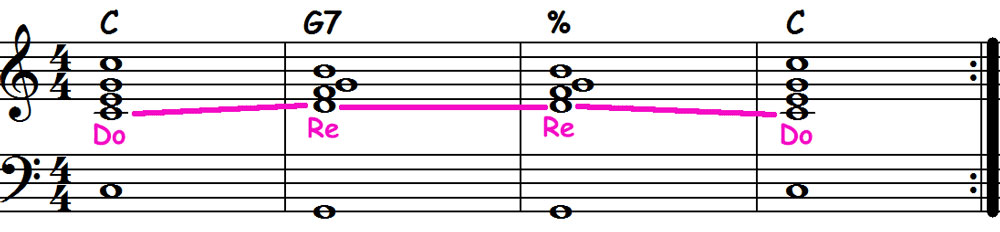
Listen to Frank model how you might sing this…
Do you hear and feel the harmonic tension created by D(Re) and the strong harmonic attraction that D(Re) has to go back to C(Do)?
Sing the “Mi-Fa-Mi” Voice…

Listen to Frank model how you might sing this…
Do you hear and feel the harmonic tension created by F(Fa) and the strong harmonic attraction that F(Fa) has for E(Mi)? The resolution of this tension makes the V7-I chord progression very powerful indeed.
Sing the “So-So-So” Voice…

Listen to Frank model how you might sing this…
Notice that this inner voice G(So) is common to both chords and does not need to go anywhere.
Sing the “Do-Ti-Do” Voice…
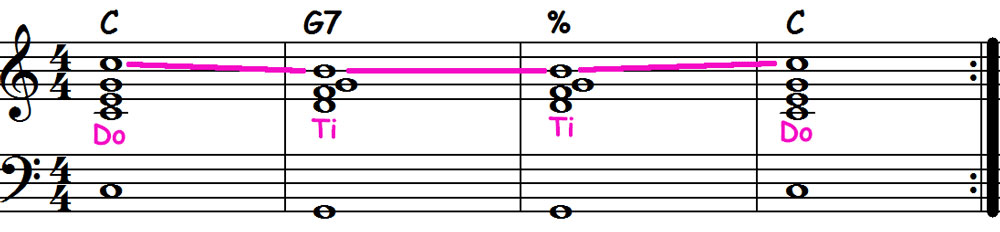
Listen to Frank model how you might sing this…
Do you hear and feel the harmonic tension created by B(Ti) and the irresistible pull of B(Ti) back to C (Do)? This tension and resolution really makes this chord progression tick.
Sing the Chords as Arpeggios…

Listen to Frank model how you might sing this…
Note: It’s okay if you hear the intervals between notes, but the goal here is to internalize the unique sound-feeling each solfege syllable with respect to the key center Do!
Studying the harmony and doing Solfege ear training this way lays a solid foundation for thinking about and experiencing the harmonic canvas on which we are going to paint with sounds and rhythms in all the articles that follow!
back to… Table of Contents
Block Chord Accompaniment
A simple, but extremely effective music composition idea is to define the harmony by playing sustained block chords in your left hand!
Here’ one possible rendition: Root-3 for the tonic chord and root-3-7 for the dominant 7th chord…

back to… Table of Contents
Chord Root Accompaniment
A simple, but effective music composition idea is to play the root of each chord in your left hand on every beat!
Here’s one possible rendition with a staccato articulation…

back to… Table of Contents
Alberti Bass
A simple, but beautiful music composition idea it to accompany the original melody with an Alberti Bass in your left hand!
Doing so clearly outlines the harmony while keeping the time flowing…

back to… Table of Contents
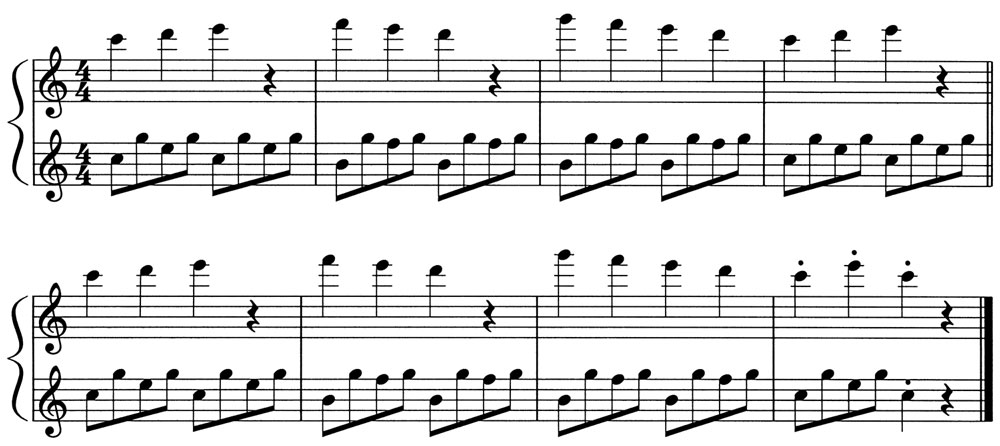
Change of Register
A simple music composition idea is to change the register, a very effective way to change the mood of a piece!
Let’s move everything up two octaves and notice how playing in a higher register gives everything a very sweet, tinkling music box sound.
back to… Table of Contents
Change of Articulation
Music composition idea: Changing the articulation of the notes is a simple, yet highly effective way to change the mood of a piece!
For example, playing the entire melody staccato rather than legato gives it a light and playful quality…
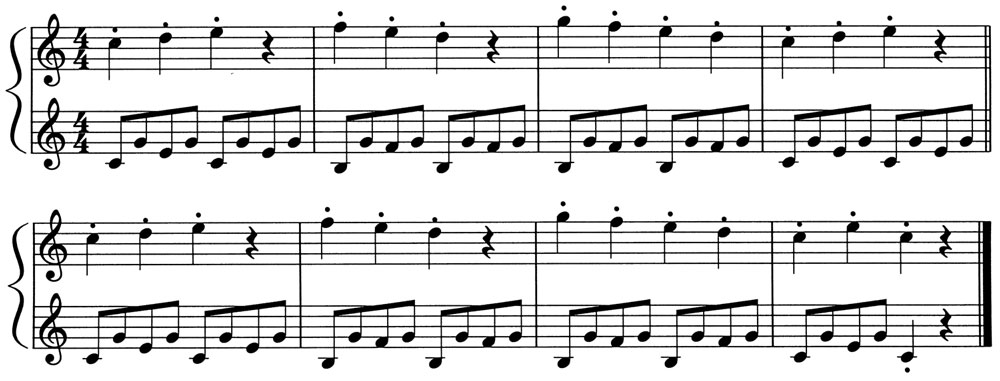
Change of Tonality
A bread and butter music composition idea is to change the tonality–commonly from a major key to it’s parallel minor key!
Notice how changing the C major chord (I) to a C minor chord (i) this instantly transforms our piece from bright and happy to dark and sad…

- The major-ness or minor-ness of any music is all about the third of the tonic chord.
- In the Key of C, E(Mi) makes things major and Eb (Me) make things minor.
- Notice that the dominant G7 chord is the same for both the major and minor tonality.
- The note B is the leading tone which is the same whether the tonality is C major or C minor.
- Because the key signature of C minor includes B flat, an accidental (in this case the natural symbol) is needed to make it the leading tone B natural.
back to… Table of Contents
Shift the Melody
A common music composition idea is to keep the same melodic contour and rhythm but to shift the melody to start on the next higher chord tone!
Notice how both the melodic contour and rhythmic motives act as glue that securely connects this new idea to the original melody…
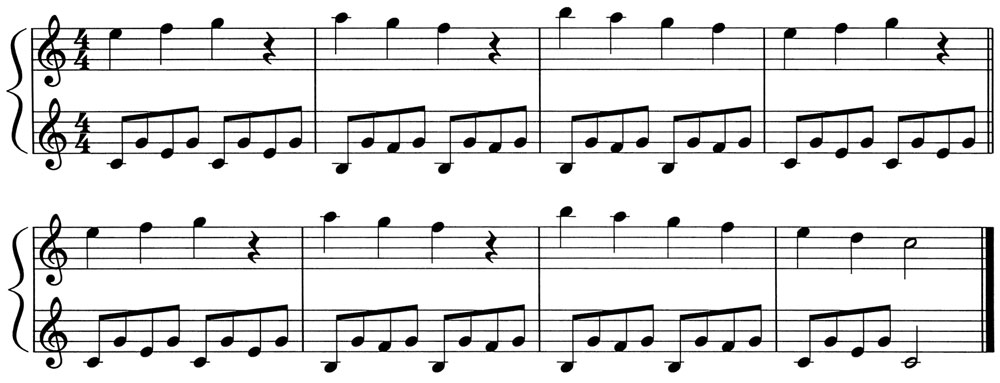
Notice that all the melody notes that fall on strong beats (1 & 3) are chord tones! This is no accident. Chord tones on strong beats is the most basic way that strong melodies are created.
back to… Table of Contents
Change of Meter
Another super simple, yet effective music composition idea is to change the meter / time signature!
In our case, let’s change the time signature from 4/4 to 3/4–and notice the lovely lilt that three-ness gives to the piece…

Notice the rhythmic adjustments that need to be made in the melody and accompaniment in order to accommodate the missing beat.
back to… Table of Contents
Chord Tone Melody
A greatly underrated music composition idea is to create melodies using nothing but chord tones in quarter notes!
Notice how we preserved the basic phrase structure of the original melody. Also notice that this frees the left hand from having to carry the harmony all by itself…
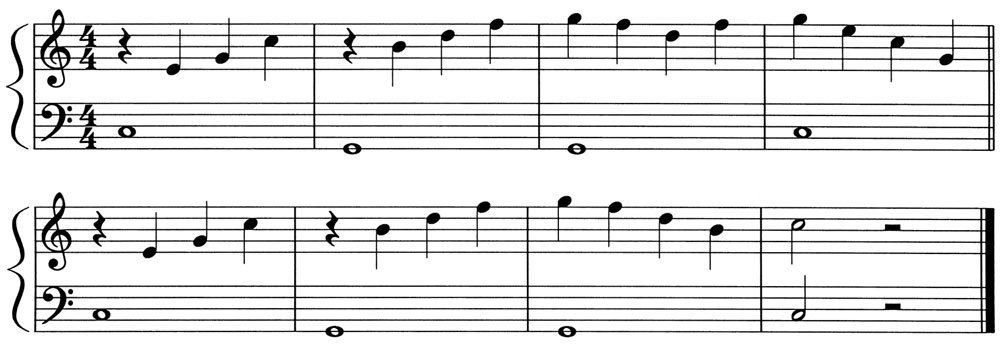
back to… Table of Contents
Scale Tone Melody
Music Composition Idea: Play two-bar phrases based on a flowing line of Scales Tones that outline the harmony and connect each chord…
It’s critically important to notice that you cannot just play scale tone willy-nilly. The placement of the scale tones with respect to both the meter and the chord changes is absolutely critical to playing lines that make sense…

Although we’re calling this a scale tone melody, it’s a lot more than just playing scales willy-nilly.
At least four structural elements–elements you will see time and again in all kinds of music–give this scale-wise melody a sense of unity and musicality:
- Each 2-bar phrase uses the exact same rhythm motive.
- At least half of the scale tones are also chord tones.
- Important chord tones fall on the first (strongest) beat in each measure.
- Each line of 1/8th notes crosses over the bar line and ends on the most definitive tone (the 3) of the next chord and on the strongest beat to boot.
back to… Table of Contents
Suspension
Composition idea: Add melodic and harmonic interest by delaying the expected chord tone resolutions!
This device, called suspension, occurs when you temporarily sustain a harmonic tension tone before resolving it to a chord tone.
In this example, hear and feel the delicious tension and release in bar 4, where Fa keeps the harmonic tension going before resolving to Mi and in bar 8, where Ti keeps the harmonic tension going before resolving to Do…
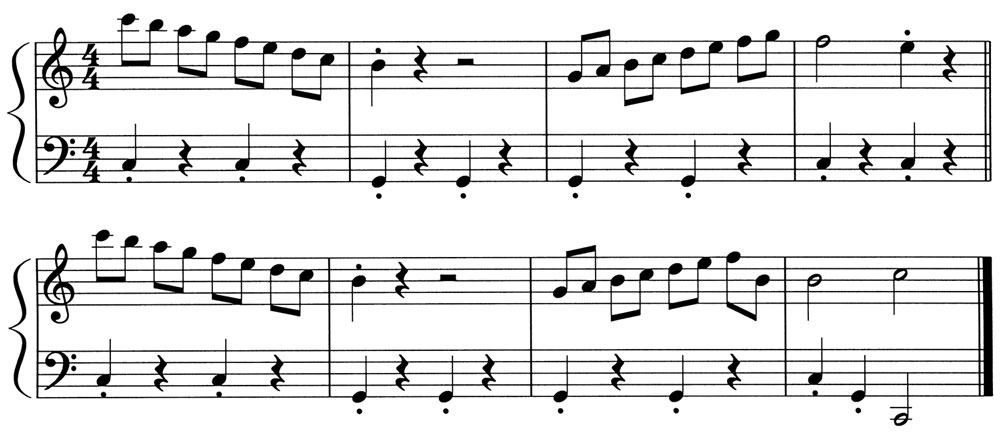
- Think of suspensions as a teasing little musical surprises.
- The commonly used suspensions and their resolutions (using chord structure numbers) are 4 to 3, 2 to 3, 6 to 5, 2 to 1, 7 to 1, and b3 to 3.
- The suspended note is typically played on a strong beat, which really emphasizes the harmonic tension… and which makes the harmonic resolution that much more satisfying.
back to… Table of Contents
Left Hand Melody
Music Composition Idea: Let your left hand play a melody while your right hand carries the harmony!
Here is a simple chord tone melody in the left hand with block chord accompaniment in the right…

- Notice the rhythmic interplay between the left and right hands: Left hand melody notes on strong beats alternating with right hand chords on weak beats.
- Also notice the symmetry of the bass line: a rising, then falling contour.
back to… Table of Contents
Harmonize Melody in 6ths
Music composition idea: Add both melodic and harmonic richness by harmonizing the melody in 6ths!

back to… Table of Contents
Divide each Beat into Triplets
Music composition idea: A simple, but effective way to add rhythmic interest is to subdivide each beat into triplets…
One way to do so is to outline the harmony and keep the time flowing by playing triplet arpeggios in your left hand…

back to… Table of Contents
Pedal Point
Music Composition Idea: Pedal Point is an easy and extremely to create harmonic tension and interest!
Pedal Point maintains a single note in the bass (typically Do or So) as the chords change above. In this case, it makes musical sense to play the tonic Do under both the I and V7 chords. Hear and feel the delicious harmonic tension created by playing Do rather than So as the bass note under the V7 chord…

back to… Table of Contents
Melodic Sequence
A bread and butter music composition idea is to play a sequence–a repeated pattern with a characteristic melodic shape and rhythm…
Notice how the chord tones typically fall on the strong beats…

back to… Table of Contents
Pickups
There is no rule that says that a song or chorus must begin on the first downbeat. A simple, yet highly effective music composition idea is to incorporate pickups in the melody!
Pickups are a great way to build melodic and rhythmic momentum and create a sense of anticipation of the upcoming chord changes as well as a way to play “through” the bar lines. The idea here is to play an ascending 3-note scale-wise line into a chord tone on the first downbeat in each measure…

- It’s important to think about, hear, and feel the chord tone as structural and the pickup as an embellishment.
- Understanding the difference between a structural element and its embellishment makes melody easy to understand, hear, perform, and remember.
back to… Table of Contents
Two-Handed Chord Melody
A clever music composition idea is to play a two-fisted melody consisting exclusively of chord tones played as alternating pairs in both hands…
Notice how much melodic material your can derive from the creative use of only chord tones…

Reading Tip: The music above is not nearly as complicated as it looks on the surface. Here is a “simplified” view of the underlying chord patterns, mostly blocks chords in an ascending and descending pattern…

back to… Table of Contents
Rhythmic Motives
A greatly underrated, but fundamental music composition idea is to play a simple, easy to remember Rhythmic Motive for each phrase…
Rhythm is an extremely powerful organizing force in music, oftentimes more so than the pitches!
Here’s a simple rhythmic motive “composed” by Frank, arguably just one of an infinite number of possible rhythm patterns…

Listen to Frank clap the meter as he scats the rhythm pattern…
It is crucial to think about and feel these rhythm patterns as entire phrases within the context of the overall form, not just “beat by beat” or “measure by measure”.
Here a possible rendition of the rhythm above using mostly chord tones. It is appropriate to think of this as simply “painting” the rhythm with chord tones…

back to… Table of Contents
Adding an Introduction
A common practice in music composition is to expand the basic form of the piece by adding an Introduction at the beginning…
… a few bars that create a sense of anticipation and establishes the mood before going into “the top” of the piece.
One commonly-used idea is simply to play the accompaniment until the melody arrives. Doing so clearly establishes the tonality, texture, and rhythmic flow…

back to… Table of Contents
Adding an Ending
It’s common practice to add a few bars at the end of the piece in order to signal a crisp and clear sense that the music is over…
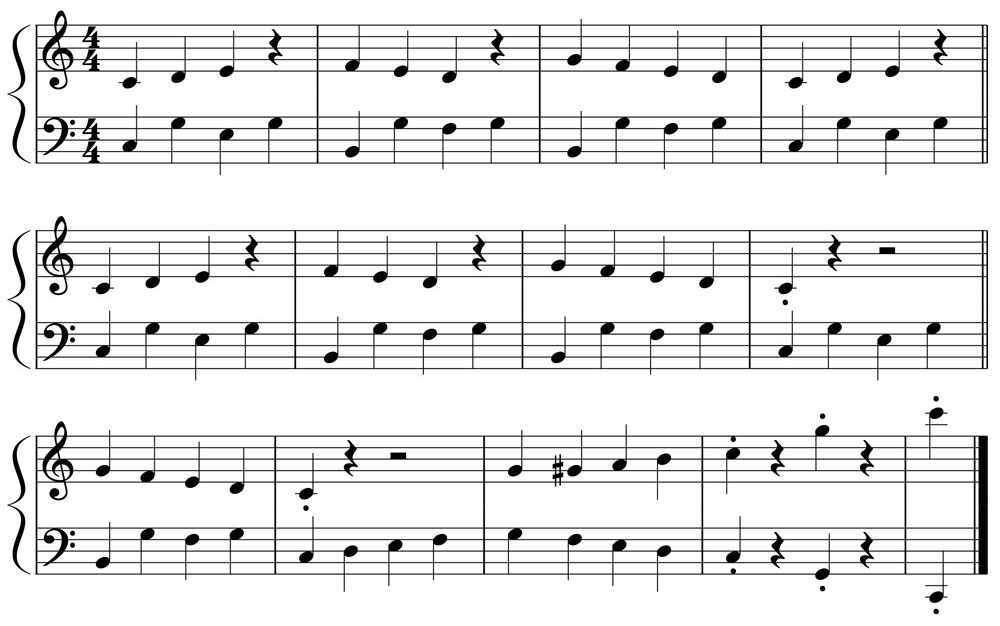
A standard way to accomplish this is to “turnaround” to the V7 chord and to postpone full resolution of the melody for a few more bars. Notice how the extra four bars fits with the established melodic, harmonic, and rhythmic flow of the piece…
This lesson brings us to end of the series on music composition. I hope it’s helped demystify the process of creating music and given you the confidence that you, too, have the power to make music–with the same joy of a curious child playing with musical building blocks!
back to… Table of Contents
learn more… Music Composition
Discover more from PIANO-OLOGY
Subscribe to get the latest posts sent to your email.
This appeals to me lots…since one year I have been playing the Native American flute and have just started to improvise from the heart with it…so this comes in handy in more ways than one.
Wow, Paula! You have quite the diverse artistic life going! Stay tuned for some [hopefully] very insightful composition and improv lessons!
Thank you for your wonderful lessons!!!
Your positive feedback means more to me than I can ever express in words, Sandra. All the best to you in music and life!