Lesson Goal: To understand the concept of chord function and to start using Roman Numeral Analysis…
Table of Contents
Prerequisites
Basic music reading skills… the LOVE of music… and the discipline to study and practice.
back to… Table of Contents
Benefits of Learning Roman Numeral Analysis
The time and energy spent studying and practicing Chord Progressions in functional terms…
- Elevates your music reading from “painting-by-number” to deep understanding.
- Facilitates “memorization” when building your repertoire.
- Sharpens your visuospatial awareness of the keyboard.
- Transforms your aural comprehension when you listen to music.
- Expands your ability to play by ear.
- Broadens your chord progression vocabulary for composition and improvisation.
- Enables you to transpose music like a pro.
And as your network of harmonic understanding grows, you will discover that many pieces that seem very complex on the surface are based on very simple harmonic ideas. And you will come to appreciate both the simplicity and creative genius behind the music you have come to love.
back to… Table of Contents
Chord Progressions & Chord Functions
A Chord Progression is a sequence of chords that achieve a larger-scale harmonic purpose than can be achieved by a single chord alone.
Such harmonic purposes include:
- Establishing a key center.
- Establishing a tonality.
- Building harmonic tension.
- Releasing harmonic tension.
- Creating a sense of forward motion and anticipation.
- Changing the mood.
- Introducing tonal ambiguity.
- Changing key center.
There are two broad classes of Chord Function:
- Chords that establish the key center and tonality (major, minor, mixolydian, dorian, blues, etc).
- Chords that create or expand harmonic motion or tension.
Here, for example, is a commonly-used chord progression in the key of C…
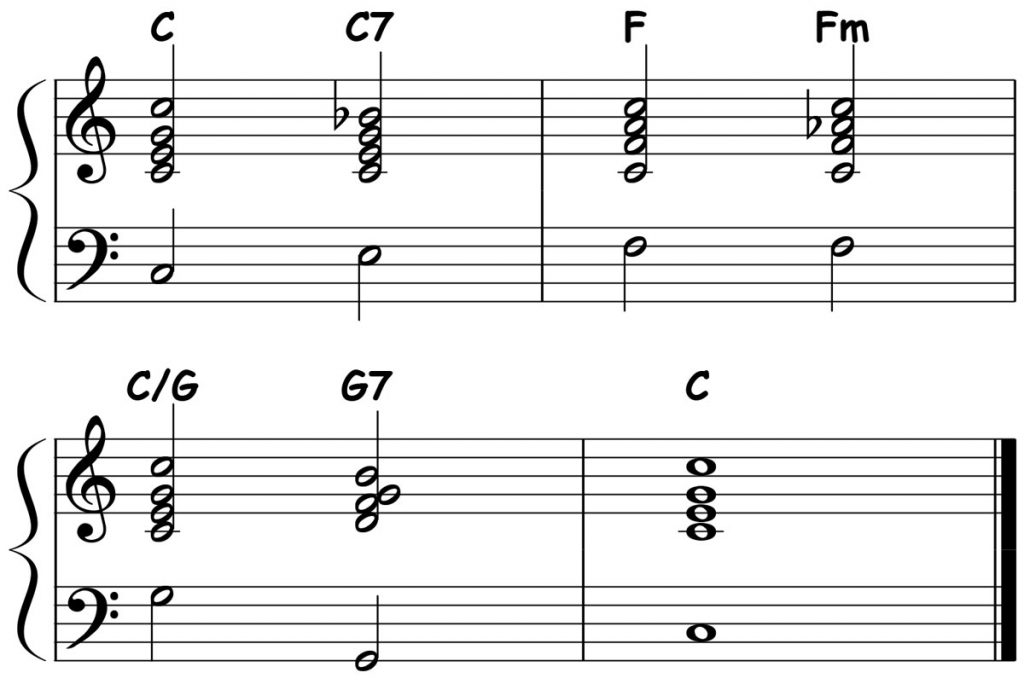
Listen and notice four things:
- The first C chord establishes the key center C and major-ness of the piece.
- The chords that follow create a chain of harmonic motion that leads naturally from one chord to the next.
- Each chord has a unique sound-feeling, a unique harmonic tension with respect to the key center C.
- The harmonic motion is eventually resolved with the final C chord.
This analysis is more than mere “theory”. It captures the organic essence of how humans naturally experience and enjoy music. Don’t fuss about the details right now. It is sufficient to understand that chord progressions create forward motion and typically follow logical paths based on a small number of simple formulas for creating, then resolving, harmonic tension.
back to… Table of Contents
Roman Numeral Analysis
A common practice for describing chords in functional harmonic terms is to analyze and name them using Roman Numerals.
The Roman Numeral naming convention works like this…
- Chords are named using the MAJOR SCALE as the point of reference.
- Each chord is assigned a number based on which note the root of the chord falls along the scale degrees of the major scale.
- Major chords use upper-case Roman Numerals.
- Minor chords use lower-case Roman Numerals.
- Diminished Chords use lower-case Roman Numerals with a “degrees” symbol (°) immediately following.
- Note: Other chord types are possible and will be discussed as they arise in context.
Roman Numeral Analysis for the C Major Scale
All seven diatonic (within the key signature) triads of the C Major scale named using Roman Numeral notation (scale degrees shown in the bass)…

In major keys, the I chord establishes both the tonic note and major-ness of the key, while all of the other chords create unique tensions with respect to that key center.
Roman Numeral Analysis for the C Natural Minor Scale
All seven diatonic (within the key signature) triads of the C Natural Minor scale named using Roman Numeral notation (scale degrees shown in the bass)…

In minor keys, the i chord establishes both the tonic note and minor-ness of the key, while all of the other chords create unique tensions with respect to that key center.
There are other tonalities besides major and natural minor. These include Harmonic Minor, Mixolydian, Dorian, Blues, etc)… as well as many other kinds of chords (seventh chords, suspensions, etc) and chord functions (secondary dominants, borrowed chords). It may seem like a lot know, but don’t despair. It will all become as you study real chord changes in context. For the moment it is enough to understand the Roman Numeral Analysis naming conventions and to start thinking about chords in functional terms.
learn more… Diatonic Triads, All Major Keys (RNA)
Discover more from PIANO-OLOGY
Subscribe to get the latest posts sent to your email.
Very useful website. Thanks a lot. The website contains a lot of helpful information. Thanks once again.
Thanks so much for the words of appreciation, Kumaresh. Your positive feedback really means a lot.