Lesson Goal: To quickly internalize some bread and butter Slow Triple-Feel Blues Piano Comping patterns… by ear, intellect, eye, and muscle…
Table of Contents
Prerequisites
Basic music reading skills… basic scale, chord, and chord progression theory… basic technique… the LOVE of music… and the discipline to study and practice.
back to… Table of Contents
Study, Practice, & Performance Tips
- All of this might sound like a lot of work, but it’s not nearly as much as you think. Because even though it takes time to talk about all these things, in practice they can all be done simultaneously!
- Your goal is not to merely memorize this, but to study and practice it until you internalize it using all four musical intelligences: ears, intellect, eyes, and muscles.
- Every time you practice something, you are programming your brain. So always play accurately.
- Practice with a Click Track or a Rhythm Track. Doing so will give you immediate feedback on any rhythmic misconceptions or places where your timing gets sloppy.
- Record Yourself. Always. Listen to the playback immediately. And ask yourself: Is that what you intended to play?”
- If anything feels tense or awkward, stop immediately and experiment with alternative fingerings or choreography.
- Play this in other keys you expect to play in. By the way, once you see the patterns (which is guaranteed if you know your scales and chords) finding the notes in other keys will be a piece of cake!
- If you feel stuck or overwhelmed, realize that anything can and will be mastered if you slow things down or break things down to small enough pieces.
back to… Table of Contents
How to Count and Feel Slow Triple-Feel Blues Meter
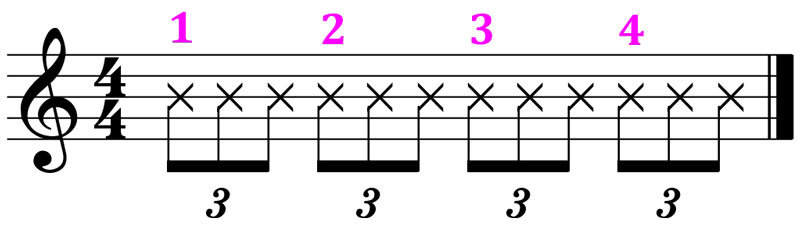
A defining feature of slow triple-feel blues meter is the feeling of four beats at the top level combined with a laid-back “three-ness” inside every one of those four beats…
This can notated in 4/4 time as follows…
It can also be notated in 12/8 time as follows…
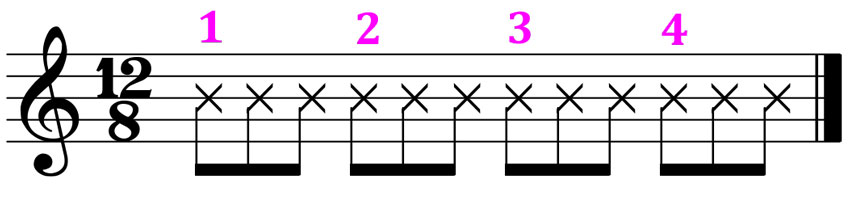
No matter how one prefers to notate the meter, the key point is that the overall feeling of “four-ness” at the top level is combined with a laid-back but relentless triplets embedded within each of those four beats.
Sidebar: Instead of counting the rhythm using numbers, a much more effective and musical way to internalize the meter is to “scat” the way it feels using easy to vocalize syllables.
For example, instead of counting “ONE-2-3-TWO-23-THREE-23-FOUR-23…” or “1 & a 2 & a 3 & a 4 & a…” trying scatting’ Boo-pi-dee-Bah-pa-dee-Bi-pa-de-Bah-pa-dee…”
Any interestin hearing Frank demonstrate one way to do this? (FYI, nobody has asked yet) [insert audio?]
back to… Table of Contents
Slow Blues Piano Comping Pattern #1
This slow triple-feel blues piano comping pattern consists of “the 1-3-5-6 thing” in the left hand with the definitive tones (3 & b7) of each of the big 3 chords in the right…
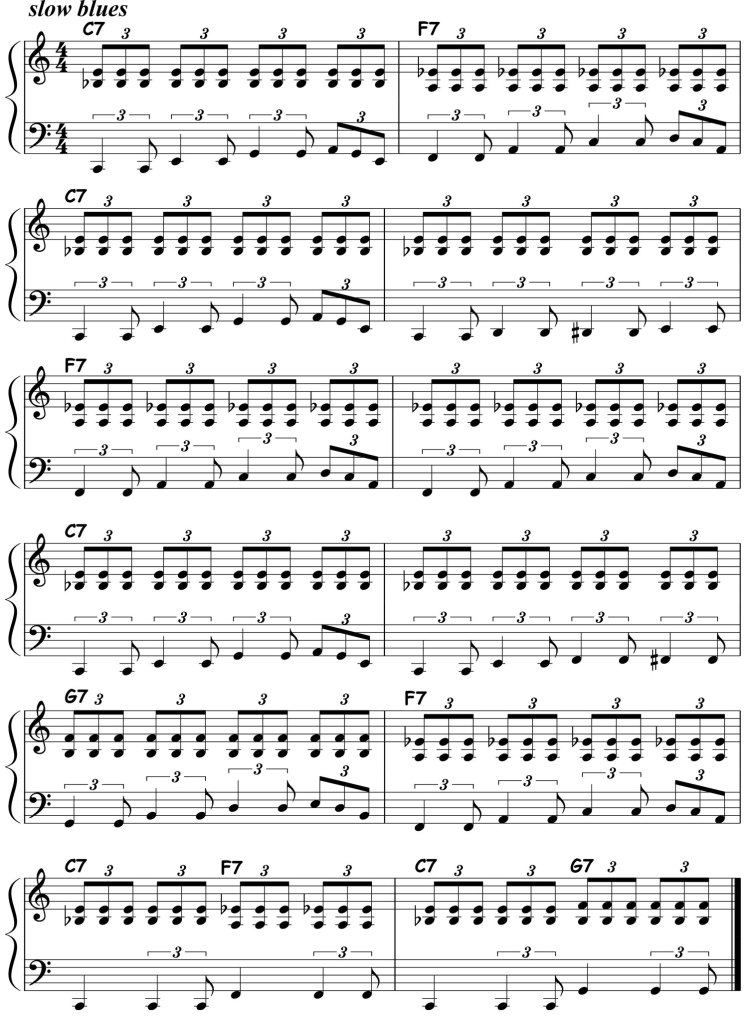
Hint: Don’t be in a hurry and don’t try to force the rhythm. Simply allow the triplets (which you hear and feel as the relentless Tik-tik-tik Tik-tik-tik Tik-tik-tik Tik-tik-tik on the hi-hats) to take both hands along for a super chill stroll…
back to… Table of Contents
Slow Blues Piano Comping Pattern #2
This slow triple-feel blues piano comping pattern consists of broken triads in the left hand and Mixolydian triads with neighbor and passing chords in the right…

Hint: Don’t be in a hurry and don’t try to force the rhythm. Simply allow the triplets (which you hear and feel as the relentless Tik-tik-tik Tik-tik-tik Tik-tik-tik Tik-tik-tik on the hi-hats) to take both hands along for a super chill stroll…
back to… Table of Contents
Slow Blues Piano Comping Pattern #3
This slow triple-feel blues piano comping pattern consists of chord roots in the left hand and “the 1-3-5, 1-4-6, 1-5-b7 thing” in the right.
In this rendition each note is given it’s full value by the liberal use of the sustain pedal on each chord change…

Hint: Don’t be in a hurry and don’t try to force the rhythm. Simply allow the triplets (which you hear and feel as the relentless Tik-tik-tik Tik-tik-tik Tik-tik-tik Tik-tik-tik on the hi-hats) to take both hands along for a super chill stroll…
In this rendition, the notes are identical, but a rest (breath) is inserted in the middle of each triplet, creating a more open sound and crisper rhythm…

Hint: Don’t try to play the note and rest durations exactly as written. Let your mood, the tempo, and the style of your playing partners decide how you want the music to sound and feel!
back to… Table of Contents
Slow Blues Piano Comping Pattern #4
This slow triple-feel blues piano comping pattern consists of “the 1-3, 4-6, 5-b7 thing” in the right with the two definitive grace notes (b3>3, b5>5) and the “1-5, 1-6, 1-b7 thing” in the left…

Hint: Don’t be in a hurry and don’t try to force the rhythm. Simply allow the triplets (which you hear and feel as the relentless Tik-tik-tik Tik-tik-tik Tik-tik-tik Tik-tik-tik on the hi-hats) to take both hands along for a super chill stroll.
back to… Table of Contents
learn more… Blues Piano Lessons