Bread and butter Boogie Woogie Comping Styles to add to your bag… by ear, intellect, eye, and muscle…
Table of Contents
Lesson Goals
To quickly internalize some bread and butter Boogie Woogie Comping Styles… by ear, intellect, eye, and muscle.
Prerequisites
Basic music reading skills… basic scale, chord, and chord progression theory… basic technique… the LOVE of music… and the discipline to study and practice.
Study, Practice, & Performance Tips
- All of this might sound like a lot of work, but it’s not nearly as much as you think. Because even though it takes time to talk about all these things, in practice they can all be done simultaneously!
- Your goal is not to merely memorize this, but to study and practice it until you internalize it using all four musical intelligences: ears, intellect, eyes, and muscles.
- Every time you practice something, you are programming your brain. So always play accurately.
- Practice with a Click Track or a Rhythm Track. Doing so will give you immediate feedback on any rhythmic misconceptions or places where your timing gets sloppy.
- Record Yourself. Always. Listen to the playback immediately. And ask yourself: Is that what you intended to play?”
- If anything feels tense or awkward, stop immediately and experiment with alternative fingerings or choreography.
- Play this in other keys you expect to play in. By the way, once you see the patterns (which is guaranteed if you know your scales and chords) finding the notes in other keys will be a piece of cake!
- If you feel stuck or overwhelmed, realize that anything can and will be mastered if you slow things down or break things down to small enough pieces.
back to… Table of Contents
Boogie Woogie Piano Comping Pattern #1
This boogie woogie piano pattern consists of the “double chop” in the left hand with the “the b3 resolved to 3 thing” and “1-3-5>1-4-6 thing” in the right…

Practice & Performance Tips
- Don’t forget to swing the 1/8th notes.
- How much “swing” can be anywhere between straight 1/8th and a shuffle, depending on the tempo, your mood, and the groove you want to establish.
- Once you establish a groove and your phrasing, stay with it!
- The rhythm is embedded primarily in your arm choreography.
- Don’t be shy. Play like you mean it!
- Don’t try to play legato. Play each note slightly disconnected with a wee bit of percusiveness.
- Don’t try to count or force the in-between notes. Just let them fall naturally into the groove.
- The 1/8th note rests are as important as the notes.
- No flams!!! Make sure both hands are perfectly synchronized… as if you have a giant ten finger hand!
back to… Table of Contents
Boogie Woogie Piano Comping Pattern #2
This boogie woogie piano comping pattern consists of a bouncing 1-1-b3-3-5-5-6-5 in the left hand with right hand chord voicings you already know…

Practice & Performance Tips
- Don’t forget to swing the 1/8th notes.
- The rhythm and technique is primary embedded in your arm motions.
- Never stop moving, especially in between the notes.
- It’s crucial to keep the rhythm flowing across each bar line and to hit the first beat in each bar with conviction.
back to… Table of Contents
Boogie Woogie Piano Comping Pattern #3
This boogie woogie piano comping pattern consists of a double chop 1-5>1-5>b3-3 thing in the left hand with syncopated chord voicings you already know in the right…
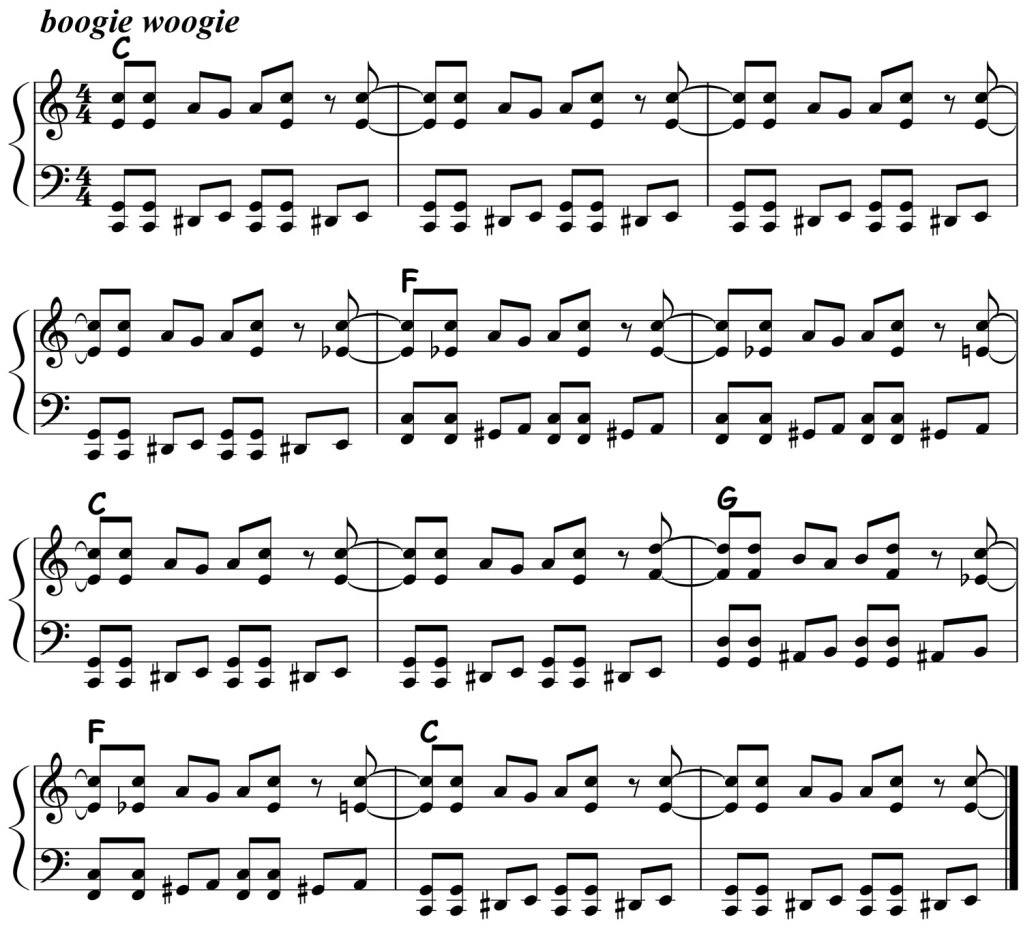
Practice & Performance Tips
- Don’t forget to swing the 1/8th notes.
- Again, the rhythm is embedded mostly in your arm motions.
- Groove before flash!
- It’s crucial to keep the left hand pumping away and to keep the momentum going across each bar line.
back to… Table of Contents
Boogie Woogie Pattern #4, 5, 6, 7
This boogie woogie piano comping pattern… (Frank will produce more if there’s enough interest. Alas, nobody has asked for more. : (
learn more… Blues Piano Lessons