Five Finger Independence Studies expertly designed to develop independence and interdependence between the left and right sides of your mind-body…
Table of Contents
Lesson Goals
To test and develop independence and interdependence between the left and right sides of your mind-body… as well as expanded your mastery of rhythm, technique, dynamics, and articulation.
Prerequisites
Basic music reading skills… the LOVE of music… and the discipline to study and practice.
back to… Table of Contents
These are Studies, Not Exercises
This is so critically-important that it’s worth repeating: These are NOT EXERCISES. These are studies. Doing them properly will not make your muscles tired. Doing them properly will make your brain tired. Because progress is not a matter of changing your muscles, but of changing your brain. You will not improve by mindlessly repeating these over and over again with faulty thinking and poor technique hoping that things will magically improve. You can and will improve in leaps and bound by experimenting with different ways of using your brain and body until you feel something click.
back to… Table of Contents
Study & Practice Tips
- Play with a metronome or click track.
- Record yourself, listen to the playback, and ask yourself if that is what you intended to play.
- IF that is not what you intended to play, try a different choreography.
- This is not a race. If you feel overwhelmed, slow things down until you feel progress.
- These will seem very difficult, if not impossible at first, but don’t give up. You will master this if you persevere–guaranteed!
back to… Table of Contents
Technique Tips
- Physical & mental ease are inseparable.
- The ability to play these with freedom and ease is not about finger training; it’s about discovering a full-body choreography.
- The ability to play these is not just about independence of your left and right side; it’s also about interdependence, coordination, cooperation, and unification!
- Don’t try to keep time with your fingers. Allow your arms to lead and let your fingers go along for the ride.
- Move in natural curves, not in unnatural straight lines.
- Have some momentum going into each and every note.
- Chunk things by imagining you have one 10-finger hand, not two separate 5-finger hands.
- Keep time by singing what you intend to play–out loud or in your mind’s ear.
- If things feel stiff, count out loud 1 2 3 4 1 2 3 4 etc and make sure you are already preparing to play on the beat before.
- Legato = connected and played with the same tone quality.
- Staccato = short + disconnected.
- To play louder, think more downward speed at your fingertips; to play softer, think less downward speed of your fingertips.
- No flams! (make sure both hands play exactly together in time)
back to… Table of Contents
Five Finger Independence Studies
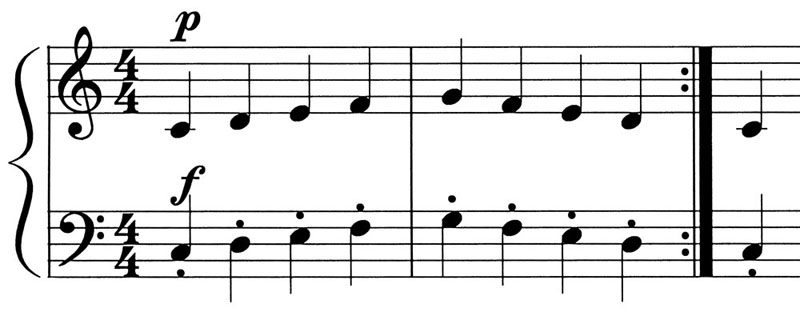
Each study uses the very same notes: a C Major Pentascale played in both hands in unison, but with the added challenge of playing thee notes using a variety of dynamics (soft, medium, loud) and articulations (Legato, Staccato) in every possible combination.
Both Hands Legato, Medium Loud
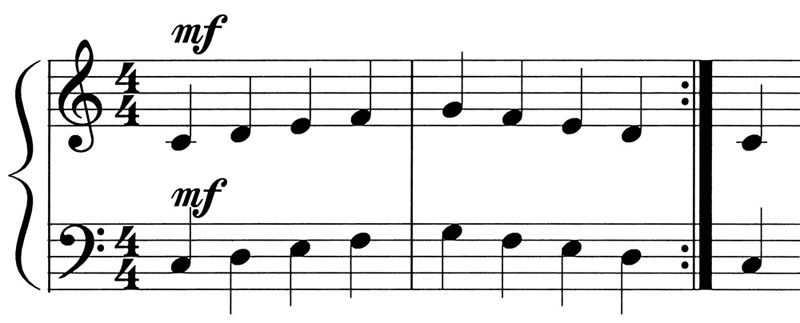
Both Hands Legato: LH Soft, RH Loud
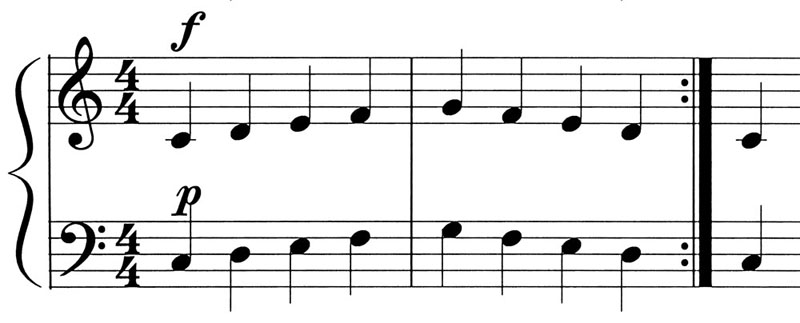
Both Hands Legato: LH Loud, RH Soft
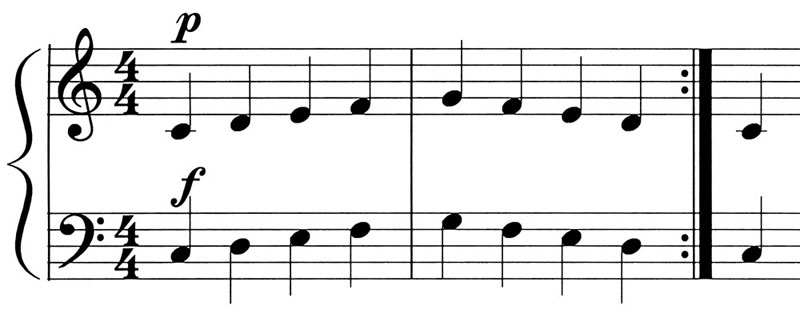
Both Hands Staccato/Medium Loud
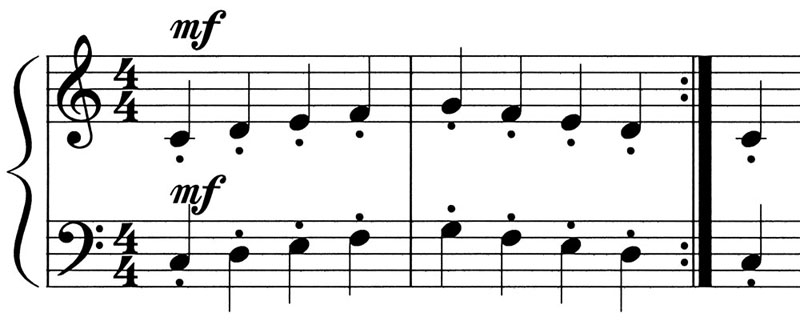
Both Hands Staccato: LH Soft, RH Loud
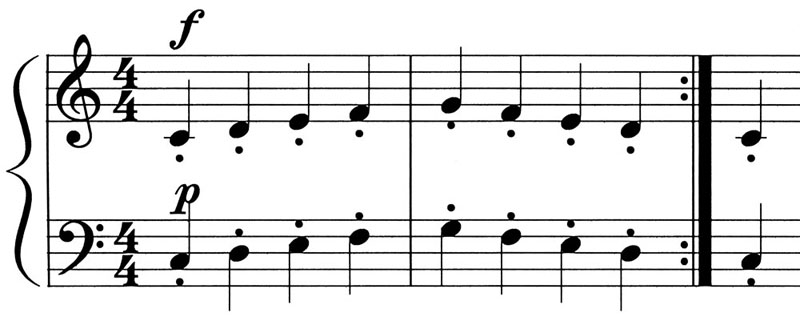
Both Hands Staccato: LH Loud, RH Soft

LH Legato, RH Staccato, both Medium Loud

LH Legato/Soft, RH Staccato/Loud

LH Legato/Loud, RH Staccato/Soft
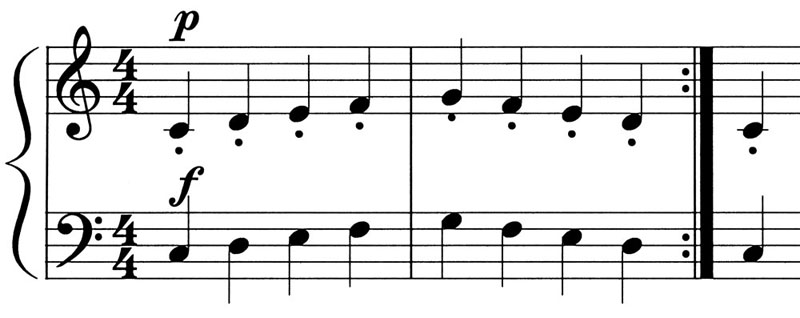
LH Staccato, RH Legato, both Medium Loud
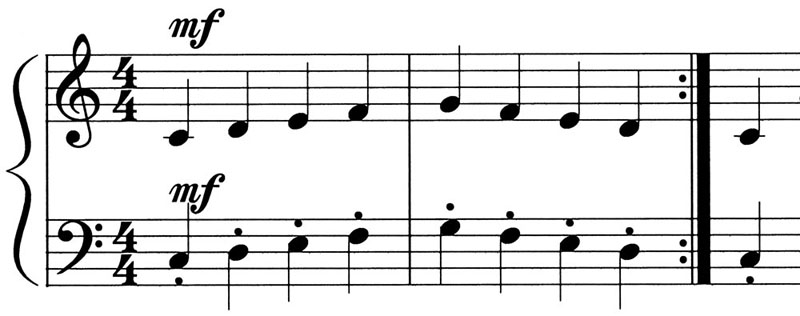
LH Staccato/Soft, RH Legato/Loud
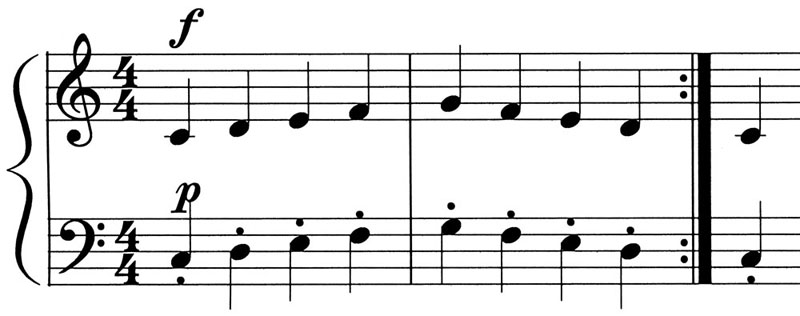
LH Staccato/Loud, Right Hand Legato/Soft
back to… Table of Contents
learn more… Piano Technique