Illuminating learn by doing studies in how to conceive of, internalize, and physically express the 1/4 Time Signature (1/4 Meter) like a musician…
Table of Contents
Lesson Goal
To deeply internalize 1/4 meter… in three ways: counting out loud, clapping your hands, and playing along.
Prerequisites
LOVE of music… and the discipline to study and practice the right things the right way.
1/4 Time Signature Study (Count Out Loud)
Lesson Goal: To read, think, and feel the 1/4 time signature by counting out loud with a metronome in 1/4, 1/8th, triplet 1/8th, and 1/16th notes…
How to Count 1/4 Meter in 1/4 Notes
Practice goals: To synchronize your counting with the metronome, to develop the sense that “1” feels like home, and to develop a feeling for beats smaller than quarter notes.

Listen to Frank model how to count this with a metronome @ 100 beats per minute…
Aim to count 8 bars at a time in one continuous breath without accenting any notes.
How to Count 1/4 Meter in 1/8th Notes
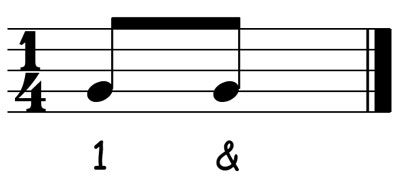
Listen to Frank model how to count this with a metronome @ 88 beats per minute…
It’s not enough to passively listen to these. In order to deeply internalize the rhythms, you must actively count out loud with a metronome.
How to Count 1/4 Meter in 1/8th Note Triplets

Listen to Frank model how to count this with a metronome @ 60 beats per minute…
Record yourself, listen to the playback immediately, and be absolutely honest about what you hear and feel.
How to Count 1/4 Meter in 1/16th Notes

Listen to Frank model how to count this with a metronome @ 60 beats per minute…
Practice Idea: Doing this while taking a walk–synchronizing your stride and counting aloud with the metronome (using a smartphone app).
back to… Table of Contents
1/4 Time Signature Study (Clap Your Hands)
Lesson Goal: To “think”, hear, feel, and express a regular pulse using both sides of your musical brain and body…
In this video, we’re going to internalize a repeating pulse by clapping our hands in our laps in a very disciplined way–in three different patterns–with the metronome at various tempos (from very slow to very fast), and while counting the meter out loud.
How to Do These Studies
- Play with a metronome. Doing so keeps you absolutely honest about when the pulses occur and what the tempo is. (because the metronome never lies.)
- Count the meter out loud. Doing so synchronizes your mental conception with your physical execution, keeps the time flowing in the otherwise silent and empty gap between clicks, helps you to anticipate when the next downbeat is coming, and transfers your sense of time from the outside of you (the metronome clicks) to the inside of you (your internal musical clock).
- Play at various tempos. From very slow to very fast. Doing so exposes any misconceptions in your sense of time and any imperfections in your technique. Frank suggests starting at 60 beats per minute, then working your way up to keep pushing your limits!
- Single source your intentions. The impulse that verbalizes the count should be the very same impulse that triggers the physical motion. Saying “1” and clapping are not two separate events that you try to synchronize. No. Saying “1” and your downward gesture should be a single unified events triggered by a single musical impulse.
- No flams. When your left and right side play together, they must play perfectly together, not one slightly before or after the other. This is closely related to the single source idea above. Perfect coordination between your left and right sides. Not two separate events that just happen to occur at the same time, but a single full body expression.
- Play with musical technique. Playing with good technique is impossible without a deep sense of rhythm that flows from you core outward. You’re on the right track when your arms and hands express the rhythm in cycles of natural, flowing motions that never stop. (see: Time Never Stops).
About the Lesson Design
Clap your hands in your lap along with a metronome at various tempos (suggested tempos: 60, 100, 140, up to 180 beats per minute) while counting the meter out loud (1 & 1 & 1 & 1 & 1 &…) in three musical patterns:
- Hands together on every downbeat.
- Downbeats left, upbeats right
- Downbeats right, upbeats left.
Pattern #1. Hands Together on Every Downbeat…
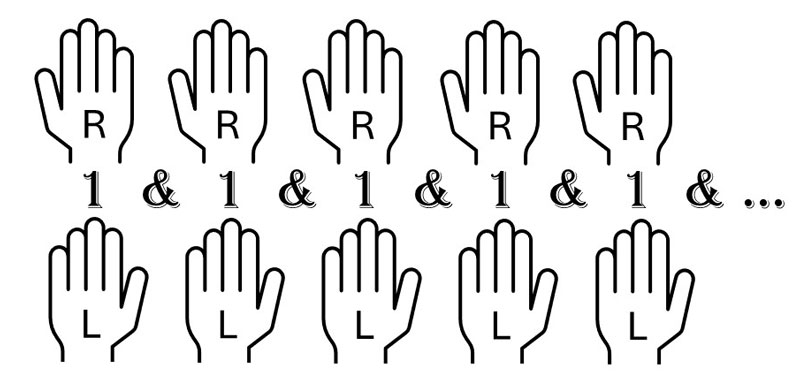
Any interest in stereo play along MP3s? (Frank will be happy to produce these to be played wearing headphones so that you can clearly hear and feel which side is playing when)
Pattern #2. Downbeats Left, Upbeats Right…
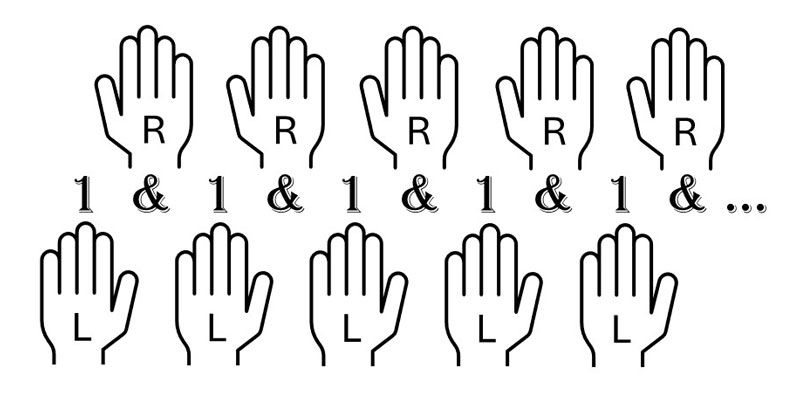
Pattern #3. Downbeats Right, Upbeats Left…

YouTube Video
Watch Frank model how to do this study…
back to… Table of Contents
1/4 Time Signature Study (Play Along)
Lesson Goal: To “think”, hear, feel, and express a regular pulse and to coordinate both sides of your brain and body…
Lesson Design: This is a play along study. The audio files (MP3s) here will make sense only if played in stereo (the left hand is panned left and right hand is panned right).
Pattern #1. Hands Together on Every Downbeat…

Listen to a sample @ 120 beats per minute…
Practice Idea: As you play along, experiment playing with different fingers, articulations, and choreographies!
Pattern #2. Downbeats Left, Upbeats Right…

Listen to a sample @ 120 beats per minute…
Pattern #3. Downbeats Right, Upbeats Left
Notice that this is a the mirror image of pattern #2…
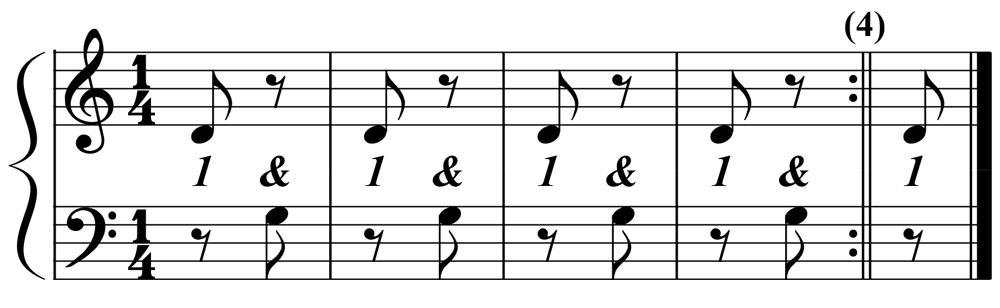
Listen to a sample @ 120 beats per minute…
back to… Table of Contents
learn more… Musical Time