Lesson Goal: To quickly internalize common practice harmonic and rhythmic elements that “jazzify” the Major 1 6 2 5 Chord Progression…
Table of Contents
Prerequisites
Basic music reading skills… basic scale, chord, and chord progression theory… basic technique… the LOVE of music… and the discipline to study and practice.
back to… Table of Contents
Study, Practice, & Performance Tips
- Never play mindlessly and mechanically. Always aspire to play musically.
- Your goal is not to merely memorize this, but to study and practice it until you internalize it using all four musical intelligences: ears, intellect, eyes, and muscles.
- Every time you practice something, you are programming your brain. So always play accurately.
- Practice with a Click Track or a Rhythm Track. Doing so will give you immediate feedback on any rhythmic misconceptions or places where your timing gets sloppy.
- Record Yourself. Always. Listen to the playback immediately. And ask yourself: Is that what you intended to play?”
- If anything feels tense or awkward, stop immediately and experiment with alternative fingerings or choreography.
- Play this in other keys you expect to play in. By the way, once you see the patterns (which is guaranteed if you know your scales and chords) finding the notes in other keys will be a piece of cake!
- If you feel stuck or overwhelmed, realize that anything can and will be mastered if you slow things down or break things down to small enough pieces.
- All of this might sound like a lot of work, but it’s not nearly as much as you think. Because even though it takes time to talk about all these things, in practice they can all be done simultaneously!
back to… Table of Contents
Rhythm Changes
The Major 1 6 2 5 chord progression (I vi ii V) is widely used staple as used in the A section of the jazz standard “I’ve Got Rhythm”, an essential part of what is referred to as Rhythm Changes.
Basic 7th Chords without Voice Leading
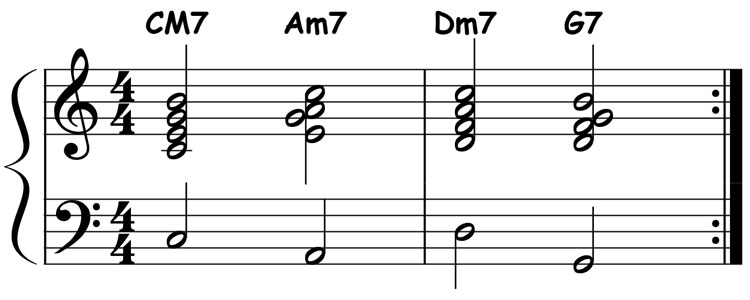
Our starting point… the least jazzy version of the major 1 6 2 5 chord progression…

Basic 7th Chords with Voice Leading
A fundamental skill is to play the basic major 1 6 2 5 chord progression using voice leading (notice how smoothly the harmony flows in five distinct voices)…
Remove the Roots and add 9ths to each Chord
An essential way to jazzify the major 1 6 2 5 chord progression is to add “the 9” to each chord. When you do so, it’s almost always a good call to drop duplicate notes (in this case “the 1” of each chord and replace it with a color tone (in this case “the 9” of each chord). Notice also that we lowered the right hand into a fuller, more pleasing register…

Drop “the 5” and add 13 in the G7 chord…
Notice how adding just a wee bit of color to the V7 chord increases the jazziness of the major 1 6 2 5 chord progression…

Walking Bass using Diatonic Approach Notes
A walking bass in relentless quarter notes is a great way to outline the harmony and keep the time flowing for the major 1 6 2 5 chord progression…

Play Right Hand Chords after the Beat
Your skill at playing chords off the beat (in this case behind the beat) will take your comping to the genius level! (Don’t forget to swing the eighth notes and rests)…

Play Right Hand Chords before the Beat
Believe it or not, you can actually play each chord ahead of the beat! Doing so will take your comping to the super genius level! (As always, don’t forget to swing the eighth notes and rests)…

Mixture of Chord Placements
Sometimes on the beat, sometimes after the beat, and sometimes before the beat…

Substitute Am7 with A7
A common practice for jazzifying the major 1 6 2 5 chord progression is to play an A7 chord (in this case a colorful A7b9) instead of the diatonic Am7 chord. Doing so adds some nice chromaticism and a stronger harmonic drive since the A7 is the secondary dominant (V7/ii) of Dm7…

Walking Bass using Chromatic Approach Notes
Chromatic approach notes will take your walking bass lines to the next level by creating a strong sense of voice leading, harmonic drive, and sense of anticipation. Pretend you are the bass player and play the bass line melodically…

Homework
- Play along with all the above until you get the feel.
- Play each pattern above by yourself with a rhythm track. Record yourself, listen to the playback, and ask yourself if that is what you wanted to play.
- Mix and mix some of the ideas above and study-practice them in all keys you would like to play in.
- Experiment with different color tones for the V7 chord (Poke around “Jazz School” for tons of ideas for super cool V& chord voicings)
learn more… Jazz Piano Lessons