An illuminating and inspiring lesson on the process of developing your own style… both in Jazz and life in general.
Table of Contents
Lesson Goal
To understanding what we mean “style” and and how to feed the process of developing your own style.
Prerequisites
Basic music reading skills… the LOVE of music… and the discipline to study and practice.
What’s Your Musical Goal?
As much as I admire their playing, I don’t want to play and sound like Thelonious Monk or Bill Evans…
I wanna play and sound like ME!
Likewise, don’t you wanna play and sound like YOU?
By the way, I’d take it as a huge NON-compliment if someone said to me: “Hey, Frank, you sound just like so and so.”
back to… Table of Contents
the Proper Mindset
Our journeys of self-discovery are made possible by embracing a particularly healthy habit: Stop comparing yourself to others! (whether in music or life in general).
Easier said than done, of course. Because we so often judge ourselves more by what we can’t do than what we can do.
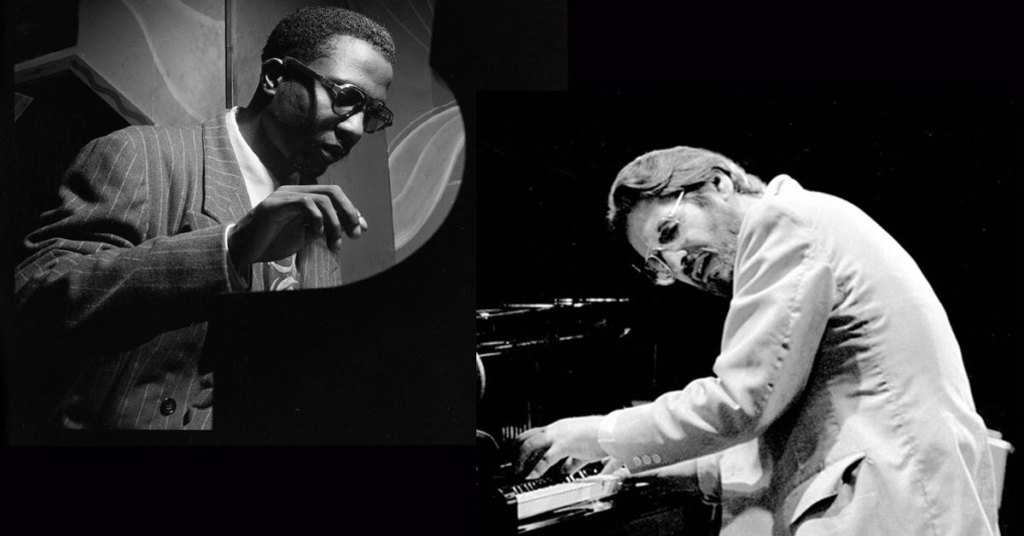
So, just in case you struggle with this universal human foible (as do I), let’s look at things another way: Before getting hung up on wanting or wishing to sound like Thelonious Monk or Bill Evans, ask yourself: Did Bill Evans play like Thelonious Monk and did Thelonious Monk play like Bill Evans?
Of course not!
So, if NOT playing like Mr. Monk was good enough for Mr. Evans and NOT playing like Mr. Evans was good enough for Mr. Monk, why wouldn’t it be good enough for YOU and ME?
back to… Table of Contents
What do We Mean by “Style”?
Monk sounds and feels like Monk and Evans sounds and feels like Evans because they each have a BAG.
Your BAG is the totality of your musical interests, knowledge, skills, and manner of playing. It includes your choice of chord voicings and chord placements, vocabulary of licks, riffs, breaks, vamps, intros and endings, rhythmic sensibilities, phrasing, dynamics, articulations, and technique.
Each artist has his own bag–a deeply personal, and therefore unique, musical mind that contains a rich collection of musical ideas they’ve internalized through years of experience. It consists of all the music they’ve studied and practiced so well that they can express themselves in a wide variety of musical situations without having to think about it… with the same ease, spontaneity, and manner in which we all speak English in our own unique way.
Sidebar: It’s tempting to reduce what an artist does to mere schtick (used pejoratively). But every true artist–Picasso, Bach, and Shakespeare included–necessarily has a “schtick” (not used pejoratively). The key point is that their “schtick” is not contrived or manipulative in the least, because it’s a deeply personal and honest expression of who they truly are.
And so, your goal is to discover and develop your schtick (your BAG)!
back to… Table of Contents
How to Develop Your Own Style
Don’t forget: Music is a LANGUAGE! And so, you develop your own jazz piano style by learning how to speak the language of music… the same way you develop your ability to speak English: by learning the alphabet, sounds (phonics,) and grammar… by learning new words… by learning about different forms and genres: prose, poetry, stories, fiction, non-fiction, etcetera… and by lots of listening, reading, writing, and speaking (especially in practical everyday situations.)
Of course, such knowledge and skill does not come for free… and does not come overnight.
You have to DO something. And that something is to study and practice the right things the right way!
back to… Table of Contents
Study & Practice Habits that Will Serve you Well
Nobody can put your ability to play music in a can and sell it. Developing your own style requires you to study and practice the right things the right way. Specific methods include the following…
- Learn the musical alphabet, solfege, scales, chords, chord progressions, forms, meters, rhythms, etc.
- Listen to lots of music and expose yourself to new musical ideas. Lots of them.
- Internalizing musical ideas that speak to you… using all four musical intelligences: ears, intellect, eyes, and muscles.
- Learn chord voicings that turn you on.
- Cop licks from your favorite players. Cop them liberally and make them your own!
- Build a library of stock intros and endings.
- Practice the kinds of rhythms that move you.
- Experiment with different phrasing, dynamics, and articulations.
- Mess around with different chord placements in the meter.
- Master some commonly used bass lines.
- Learn stylistic elements that characterize the kinds of music you want to play.
- Seek ideas from all sources: Recording, Fake Books, How-to Books and Videos.
- Learn to play some Jazz standards… and work out how YOU might comp or solo on the forms and chord changes.
- Go to concerts and see what performer do live.
- Jam with play along recordings.
- Jam with friends.
- Can you think of some others?
Sidebar: Learning how to speak jazz requires no less talent than, but no less effort than, learning to speak English.
back to… Table of Contents
Closing Thoughts & Words of Encouragement
As you’re doing all the above, you are not trying to develop your own jazz piano style. You are not trying to be unique. You are discovering your own voice as a process of selection. In discovering what grabs you, you are discovering your musical self. And every time you internalize something you like, it automatically becomes part of your sound, part of your voice, part of your musical mind, part of your style… in a never-ending process of growth with no final destination.
So, enjoy the process of developing your own very personal jazz piano style! In doing so, you’ll begin to discover and develop your own musical mind… and learn that it’s not all about talent, but about having the confidence and courage to be yourself… in a world of music that’s big enough for everyone!
back to… Table of Contents
learn more: Jazz Piano Lesson: Levels of Fluency
Excellent and remarkable site. I learned a lot. Thank you
It’s my pleasure and privilege to share, my anonymous friend.
Hi Frank, you have done it again. I say “YOU ARE MUSIC”
Hello and heartfelt thanks to you, my anonymous and generous friend!