An illuminating lesson in a commonly used chromaticism: Chord Tone Embellishment of Major and Minor Triads…
Table of Contents
Lesson Goal
To recognize a chord tone embellishment when you read it or you hear it… and to use chord tone embellishments when you compose or improvise.
Prerequisites
Basic music reading… LOVE of music… and the discipline to study and practice.
What Does “Chromatic” Mean?
Chromatic is just a fancy adjective that refers to notes that are not defined by the key signature. And so, chromatic notes are identified using an accidental–a sharp, flat, or natural symbol–that momentarily overrides the key signature. In the simplest terms, diatonic means the notes defined by the key signature and chromatic is everything else.
How Chromaticism is Used to Embellish a Chord Tone
Let’s illustrate how chromaticism is used to embellish a chord by studying two famous examples: For Elise and Show Me the Way to Go Home.
For Elise (Key of A Minor)
The opening trill in For Elise is a great example of chord tone embellishment…

Let’s break this down in order to understand, hear, and feel the musical patterns here…
- The circled note E is a chord tone… specifically “the 1” of the E7 chord (It also happens to be the Solfege syllable So).
- D# is the note immediately below E.
- Going back and forth between E and D# is more elegant than just playing the note E all by itself.
- The chord tone E is played on a downbeat while the chromatic tone D# is played on an upbeat. This is no accident.
Sidebar. The “chord tone on the downbeat, next note below on the upbeat” pattern is fundamental to making all kinds of melodies really tick. Two experiments will quickly demonstrate the power of this pattern…
Experiment #1. Play a D natural instead of a D# and see how it sounds and feels.
Experiment #2. Shift the melody so the the D# falls on the downbeat and E and the upbeat and see how it sounds and feels.
Show Me the Way to Go Home (Key of C Major)
The melody for Show Me the Way to Go Home is another great example of chord tone embellishment…

Let’s break this down in order to understand, hear, and feel the musical patterns here…
- The circled note E is a chord tone… specifically “the 3” of the C chord (It also happens to be the Solfege syllable Mi).
- D# is the note immediately below E.
- Going back and forth between E and D# is a lot more fun than just playing the note E all by itself.
- The chord tone E is played on a downbeat while the chromatic tone D# is played on an upbeat. This is no accident.
Sidebar. The “chord tone on the downbeat, next note below on the upbeat” pattern is fundamental to making all kinds of melodies really tick. Two experiments will quickly demonstrate the power of this pattern…
Experiment #1. Play a D natural instead of a D# and see how it sounds and feels.
Experiment #2. Shift the melody so the the D# falls on the downbeat and E and the upbeat and see how it sounds and feels.
Major Triad Chord Tone Embellishments
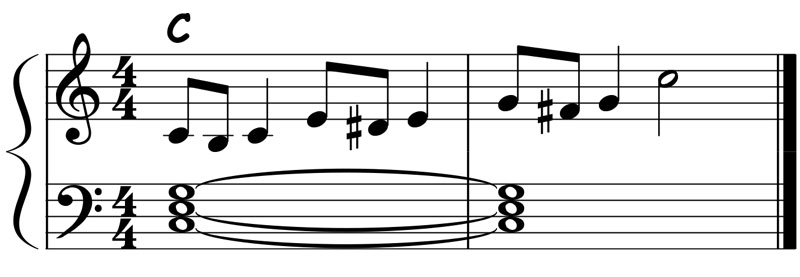
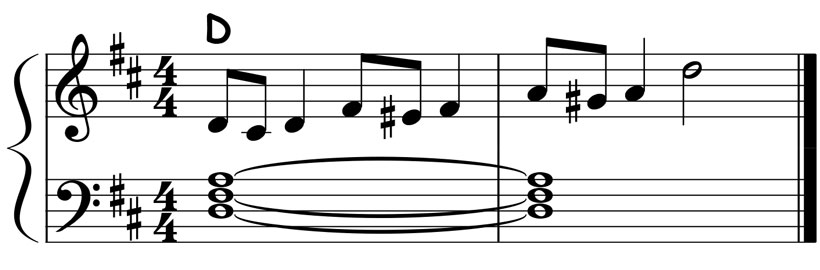
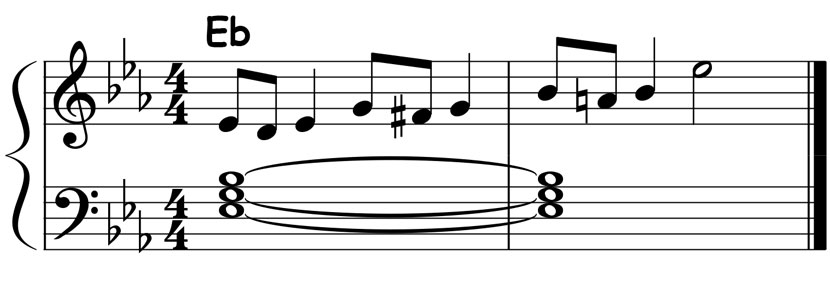
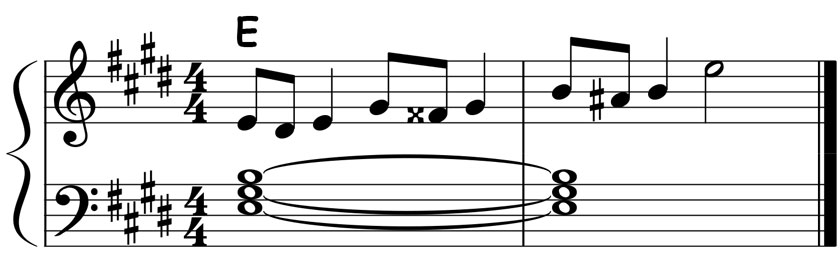
The pattern is quite simple once we break it down as follows. For any major triad primary chord tone (1-3-5):
- Play the primary chord tone on a downbeat.
- Play the note that’s a minor 2nd below the chord tone on the following upbeat.
- Repeat the primary chord tone on the next downbeat.
Special Note: All the following are presented for the Roman Numeral “I” chord in each key, but the same pattern can be used to embellish any major triad, no matter it’s Roman Numeral function.
C Major Triad
D Flat Major Triad

D Major Triad
E Flat major triad
E major triad
F major triad

G Flat Major Triad
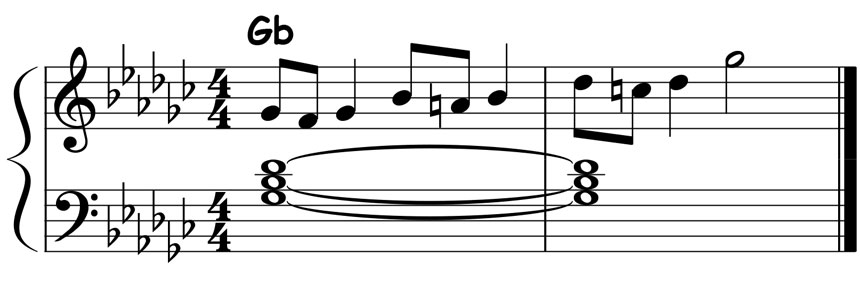
G Major Triad

A Flat Major Triad

A Major Triad
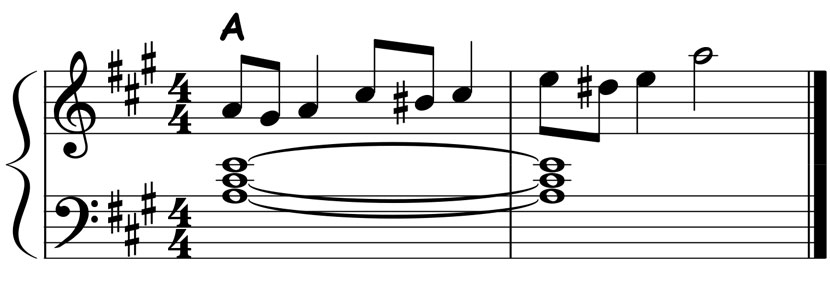
B Flat Major Triad

B Major Triad

Minor Triad Chord Tone Embellishments
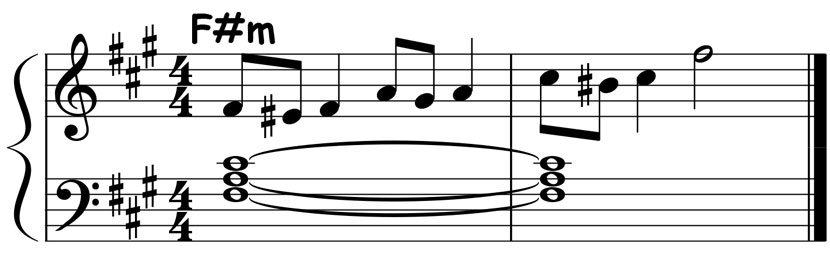
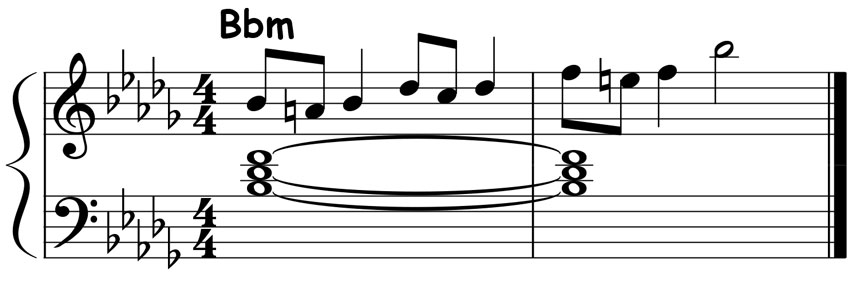
The pattern is quite simple once we break it down as follows. For any minor triad primary chord tone (1-b3-5):
- Play the primary chord tone on a downbeat.
- Play the note that’s a minor 2nd below the chord tone on the following upbeat.
- Repeat the primary chord tone on the next downbeat.
Special Note: All the following are presented for the Roman Numeral “i” chord in each key, but the same pattern can be used to embellish any minor triad, no matter it’s Roman Numeral function.
C Minor Triad

C Sharp Minor Triad

D Minor Triad

E Flat minor triad
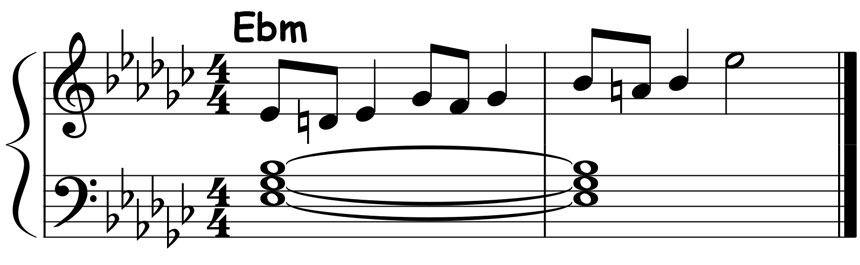
E minor triad

F minor triad
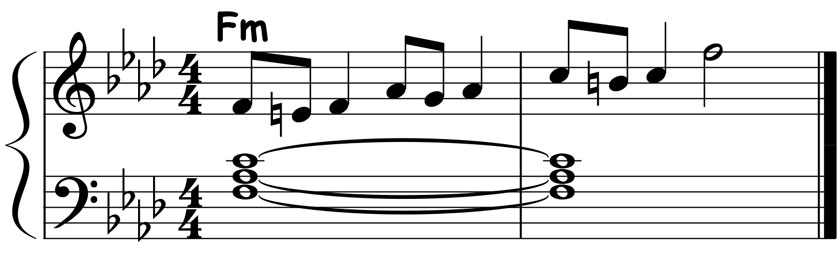
F Sharp Minor Triad
G Minor Triad

G Sharp Minor Triad

A Minor Triad

B Flat Minor Triad
B Minor Triad

Takeaway
We’re not just doing intellectual “music theory” here. We are learning how to read music and hear music like a musician. With just a wee bit of experience, you will start to recognize the “chord tone on a downbeat, minor 2nd below on the upbeat, chord tone on the down beat” pattern whenever you see it in written music and hear it being played.
more like this… How Music Works