Short and sweet lessons in The Physics of Sound (Pitch, Loudness, Harmonics, Timbre)…
Table of Contents
Lesson Goals
To understand, hear, and feel how pitches work… in order to expand our capacity to listen like a musician.
Prerequisites
LOVE of music and the discipline to study and practice the right things the right way.
What is Sound?
Simply put, sound is a vibration that we can hear.
Sources of musical sounds include:
- vibrating strings (guitar, violin)
- vibrating columns of air (clarinet, pipe organ)
- vibrating diaphragms (drums, timpani)
- virtual electronic vibrations played through a loudspeaker (electric piano, synthesizer)
Since an acoustic piano makes sound by vibrating strings, let’s use a vibrating string in our discussion on acoustics. If you pluck a string, it will vibrate back & forth like this…

As the string moves, it compresses the air around it, changing the air pressure from high to low to high to low every time the string goes back & forth & back & forth. This pressure change travels at the speed of sound in all directions until it reaches your ears, causing your ear drums to vibrate at the very same frequency (number of vibrations per unit time). This vibration of your ear drums is relayed to your brain via a bundle of nerve cells where it is perceived as the pitch of the vibrating string.
back to… Table of Contents
Pitch
The number of times a string or column of air naturally vibrates back and forth in a given unit of time is perceived by our ears/brains as the pitch of the note. The more often the string or column of air vibrates back & forth, the higher the pitch; the less often the string or column of air vibrates back & forth, the lower the pitch.
Listen to a comparison of High and Low pitches…
The number of times the string or column or air vibrates back and forth per unit time is called its frequency. The usual way to measure frequency is in cycles per second, also named Hertz (Hz). So, “100 Hz” is the same as “100 cycles per second.”
By the way, concert pitch (the standard tuning for ensemble instruments) defines middle A as 440 Hz. In other words, the A above middle C is tuned such that it vibrates back and forth 440 times per second.
The pitch (frequency that the string vibrates back & forth) depends on three things:
- the length of the string.
- the weight of the string.
- the amount of force (tension) used to stretch the string.
Effect of String Length on Pitch
All else being equal, the shorter the string, the higher the pitch and vice versa.
This short string…

vibrates faster & sounds higher in pitch than this long string…

Effect of String Weight on Pitch
All else being equal, the lighter the string, the higher the pitch and vice versa.
This light string…

vibrates faster & sounds higher in pitch that this heavy string…

Effect of String Tension on Pitch
All else being equal, the tighter the string is stretched, the higher the pitch and vice versa.
This string, stretched with more tension,…

vibrates faster & sounds higher in pitch that this string, stretched with less tension…

Try it Yourself: You can try all the above yourself by simply stretching rubber bands of various lengths and thicknesses between your fingers and plucking away, noticing the effect that length, weight, and tension have on the pitch.
back to… Table of Contents
Loudness
The bigger the vibration (the more distance the string travels back and forth), the louder the sound. The smaller the vibration, the softer the sound.
And so, this vibration….

will sound louder than this vibration…

because the first vibration moves more air back and forth than the second vibration. The more air that is compressed, the higher the pressure, the more your ear drums move in response, and the louder your brain perceives the sound.
back to… Table of Contents
Harmonics
When you pluck a string, a very interesting thing happens. Not only does the string vibrate like this…

but it also vibrates like this…
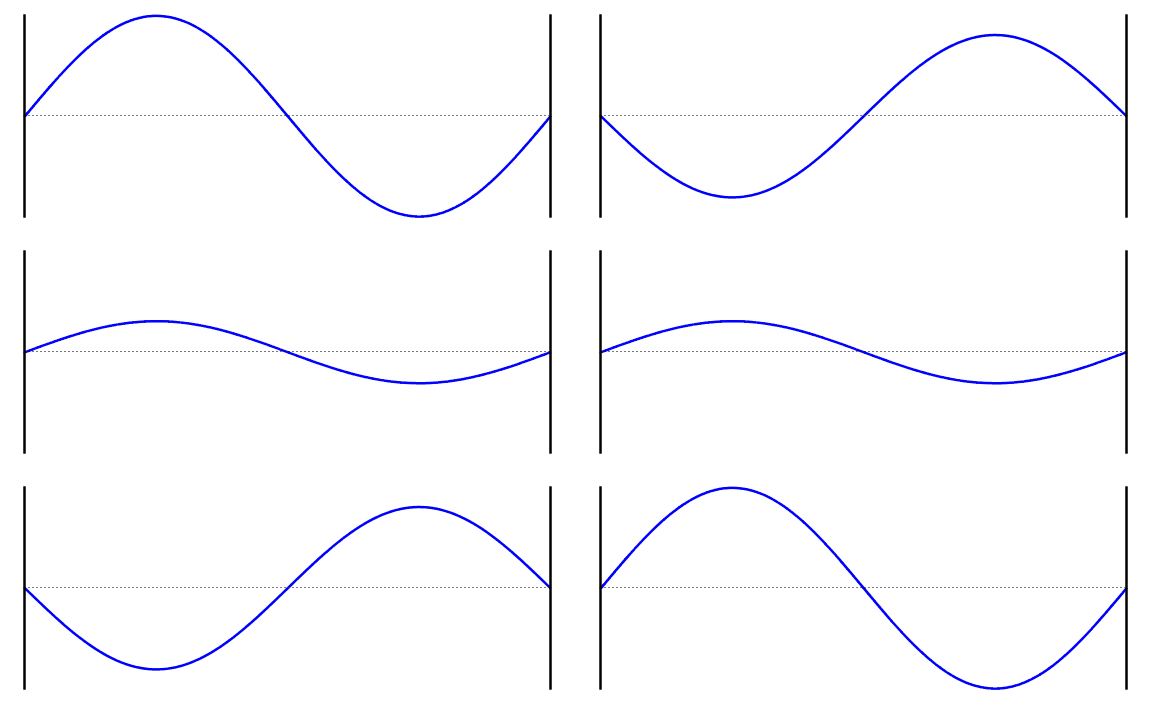
and like this…

and so on in 4ths, 5ths, etc…

Notice that the “shape” of each vibration is found by dividing the length of the string into equal-length sections that are each whole number division of the total length of the string: 1, 1/2, 1/3, 1/4, 1/5, etc.
The first vibration is called the fundamental and is perceived by our brains as the pitch of the note.
The “extra” vibrations are called overtones or harmonics.
These overtones are typically of a smaller amplitude, and therefore are not as loud as the fundamental. They add harmonic “colors” to the fundamental pitch, which we perceive as something called Timbre.
back to… Table of Contents
Timbre
Different musical instruments sound different from each other because the relative strength (loudness) of their harmonics (overtones) are different.
The relative loudness of these overtones depends on the materials, size, and shape of the instrument as well as the technique of the person playing it. Some overtones may not even have any loudness at all. The relative strengths of the harmonics also change as vibrations decay and resonate with each other over time.
Each instrument has a unique sound signature based on its unique combination of overtones. Our brains perceive these harmonics in way that allows us to recognize the “voice” of the instrument (and human voices, too!). This perception is called timbre.
Such impressions may be described using adjectives such as warm, mellow, bright, velvety, nasal, brassy, tinny, tender, and countless others.
By the way, a spinet piano sounds quite different from a grand piano. Even grand pianos sound different from each other. In fact, two pianos that are the exact same model may not sound exactly alike.
back to… Table of Contents
The Physical Basis of Harmony (YouTube)
A fun look at the physical basic of harmony–based on the organic ways that physical objects naturally vibrate!
back to… Table of Contents
learn more… Ear Training Fundamentals