An introduction to chord inversion, a concept and practice that greatly expands the palette of harmonic and melodic possibilities…
Table of Contents
Prerequisites
Basic music reading skills… the LOVE of music… and the discipline to study and practice.
Lesson Goal
To understand the concept of Chord Inversion… and to start applying this understanding when you listen, read, compose, and improvise…
Chord Inversion Defined
There is no rule requiring that the root of the chord be the lowest note played. In fact, you can create a wonderful variety of melodic and harmonic effects by using other chord tones as the lowest note. Using a chord tone other that the root of the chord in the bass is known as Inversion, which has a profound effect on how a chord sounds, feels, and functions.
back to… Table of Contents
Chord Inversion and Chord Voicing Compared
It’s important to understand that chord Inversion and chord Voicing share some overlapping features but are not synonyms. Here are a few points to makes things clear:
- Every chord has a voicing: a particular vertical arrangements of notes.
- Each chord may or my not be inverted.
- Inversion is all about the bass.
- Voicing has a strong effect on the quality of the chord.
- Inversion has a powerful effect on the function of the chord.
- Each inversion can have a variety of voicings.
- The function of a chord always depends on the context.
- Don’t get hung up on the names of things. It’s all about how something sounds, feels, and functions.
For example, the second and third chords in the following sequence are not inversions (because the root of the chord is the lowest note, which makes all three chords sound and feel like stable and resolved tonic major chords). Prove this to yourself by playing, listening, and simply experiencing how each chord sounds and feels…

On the other hand, the second and third chords in the following sequence are inversions (because the lowest note is not the root, which makes each chord sound and feel unstable and unresolved, like it wants to go somewhere). Prove this to yourself by playing, listening, and simply experiencing how each chord sounds and feels…
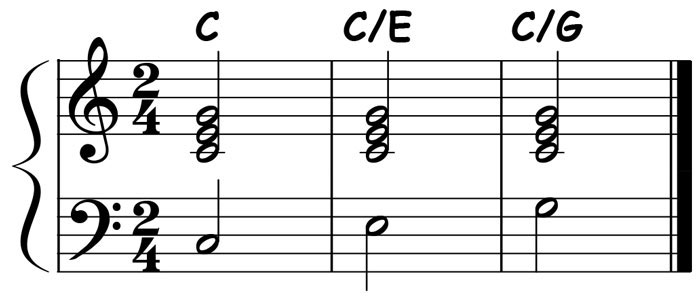
Inversion Applied to a C Major Triad
Let’s see how inversion works to create harmonic instability and forward motion applied to a C Major Triad. Because a C major triad has three notes, any of these three notes (C, E, G) can be the lowest (the bass), as follows…
C Major Triad, Root Position
Root Position means “the 1” of the chord is the lowest note. Here is one way you might play a root position C chord…
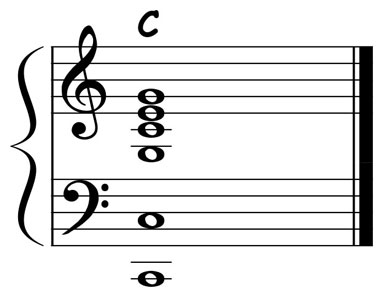
Functional Ear Training: Notice how stable this arrangement of notes sounds and feels.
C Major Triad, First Inversion
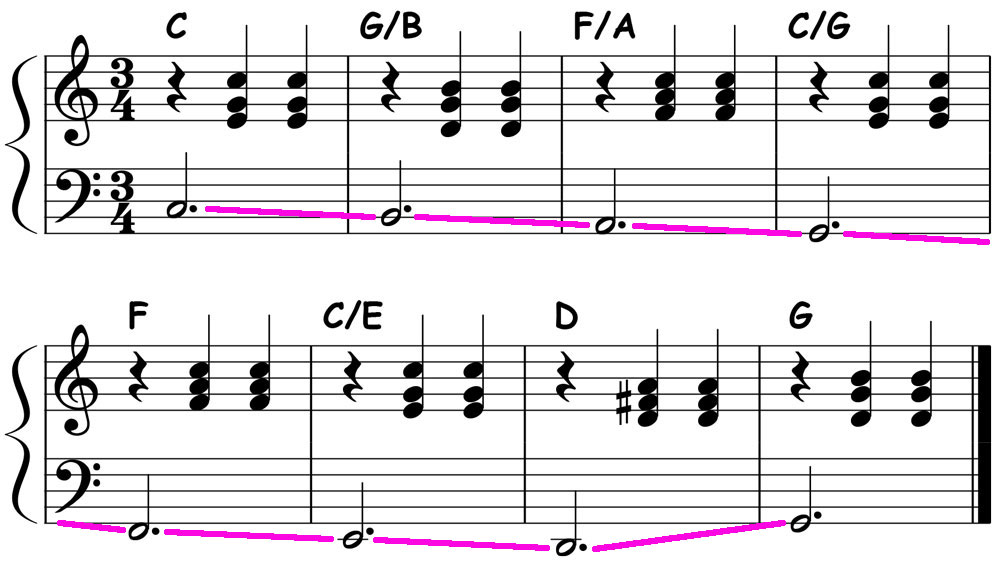
First Inversion means “the 3” of the chord is the lowest note. Here, in the second bar, is one way you might play a first inversion C major triad (C/E)…
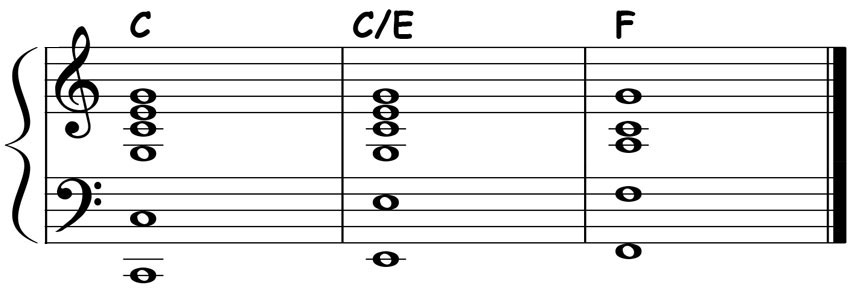
Functional Ear Training: You might recognize this as Eric Clapton’s “Layla”. In this case, the inversion is used to create harmonic instability and melodic interest in the bass line that naturally moves from the I to IV chord.
C Major Triad, Second Inversion
Second Inversion means “the 5” of the chord is the lowest note. Here, in the very first bar is a C chord played with G in the bass…
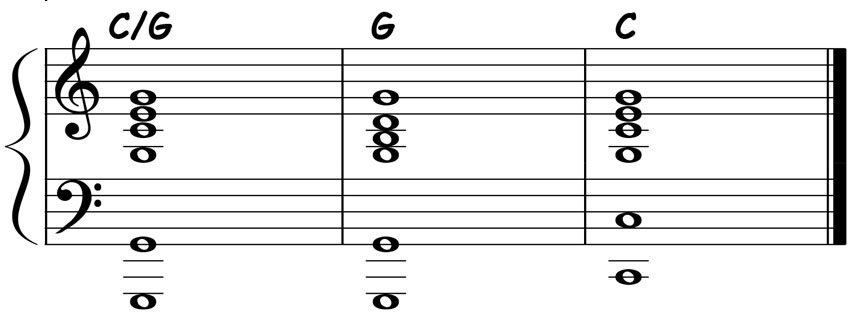
Functional Ear Training: Notice how unstable the C/G chord sounds and feels… like it needs to go somewhere. This happens to be a very common way to prepare to end a piece of music, where the C/G chord functions as a double suspended V chord that accentuates the dominant harmony before resolving to G chord (V) which then resolves to the tonic C chord (I).
back to… Table of Contents
Chord Inversions & Bass Melodies
An musical way to expand the melodic and harmonic possibilities of a chord progression is to invert some of the chords along the way. Doing so does at least two things: It adds harmonic interest and creates smooth melodic movement in the bass line.
Let’s see how the process works and enjoy its pleasing effect by using a familiar chord progression as an example.
First, without Chord Inversion
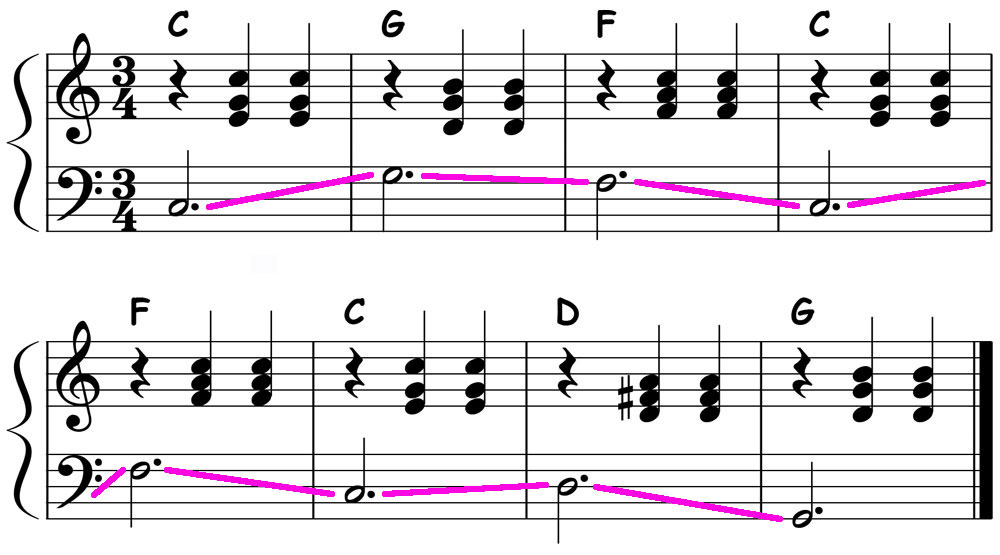
Here’s a I-V-IV-I-IV-I-II-V chord progression in the key of C Major, played without chord inversion (all chords in root position)…
Second, with Chord Inversion
Here’s the same chord progressions with some of the chords inverted… in order to create a linear bass line that descends smoothly and melodically through the changes using voice leading…
back to… Table of Contents
I’m really gonna have to start reading music again. (And playin’) You put together such wonderful classes…
(Do you teach music in person?)
Thanks for appreciating my work, man. I teach live in person and live on zoom. In fact, most of my students are outside the USA. So, what kind of music speaks to you most deeply?
That’s nice. Live and Zoom.
What kind of music? I have a wide range of taste. From Rachmaninoff to Nina Simone. I’m a child of Rock n’ Roll. Love the Blues. But I can also love a concert by Yuja Wang. Stretched thin!
PS, I was also brought with African and Indian music. Go mix all that…
So much amazing music from around the world! I was fortunate many years ago to get some Ethiopian music lessons from a Mister Mitiku Tesfaye in Addis Ababa. I also got to play a bit at the Itegue Taitu Hotel and Lucy Gazebo Restaurant… and to sit in with an Ethio-Jazz band at the Jupiter Hotel in Addis. Such a pleasant surprise to see how pianos were to be found there… and oh how music is a great connector of humans everywhere. Cheers, man!
That’s right you’ve been to Addis… Amazing.
I finished High School there. And my generation is still in touch.
Bye
Bole Bole Bole!!!