Lesson Goal: To internalize the form, harmony, and rhythm for Ray Charles’s “Hit the Road Jack“… by ear, intellect, eye, and muscle…
Table of Contents
Prerequisites
Basic music reading skills… basic scale, chord, and chord progression theory… basic technique… the LOVE of music… and the discipline to study and practice.
Study, Practice, & Performance Tips
- Never play these mindlessly and mechanically. Always aspire to play them musically.
- Your goal is not to merely memorize them, but to study and practice until you internalize them using all four musical intelligences: ears, intellect, eyes, and muscles.
- Every time you practice something, you are programming your brain. So always play accurately.
- Practice with a Click Track or a Rhythm Track. Doing so will give you immediate feedback on any rhythmic misconceptions or places where your timing gets sloppy.
- Record Yourself. Always. Listen to the playback immediately. And ask yourself: Is that what you intended to play?”
- If anything feels tense or awkward, stop immediately and experiment with alternative fingerings or choreography.
- Play the keepers in other keys you expect to play in. By the way, once you see the patterns (which is guaranteed if you know your scales and chords) finding the notes in other keys will be a piece of cake!
- If you feel stuck or overwhelmed, realize that anything can and will be mastered if you slow things down or break things down to small enough pieces.
- Although it take time to talk about all the above practice habits, practicing them takes almost no time at all because they can all be done simultaneously!
- Mastering all this takes no special talent. All it takes is a wee bit of knowledge and the discipline to employ a very short list of productive study and practice habits.
back to… Table of Contents
Special Note about these Lessons
This series of lessons is Frank’s take on Ray Charles‘s studio and live versions of “Hit the Road Jack“. Topics include the form, harmony, melody, tonality, bass line, comping, soloing, and performance tips. Along the way, Frank will make a sincere attempt to correct so much unmusical information you’ll see on YouTube and offer alternatives to the many watered down versions in sheet music for sale
Frank’s goal is to teach you how to make this musical gem your own… while paying due respect to the legacy of Mister Charles and his colleagues. Let’s go!
back to… Table of Contents
Ray Charles’ Studio Recording of “Hit the Road Jack”
First things first. Let’s start using our ears by having a listen to the original studio recording…
Play along with the bass line (even if just by trial and error) and notice that this is in the key of G# minor.
Frank Comment #1: Those who say this is in the key of Ab minor are not technically incorrect, but doing so seems to me an unnecessary complication in terms of the notation. Why use a key signature with seven flats when you can use a key signature with five sharps (G# minor)? By the way, G# minor is just the relative minor of B major, two scales you should already know by ear, intellect, eye, and muscle.
Frank Comment #2: Why did Ray choose the key of G# minor? Did it just feel right? Did it suit the sweet spot of Ray’s voice? Did it provide maximum punch for the Raylettes’ vocals? Did it provide a lots of keys that stick up to maximum tactile feel on the keyboard? Was is the best register for the bass line? All the above? Does anyone out there know? Please comment below. Thanks a bunch in advance.
Frank Comment #3: I wasn’t thrilled to discover this was in a key in which I’ve never played blues before. And so I asked myself: What is my goal here? And had at least five answers: 1. To understand what makes this piece tick, 2. To play along with Ray, 3. To jam (comp and solo) with a band in commonly used keys, 4. To accompany a vocalist in a key they prefer, 5. To play a solo version in a key that feels right.
“Hit the Road Jack” Transposed to A Minor
I transposed the original recording into the two nearest “easier” keys: “up” to A minor and “down” to G minor to see how they sound and feel…
“Hit the Road Jack” Transposed to the Key of A Minor…
“Hit the Road Jack” Transposed to G Minor
“Hit the Road Jack” Transposed to the Key of G Minor…
Frank Comment #4: To my ears, it sounds and feels a bit “thin” in the key of A minor compared to G minor.
So, based on a combination of simplicity and my goals above the rest of this series will be presented in the key of G Minor.
Frank Comment #5: For a donation to the website, Frank would be happy to send you music scores and MP3s in a key that speaks to YOU.
Before we get into the details of the tonality, harmony, and melody let’s make sure we have a deep understanding of the high-level structure of the song.
back to… Table of Contents
“Hit the Road Jack” Song Form
The form follows a formula you will see again and again in every kind of music from classical to pop:
- 4 bar Intro
- 8 bar choruses/verses
- Tag ending, repeated ad lib.
It’s crucial to understand, hear, and feel the choruses and verses as being EIGHT bars long, each divided into two FOUR bar phrases, and with a cyclical bass line that’s TWO bars long. The layering and interaction of these structural elements is a huge part of what makes this piece really tick.
Have a listen (and also sing along and play the bass line) with special attention to three things:
- When each 8-bar chorus/verse begins and ends.
- When each 4-bar phrase begins and ends
- When each 2-bar bass line cycle begins and ends.
Repeat as many times as needed until you develop a “feel” for where and how these elements interact with each other and fit into the 8-bar structure.
Takeaway: The song form provides the infrastructure upon which we are going to add the more detailed rhythmic, harmonic, and melodic details that are essential for fluent comping and soloing.
back to… Table of Contents
Meter & Tempo
Now that we understand the overall form, the next level of assembly is to deeply understand what makes “Hit the Road Jack” tick when it comes to two crucial aspects of musical time: meter and tempo.
Meter
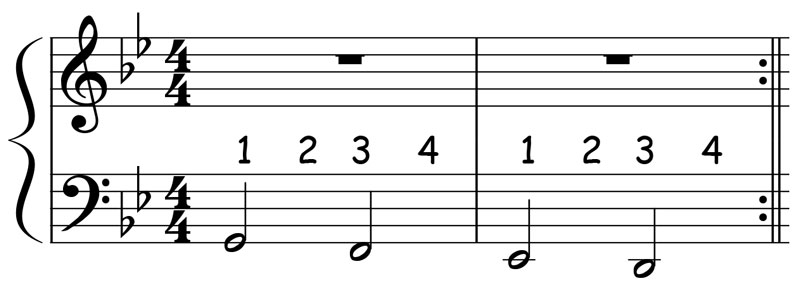
Alas, lots of sheet music is written in 4/4 time as follows…
Play along with the band and count 1-2-3-4-1-2-3-4 out loud and and ask yourself how it feels…
Now play along with the band and count 1-/-2-/-1-/-2 out loud and and ask yourself how it feels…
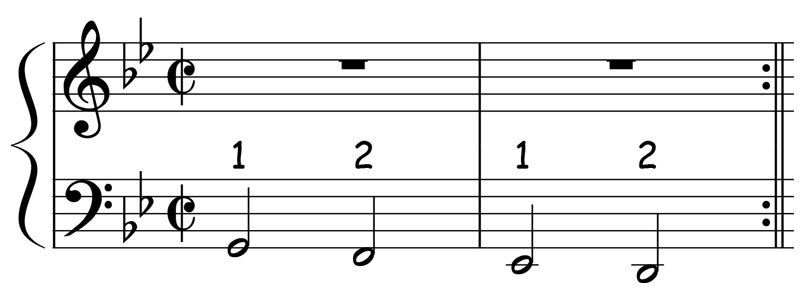
Frank Comment #9: To my ears and guts, thinking about and counting this in 4/4 time feels rushed and stiff while thinking about and counting this in 2/2 time provides the space for things to really breathe and swing.
Tempo
Once we understand the meter, we can figure out the tempo, which is about 86 beats per minute (one beat = a half note)…
A Sidebar about Tempo
By the way, playing at an appropriate tempo is a big deal. Let’s prove this to ourselves by doing two short experiments…
First, let’s Slow Things Down…
Let’s prove this to our selves by having a listen at just 10% slower (~79 beats per minute) and as yourself how this sounds and feels compared to the original tempo…
To my ears and guts this tempo is too laid back, feels like an unnaturally slow flow of two people having an argument, and doesn’t feel passionate or angry enough.
Second, Let’s speed things up…
And now by having a listen at just 10% faster (~94 beats per minute)…
To my ears and guts this tempo pushes too hard, feels like an unnaturally fast flow of two people having an argument, and doesn’t give the listener enough time to absorb the emotions involved.
Takeaways: Never underestimate the effects that meter and tempo have on establishing the appropriate mood and feel of a piece of music.
back to… Table of Contents
Rhythm
Now that we understand the form, meter, and tempo the next level of assembly is to deeply understand two huge aspects of the rhythm that makes “Hit the Road Jack” really tick: Heavy emphasis on the back beats and swing 1/8th notes…
The Back Beats
Listen to what’s happening in the drums and notice the heavy emphasis on the backbeats…
To Frank’s ears, every beat is played on the ride cymbal while all the backbeats are played by stepping on the hi-hats and adding some side tapping on the snare in order to really make each backbeat really pop…

(Yes, Frank is not a drummer!)
Swing 1/8th Notes
Listen to the melody and notice that the 1/8ths notes are not sung “straight”, but are swung by playing the 1/8th notes on the downbeats a bit longer and shortening the 1/8th notes on the “between” beats accordingly…
Takeaways: The two huge aspects that really make “Hit the Road Jack” tick rhythmically are the heavy emphasis of the backbeats and swing 1/8th notes in the melody!
back to… Table of Contents
Tonalities & Scales
Now that we understand the form, meter, tempo, and rhythm the next level of assembly is about the tonalities and scales used…
A defining feature of “Hit the Road jack” is the delicious mixture of two very distinct tonalities and scale types:
Bass Line Theory & Ear Training
The bass is simply a Descending Natural Minor Scale…

A super effective way to internalize this (by ear, intellect, eye, and muscle) is to read the music, play the bass line, and sing along with the recording using Solfege (Do-Te-Le-So)…
Melody Theory & Ear Training
The melody is built exclusively using tones from the Minor Pentatonic Scale (Do-Me-Fa-So-Te)…
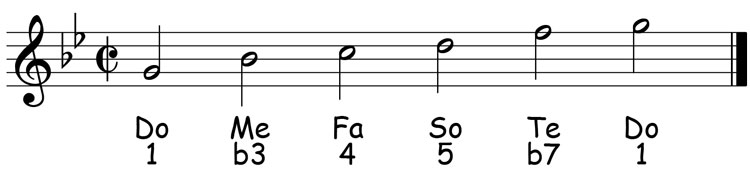
A super effective way to internalize this (by ear, intellect, eye, and muscle) is to read the music, play the notes one by one, and sing the Solfege syllable for each note out loud with the recording playing in the background…
Frank plans to share a transcription of the melody in the very next lesson, but in the meantime, encourages you to use your ears and knowledge of the minor pentatonic scale to work it out for yourself.
Takeaway: Taken together, the Natural Minor tonality/scale in the bass (the bottom) and minor pentatonic tonality/scale in the melody (the top) scream MINOR BLUES, but with a particular flavor that makes this piece of music really tick!
back to… Table of Contents
Melody (Solfege)
Now that we understand the form, meter, tempo, rhythm, tonalities, and scales used let’s go deep into the melody by analyzing it using Solfege.
Notice that the melody uses the five tones in a G Minor Pentatonic Scale. No Exceptions. By the way, this is yet another great example of how knowing your music theory greatly facilitates reading, memorization, improvisation, transposition, ear training, and performance.
Frank’s Transcription & Solfege Analysis
Read as you play along with the recording and try to mimic the exquisite and very human dynamics, articulation, and phrasing of the vocalists.
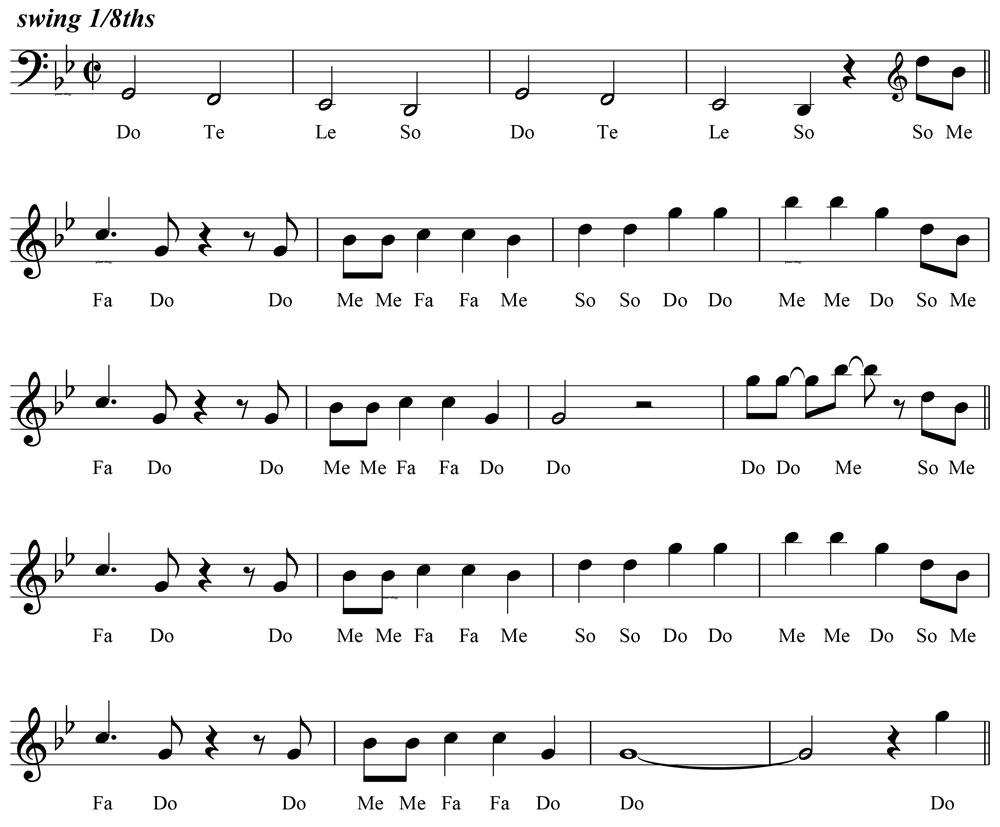

(Yes, this is a somewhat abbreviated version, for reasons explained below)
About Frank’s Transcription
- In order to make things easy to read, the 1/8th notes are written “straight”, but realize that each 1/8th note pair must be “swung” in order to capture the right rhythm and feel.
- As you read the score, notice that Frank has made things easy to read by organizing everything to fit four bars wide and only two pages.
- Also notice how the form is made easy to visualize by separating the intro and each 8 bar verse and chorus with a double bar line.
- For the sake of brevity, Frank did not transcribe the later verses and chorus. This is because they are just minor variations of what you see here. Feel free to transcribe them on you own, but the 80:20 Rule suggests that your precious study and practice time is much better spent working on other aspects of the music to suit you own personal musical goals.
- Is anyone interested in a hi-res pdf of the score?
back to… Table of Contents
Bass Line
Now that we understand the form, meter, tempo, rhythm, tonalities, scales, melody, and solfege let’s explore some tasty ways we might play the bass line, whether solo or with a band.
Rather than do a verse by verse and chorus by chorus analysis of the studio version and many live versions, we’re going to construct some bass lines using some bread and butter ideas and patterns that everyone should internalize–by ear, intellect, eye, and muscle.
The Basic Bass Line
Listen to the original studio recording and notice that the bass line is just a snippet of the descending melodic minor scale…

These four notes are part of the infrastructure that establishes the meter, defines the minor tonality and key center. It also provides melodic interest and keeps the time flowing in four note cycles.
Play along until the sounds, feelings, and rhythm get into your ears, intellect, eyes, and muscles… and don’t underestimate the challenge of playing each note at the right time…
You always record yourself, right? You always listen to the playback immediately, right? You always ask yourself if THAT is what you intended to play, right? You keep experimenting with different ways to think about the music and how to move your body until it sounds and feels the way you intended, right? (Make these simple and easy to do things a regular habit and enjoy the results, guaranteed!)
Listen to a bit of Frank playing along (yes, my timing and phrasing still needs a bit more work)…
The Basic Bass Line, a Closer Listen
It’s not enough to play the right notes. You also need to play with the right dynamics, flow, and articulation. To my ears and feelings, each bass note should be played with a separate impulse, given at least a full beat to resonate, detached from each other with a sufficient rest that sets up the next note (definitely not legato), while each four note phrase is played as a coherent, meaningful musical chunk.
The score might look something more like this (but even this doesn’t do it justice). The goal is to mimic as best you can the big fat round notes of a stand up bass…
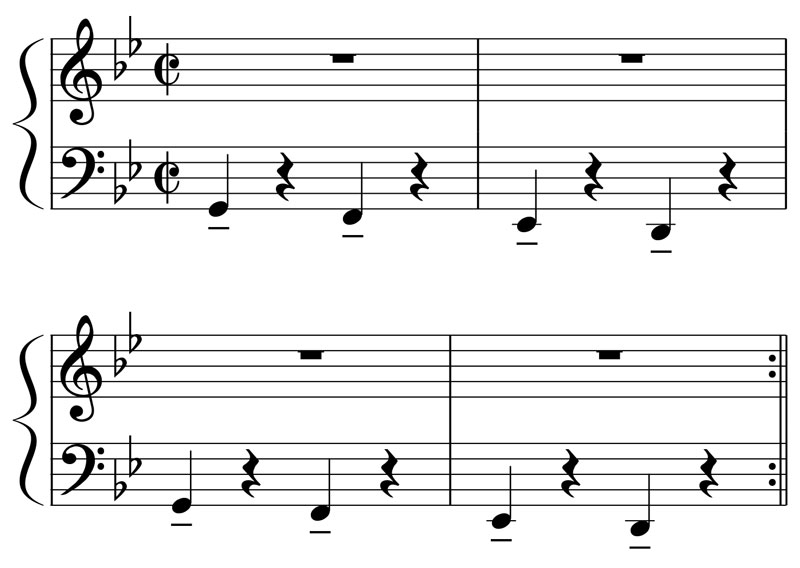
Play along with the recording and try to capture “the feel” of how the notes are played–something that cannot really be put into words or captured in music notation…
Listen to a bit of Frank playing along (my timing and phrasing still needs a bit more work)…
Add a “So>Ti” Pickup to Do
A great way to create a sense of harmonic and rhythmic drive and anticipation is to play a pickup into the next four note cycle.
Here’s one way you might add a “So>Ti” pickup to the basic bass line…
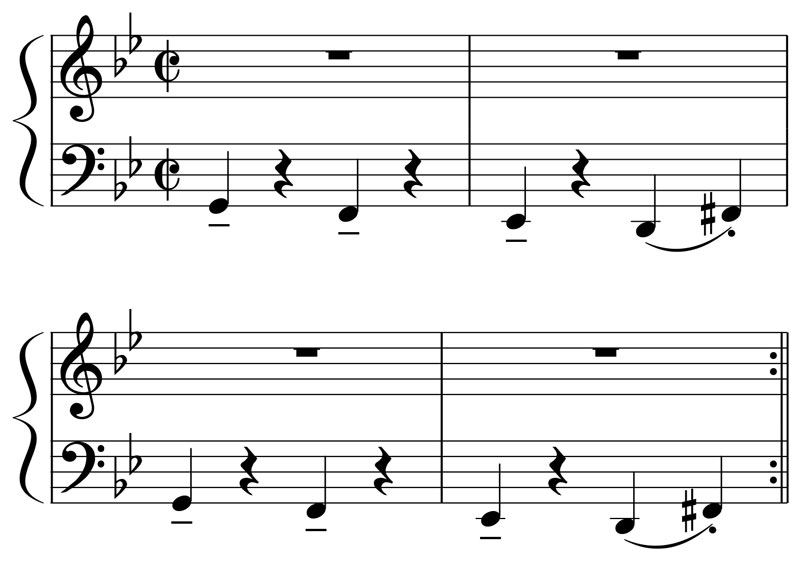
Play along and experiment with different feels and choreographies for the pickup…
Listen to a bit of Frank playing along (my timing and phrasing still needs a bit more work)…
Because you studied your scales like a musician, you already know that Ti is the leading tone, right?
And because you studied my piano technique lesson and videos, you know how to play a two note slur, right?
Add a “So>La>Ti” Pickup to Do
You can create an even stronger sense of harmonic and rhythmic drive and anticipation by playing a longer pickup.
Here’s one way you might add a “So>La>Ti” pickup to the basic bass line…
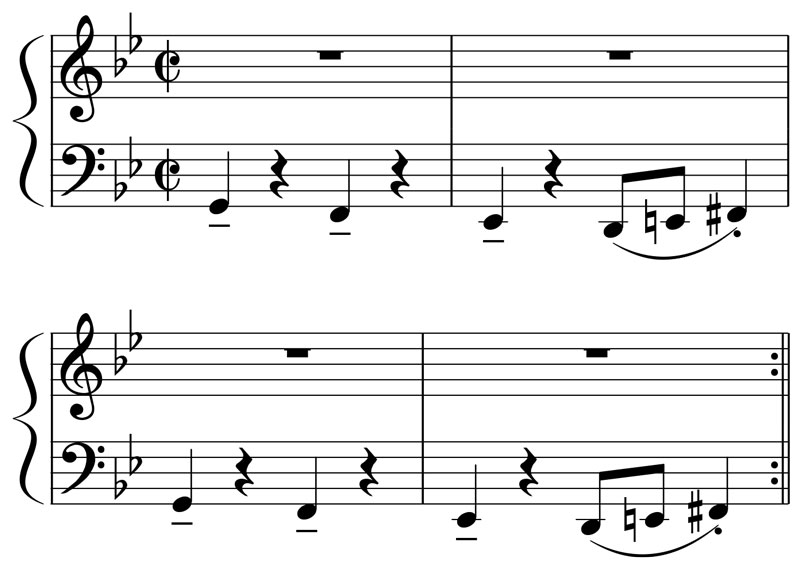
Because you’ve studied your scales like a musician, your know that E is La F# is Ti and that these are the two definitive notes in the G ascending melodic minor scale, right? (Yet another example of how knowing your scales pays huge dividends in all your music making!)
As you play along don’t forget to swing the 1/8th notes and play the pickup a bit understated and with a single unified impulse (it’s ornamental, not structural)…
Listen to a bit of Frank playing along (my timing and phrasing still needs a bit more work)…
Add a “Le>So>La>Ti” Pickup to Do
You can create an even stronger sense of harmonic and rhythmic drive and anticipation by playing an even longer pickup.
Here’s one way you might add a “Le>So>La>Ti” pickup to the basic bass line…
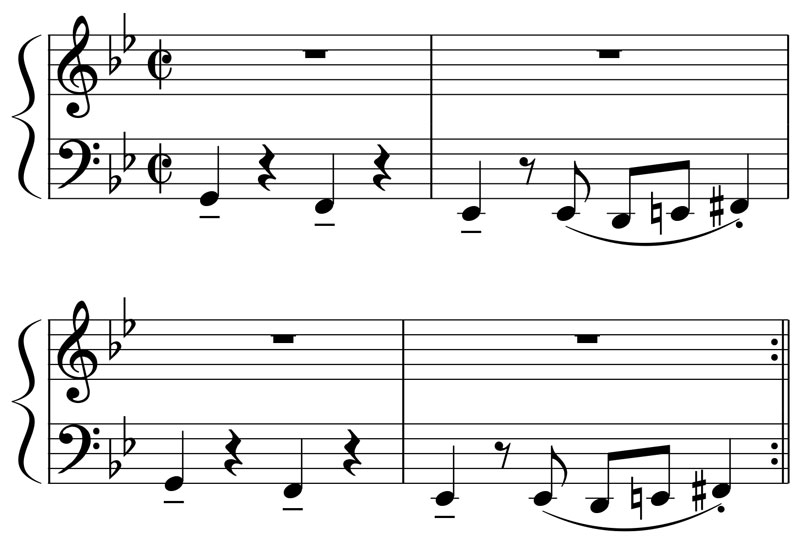
As you play along, experiment with different choreographies until you discover a kind of laid back “bounce” that flow naturally into the next phrase. Again, don’t forget to swing the 1/8th notes!…
Listen to a bit of Frank playing along (my timing and phrasing still needs a bit more work)…
Rocking Octaves
A bread and butter pattern is to play the bass notes in rocking octaves as follows…
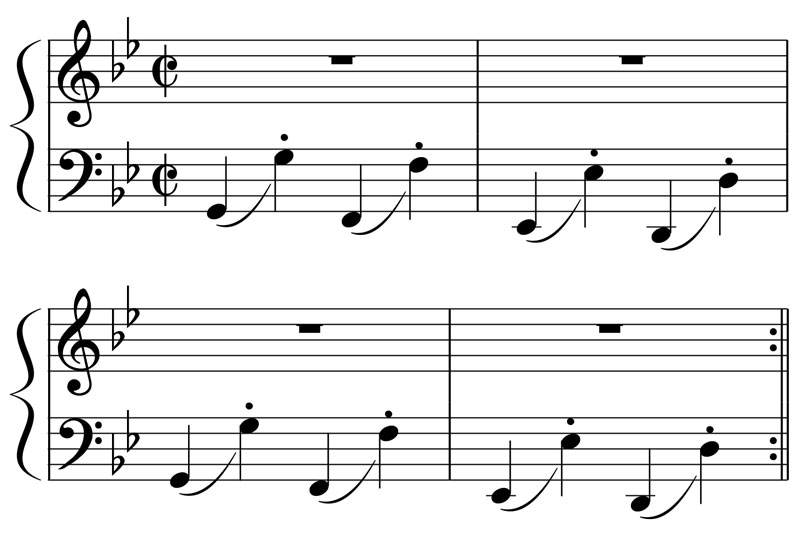
Each octave is a two-note slur. Experiment with your choreography so that the higher note in each octave is shorter and more subdued than the lower note (Hint: It has nothing to do with finger gymnastics)…
Listen to a bit of Frank playing along (my timing and phrasing still needs a bit more work)…
Rocking Octaves Plus a Pickup
Now that we have the building blocks in place, we can combine the rocking octaves with a pickup (feel free to use any other pickup)…
Here’s one possibility…
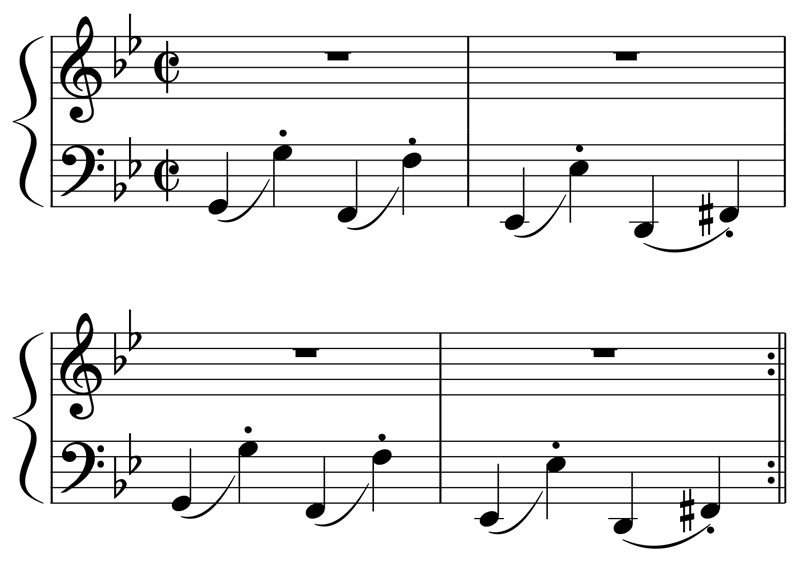
Play along and experiment with your choreography in order to get the proper feel (see all comments above)…
Listen to a bit of Frank playing along (my timing and phrasing still needs a bit more work)…
Feel free to roll your own bass lines by mixing and match all the above to suit your own personal taste… while making adjustments as needed to match what’s happening musically at the time–whether in the intro, a particular verse, a particular chorus, or the tag ending.
back to… Table of Contents
Harmony
Now that we understand the form, meter, tempo, rhythm, tonalities, scales, melody, solfege, and bass line let’s explore some possible chord changes and chord voicings…
Totally Wrong Chord Voicings
Before exploring some proper chords and voicings for “Hit the Road Jack”, let’s be clear on the absolutely wrong chord changes.
Sidebar: I bring this up only because there’s these wrong changes are still promoted and up for sale on the internet. I suspect this is a classic case of theory deafness: the all too common phenomenon where one’s knowledge of music theory makes people deaf to what they are hearing and playing.
Anyway, the widely prescribed WRONG chord progression is i-bVII-bVi-V (G-F-Eb-D) as follows…
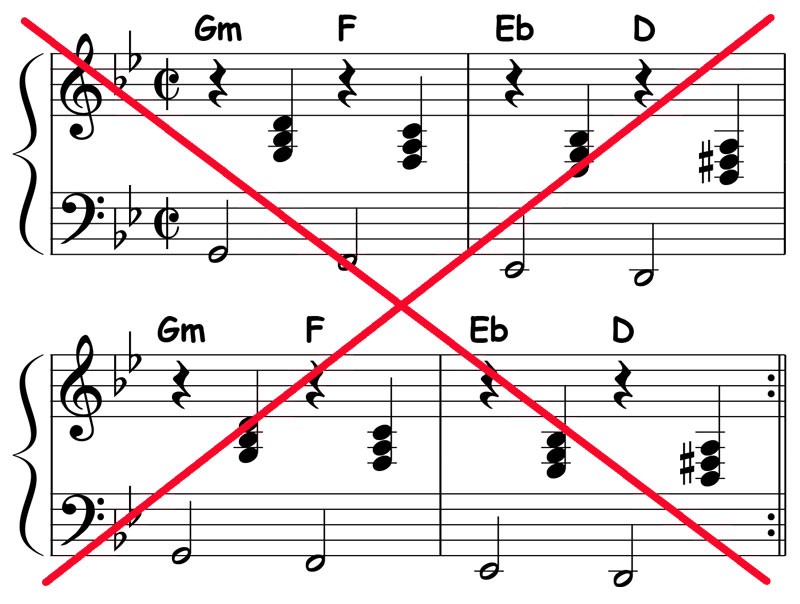
This chord progression is sometimes called an Andalusian cadence (because it’s so commonly used in flamenco music from Southern Spain). While it perfectly suits Flamenco and some styles of minor blues and pop/rock, it just doesn’t work for “Hit the Road Jack”. Don’t just trust me on this. Prove it to yourself by playing these wrong changes along with the recording and notice that things don’t sound or feel right at all (It sounds even more wrong with Mister Charles’s live recordings)…
Please don’t play the chords on the downbeats. This two fisted rhythm is non-negotiable! : )
Listen to Frank play along using the wrong chords…
(Hint: The F# in the D chord is particularly out of place because it sounds and feels too much like European tonal music, not modal blues).
Better Chord Voicings
You’re better off simply playing a G minor triad over the top of the bass line as follows (because it’s a better match with the modal minor blues tonality)…
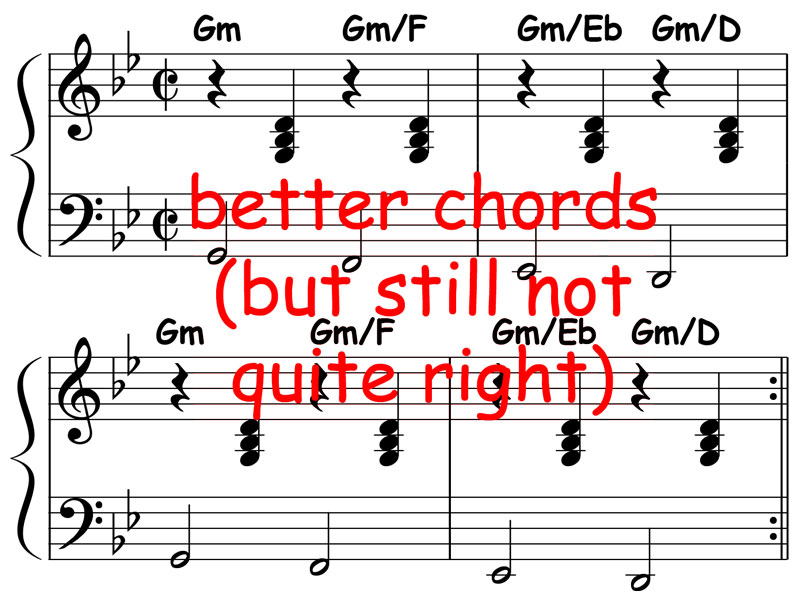
Play this along with the recording and notice that it sounds and feels lots better than the Andalucian cadence, but even THIS doesn’t quite sound and feel right…
Listen to Frank play along using the “better” chords…
(Hint: Can you figure out why this still doesn’t quite work?)
Killer Chord Voicings (Frank’s Vamp)
Of course we could keep on exploring many other possible ways to play “Hit the Road Jack” but allow me to cut to the chase by playing along using my (Frank’s) favorite way to play the famous vamp (a composite derived from Ray Charles’s live performances)– which works great whether playing solo, as an accompanist, or with a band…
Hint: It’s a hybrid of the two patterns above, with a rocking bass line, and some tasty voicings that grow out of the deep harmonic roots of Mister Charles’s musical experience.
Special Note from Frank: Due to little to no interest in this series (only two likes and no comments) and the scourge of greedy marketers who keep pirating the hard work of others for profit, I’ve decided to share the score, theoretical logic, and background information for the vamp you hear me play above with my live students and subscribers only. (Five super cool sustaining piano-ology donors excepted).
back to… Table of Contents