How to think about, read, write, hear, study, and practice scales like a mindful musician, not like a mindless robot…
Table of Contents
Lesson Goal
To deeply understand what it means to really “know your scales”? This includes understanding what scales are, what they do, why it’s important to learn some commonly used scales, what knowledge and skills help you perform better, and how to study and practice scales in order to quickly internalize them using all four musical intelligences: ears, intellect, eyes, and muscles.
Prerequisites
Basic music reading skills… basic scale, chord, and chord progression theory… basic piano technique… the LOVE of music… and the discipline to study and practice.
Why Study Scales?
The study of Scales, done right, is essential to understanding how the overwhelming majority of music works. Studying and practicing scales like a musician–using all four of your musical intelligences–…
- Teaches you that a scale is so much more than a ladder of equally important notes that go up and down in “half steps” and “whole steps”.
- Teaches you that a scale is a palette of sound-feelings that have various degrees of harmonic stability and harmonic tension with respect to the key center Do… and to each other.
- Prepares you to recognize a scale when you hear it.
- Prepares you to recognize a scale when you see it in written music.
- Enables you to think about, hear, and play melodies in functional terms.
- Teaches your that every scale is not just about melodic relationships, but is rich with harmonic relationships.
- You will see how scales and chords are inseparable, interrelated views of the same musical stuff.
- You will appreciate how knowing your scales helps your know your chords and how knowing your chords helps you know your scales.
- Elevates your music reading from “painting-by-number” to deep understanding.
- You will see patterns in written music that you had difficulty reading before.
- You will see and hear patterns in music that you had difficulty hearing before.
- Enables you to internalize music based on meaningful patterns, not brute force note-by-note memorization.
- Deepens your visuospatial awareness of the keyboard so that you “really know your way around the piano”.
- Develops your piano technique.
- Expands your ability to play by ear.
- Integrates reading, theory, ear training, and visuospatial keyboard awareness.
- Broadens your scale and chords vocabulary for composition and improvisation, enabling you to “speak” the language of music in a wide variety of contexts.
- Enables you to transpose melodies to other keys like a pro.
What is a Scale?
A Scale is a collection of pitches that work together in order to achieve some melodic and harmonic purpose…
There are many kinds of melodic and harmonic purposes; there are many types of scales:
- Each scale type has a unique personality.
- Each scale type sounds different.
- Each scale type feels different.
Think of each scale as a distinctive palette of musical sound-colors that work together to create a certain mood or feeling. Never think of a scale as an unbendable or unbreakable rule.
What Do Scales Do?
A scale is not merely a ladder of notes that goes up and down. A scale is much more like a palette of notes, where each note in the scale has a particular musical function:
- Some notes establish the key center.
- Some notes define the tonality (major, minor, mixolydian, dorian, blues, etc.)
- Some notes create melodic-harmonic tension.
- Some provide melodic-harmonic release.
This will all make sense when you study the music theory and ear training for a variety of scale types–major, minor, mixolydian, dorian, and more–by ear, intellect, eye, and muscle.
What “Knowing Your Scales” Isn’t
“Knowing your scales” does not mean mindlessly playing a scale up and down the keyboard over four octaves in parallel and contrary motion as fast as you can in both hands with bad technique, bad rhythm, no understanding of scale structure, no understanding of harmony, no musical intentions, and without your ears fully engaged.
- Repeatedly playing all the major and minor scales in my left hand is time much better spent study-practicing bass lines, stride bass, blues, rock, jazz patterns like arpeggios, and chord voicings.
- I spend almost zero time “practicing scales”. I sometimes use my knowledge and skill with scales (major, all minors, blues, pentatonic major, pentatonic minor, mixolydian, dorian, others) as a basis for improvisation, but only in the same way one uses the alphabet as basis for reading and writing.
- I spend almost no time “practicing scales”… any more than I practice writing and speaking by reciting the ABCs over and over and over again. I do use scales (major, all minors, minor blues, major blues, pentatonic major, pentatonic minor, mixolydian, dorian, others) as a basis for improvisation, but only in the sense that one uses the alphabet as basis for reading and writing. In other words, I go beyond the scales by understanding the grammar of the context and the kinds of vocabulary that suit the occasion.
- One does not get good at writing by reciting the alphabet over and over and over. One gets good by learning meaningful words. Music is no different. So, spend your precious time and energy mastering meaningful musical words, not by mindlessly and mechanically playing scales as prescribed by most “teachers”.
- Studying and practicing scales is less about “building” technique and more about really learning your way around the keyboard, ear training, and visuospatial pattern recognition. Once you know where the notes are, playing scales in all kinds of torturous ways (hands together, 4 octaves, contrary motion, starting on different notes, in two different rhythms, etc) brings diminishing returns.
- Why left-hand scales are not a good use of time… Your left hand usually plays quite different patterns than the right, and therefore must master different motions. In fact, once you master some of these left-hand patterns, you will discover that your RIGHT hand now cannot play them as well as your LEFT.
- Focus on Left hand Accompaniment Patterns, not scales… the source is the music you want to play!
- Such torture is not worthless effort, but… there are hundreds of other things to study-practice that are infinitely more valuable (and fun) in developing your musicianship.
back to… Table of Contents
The “Know Your Scales” Mindset
The musical way to think about, study, and practice your scales:
- Study and practice your scales for performance, not for getting good grades on a music theory test.
- It’s not just about what a scale is (a noun); it’s about what a scale does (a verb).
- How does each notes in the scale sound, feel, and function?
- How does each notes in the scale relate to the other notes in the scale?
- Music theory should always be integrated with ear training.
- Learn to spell each scale just as you learn to spell, literally spell, any word in English.
- For example, the C Major Scale is spelled C-D-E-F-G-A-B-C and the D Flat Major Scale is Spelled: Db-Eb-F-G-Ab-Bb-C-Db.
- For example, the C Natural Minor Scale is spelled C-D-Eb-F-G-Ab-Bb-C.
- Don’t learn the major scale by counting whole-steps and half-steps; instead learn the major scale by ear: by singing Do-Re-Mi-Fa-So-La-Ti-Do and finding the notes.
- Scale study and practice, done right, is about training your brain, not your muscles. You’ll know you’re making progress when your brain, not you muscle, get tired.
back to… Table of Contents
The “Know Your Scales” Skill Set
Here, for your consideration, is a list of the knowledge and skills (in no particular order of importance or priority) that will help you perform better, not just get better grades on a music theory test:
- Name each note in the scale by its Letter Name.
- Describe the Scale Structure for the Scale using the Number System.
- Describe the Scale Structure for the Scale using the Solfege System.
- Name each note in the scale using the Number System.
- Name each note in the scale using the Solfege System.
- Name each note in written music using its Letter Name.
- Name each note in written music using its Number Name.
- Name each note in written music using its Solfege Name.
- Visualize the unique pattern of white and black keys on the keyboard.
- Name each note on the keyboard using its Letter Name.
- Name each note on the keyboard using its Scale Degree (number name).
- Name each note on the keyboard using its Solfege Syllable.
- Explain what each note in the scale does.
- Know the Key Signature and be able to write it on the grand staff (Treble and Bass clefs).
- Recognize when the scale or scale fragment is being used in written music.
- Be able to define the key center (Do) and tonality (major, minor, mixolydian, dorian, blues, etc).
- Recognize the unique sound-feeling of each note with respect to the key center.
- Recognize the unique sound-feeling of each note with respect to the other notes.
- Connect the unique sound-feeling of each note to its letter name, scale degree, and Solfege syllable.
- Construct, think about, hear, see, and play the chords than can be built using the notes in the scale.
- Construct, read, write, name, visualize, hear, and play the modes for each scale.
- Play each scale in musically meaningful patterns using easy fingering and choreography.
- Can you think of some others?
(*) Naming things is not a necessary performance skill. The Letter Names, Scale Degree Numbers, and Solfege Syllables are just like training wheels that you will quickly abandon as you build you learn to speak the language of music.
back to… Table of Contents
Scale Mastery Checklist (Needs Work)
Major Scales
- Names of the Notes
- Read & Write in Treble Clef
- Rear and Write in Bass Clef
- Scale Structure using Scale Degrees
- Scale Structure using Solfege
- Be able to use Letter Names, Scale Degrees, and Solfege Interchangeably.
back to… Table of Contents
Knowledge & Skill Set Sample Questions
Another way to clearly communicate the kinds of knowledge and skill required is to ask some sample questions, as follows…
Q: What is the Key Signature of the key of Eb Major?
A: Three flats: Bb, Eb, Ab.
Q: What does Mi in a major scale do?
A: It defines the scale as major.
Q: What does Me in a minor scale do?
A: It defines the scale as minor.
Q: What is the leading tone in the key of F major?
A: The note “E”.
Q: What function does “Ti” typically perform in a Major Key?
A: “Ti” creates strong harmonic tension that wants to resolve to Do. “Ti” is called the “leading tone” because it naturally leads the ear back to the key center Do.
Q: What is the Letter Name of scale degree “6” in the key of D Major?
A: The note “B”.
(*) Naming things is not a necessary performance skill. The Letter Names, Scale Degree Numbers, and Solfege Syllables are just like training wheels that you will quickly abandon as you build you learn to speak the language of music.
Ways to Know a Scale
Letter Names & Keyboard Layout
The baseline skill that lays the foundation for every other skill…
Sample Question: What are the letter names of the notes in a G Major Scale?
Answer: G-A-B-C-D-E-F#-G.
Sample Question: Play them.
Answer: [insert video]
Literacy (Reading & Writing)
A sampling of music reading and writing skills that someone who really knows their scales should be able to demonstrate without hesitation…
Skill #1: Write the Key Signature and notes for a Bb Major Scale (and name them using their letter names, scale degree, and Solfege name in two octaves in both Treble & Bass Clef).
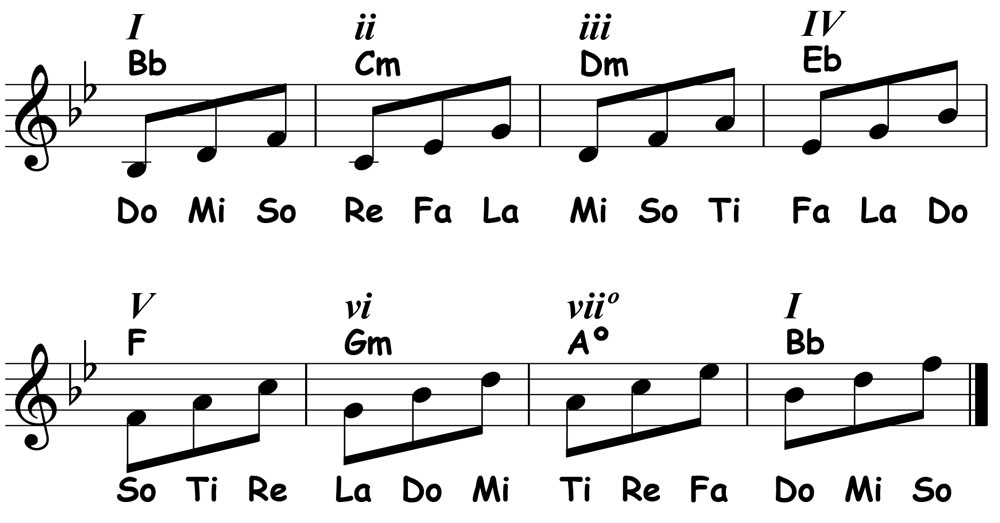
Skill #2: Write the Key Signature, notes, and diatonic triads for a Bb Major Scale (and name each chord using it’s Letter Name and Roman Numeral Name).
Reading & Writing the B Flat Major Scale
The ability to map the melodic-harmonic function of each note in a scale to music notation is a huge advance in your musicianship.
Here, for example, is the Bb Major Scale written over two octaves in both treble and bass clef, along with the letter names, scale degrees, and Solfege syllables for each note…
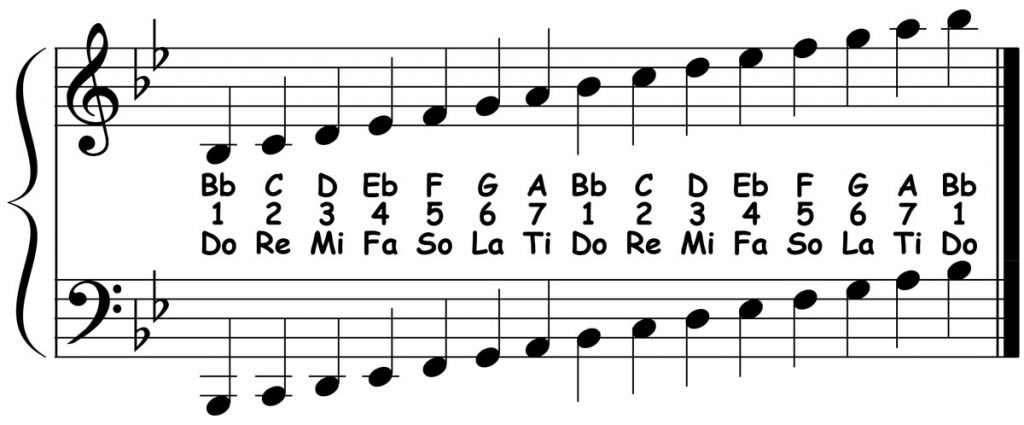
Knowledge & Skill Set: Given the music notation and key signature, be able to identity the letter names, scale degrees, and Solfege syllables for any note in the scale.
Scale Structure, Scale Degrees & Solfege Ear Training
Study & Practice Idea: Read, play, and sing the notes in a Bb Major Scale over 1 octave, ascending and descending, using one finger, with a metronome at 60 beats per minute.
Sidebar: The goal here is to connect and internalize the letter names, scale degrees, solfege, reading, and pattern of black and white notes are on the keyboard. Play with your index finger for now. It’s ok if you playing using the standard fingering, but please start thinking choreography, not finger gymnastics.
[insert notation, keyboard, audio, and video]
Sample Question: What is the scale structure for all Major Scales (using Scale Degrees)?
Answer: 1-2-3-4-5-6-7-8(1).
Sample Question: What is the scale structure for all Major Scales (using Solfege Syllables)?
Answer: Do-Re-Mi-Fa-So-La-Ti-Do.
Sample Question: What is the Letter Name of “Do” in the key of Bb?
Answer: “Bb”.
Sample Question: What is the Solfege name for F# in the key of E?
Answer: “Re”.
Diatonic Triads
Knowledge & Skill Sets:
- Given a key center and scale type (major, minor, etc.), name each chord by its Roman Numeral name, letter name, and type (major, minor, diminished)
- Know the letter names and Solfege syllables for the notes in each chord.
Sample Question: What are the diatonic triads in the F Major Scale?
Answer: F, Gm, Am, Bb, C, Dm, Edim.
Sidebar: Scales and chords are inseparably and intimately inter-related views of the same musical stuff. Knowing your chords helps you know your scales and knowing your scales helps you know your chords.
Diatonic Triads for the B Flat Major Scale

Diatonic Triad Arpeggios for the B Flat Major Scale
Study-Practice Idea: Play each triad as an arpeggio. As you play, say the chord name, and sing the letter names and sound names for each note out loud. Do this going either up or down the scale.
Diatonic 7th Chords for the B Flat Major Scale
Study-Practice Idea: Play each seventh chord as an arpeggio. As you play, say the chord name, and sing the letter names and sound names for each note out loud. Do this going either up or down the scale.

Modes
Ionian (1st) Mode of the B Flat Major Scale
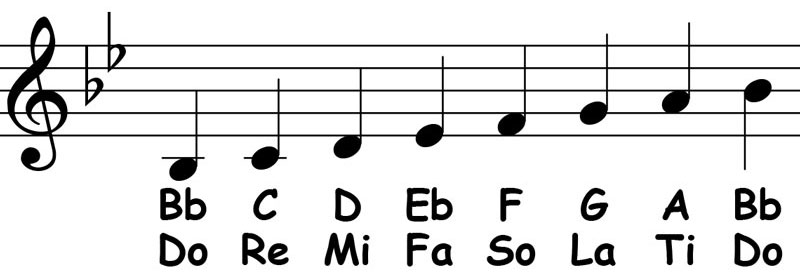
Dorian (2nd) Mode of the B Flat Major Scale

Phrygian (3rd) Mode of the B Flat Major Scale

Lydian (4th) Mode of the B Flat Major Scale

Mixolydian (5th) Mode of the B Flat Major Scale

Aeolian (6th) Mode of the B Flat Major Scale

Locrian (7th) Mode of the B Flat Major Scale
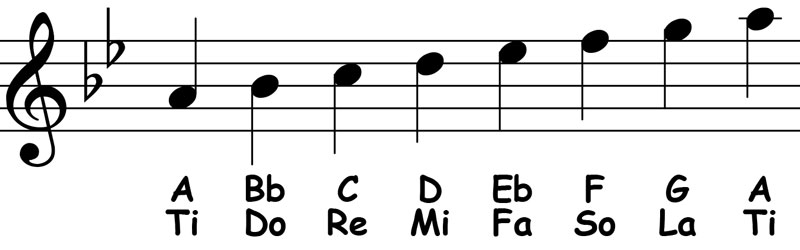
Performance
Never, ever, ever play scales as mere “exercises”… like mindlessly lifting weights or doing jumping jacks. Doing so is not good preparation for performance. You should study and practice scales in a way that helps you perform better.
To that end:
- Study and practice scales in musically-useful patterns (see below).
- Always play scales musically–with musical phrasing, articulation, and dynamics.
- Always play with good rhythm. In order to check your time, play with a metronome or click track.
- Always play with good technique. Never accept any tension or awkwardness in your execution. (see Piano Technique)
- Always, always, always play with your ears fully engaged. Hint: Sing the notes in your mind’s ear as you play, and play it like you sing it!
Here are some musically-useful scale patterns applied to the Bb Major Scale that combine reading, theory, keyboard awareness, ear training, fingering, technique, and interpretation all at once.
Many other musical patterns are also possible, but at this point you are better served by getting your study-practice material directly from the kinds of music that YOU want to play!
Takeaway #1. A scale is not just a row of notes to be mindlessly played up and down the keyboard as physical exercise day after day after day. Never, ever, ever, ever, ever play scales as mere “exercises”… like mindlessly lifting weights or doing jumping jacks. Why? Because doing so is NOT effective preparation for performance.
B Flat Major Nine-Note Scale Played Legato over a I-V7-I Chord Progression
Ascending with crescendo, then descending with diminuendo…

Descending with diminuendo, then ascending with crescendo…

B Flat Major Scale Nine-Note Scale Played Staccato over a I-V7-I Chord Progression
Ascending with crescendo, then descending with diminuendo…

Descending with diminuendo, then ascending with crescendo…

B Flat Major Scale Played in Duplets over 2 Octaves
Ascending…

Descending…

B Flat Major Scale Played in Triplets over 3 Octaves
Ascending…

Descending…

B Flat Major Scale Played in Broken Thirds
Technique Tip: This pattern absolutely requires lateral and rocking arm motion…
Ascending…

Descending…

B Flat Major Scale Played in Broken Duplets (Two-Note Slurs)
Ascending…

Descending…

B Flat Major Scale Played in Broken Triplets
Ascending…

Descending…

Many other musical patterns are also possible, but at this point you are better served by getting your study-practice material directly from the kinds of music that YOU want to play!
Relative Keys
Sample Question: What Minor Scale has the same key signature as A Major?
Answer: F# Minor (three sharps: F#, C#, G#).
Sample Question: What Mixolydian Scale has the same key signature as C Major?
Answer: G Mixolydian (no sharps or flats).
Sample Question: What Dorian Scale has the same key signature as D Major?
Answer: E Dorian (two sharps: F# & C#).
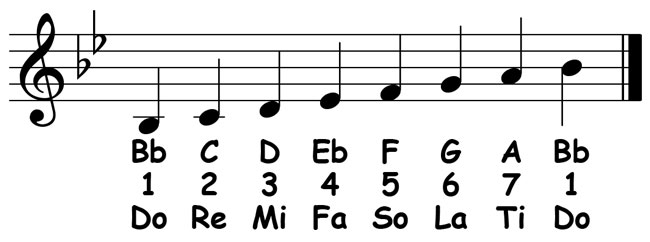
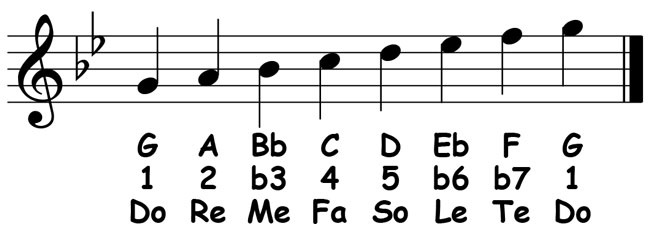
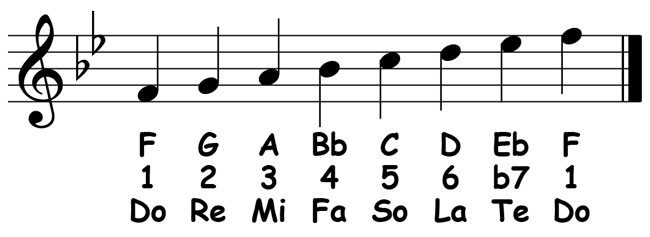
Relative Keys of B Flat Major Scale
B Flat Major shares the exact same key signature of two flats (Bb, Eb) with the keys of G Minor, F Mixolydian, and C Dorian…
B Flat Major…
G Minor…
F Mixolydian…
C Dorian…
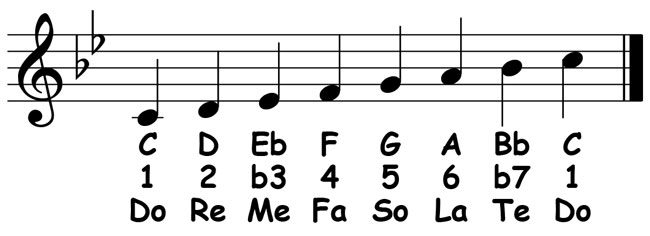
Important: These are not modes of each other. Each one has its own key center Do and tonality in and of itself.
Words of Encouragement
Studying your scales so deeply and in so many ways may seem like an overwhelming task until you realize four things:
- You can study-practice many of these skills–reading, theory, ear training, chords, chord progressions, visuospatial keyboard awareness, fingering, technique, and interpretation all simultaneously.
- Each skill overlaps with every other skill, so that they mutually reinforce each other.
- Mastering your scales is a very learnable skill that requires no special talent. All it takes is the discipline to study and practice the right things the right way.
- The process of knowing your scales will become self-sustaining once you see the enormous benefits of do so.
Don’t worry if you don’t know all the above yet. That’s what the following lessons are for!!! Keep on browsing and doing. It will all make sense in no time!
learn more… Scales
Hi Frank, Good morning from Ghana. It your disciple “Saxman”. I’ve just read your topic” Piano Scales: Piano Scales Mastery, From Beginner To Advanced” I just want to thank you for re orienting me on how to study and play Music scale like a real musician. I hope you are doing well.
Hi, Saxman! It’s always nice to hear from you. Thanks you so much for the positive feedback. Wishing you all the best in music and life!