An illuminating lesson in how to transpose melodies like a mindful musician… not like a mindless computer…
Table of Contents
Lesson Goal
To understand and apply the process of transposing a melody by using your knowledge of scale structure (scales degrees or solfege), not by using the brute force counting half steps method.
Prerequisites
Basic music reading… LOVE of music… and the discipline to study and practice.
Benefits of Learning How to Transpose Music
Transposition–the process of playing or writing a piece of music in other than the original key–enables you…
- To play a song in a comfortable range for the vocalist… a valuable skill for any accompanist.
- To play in keys preferred by other instrumentalists in an ensemble setting. For example, guitarists prefer keys with open strings such as of E and A, while horn players prefer “flat” keys such as F, Bb, and Eb.
- To play comping patterns, chord voicings, and licks in a variety of keys… a valuable skill for all blues, pop, rock, and jazz players.
(Of course, nobody ever asks the piano player what keys they prefer!)
back to… Table of Contents
How NOT to Transpose Music
The ridiculous, but widely-prescribed formula for transposing any music is to count how many half-steps the new key is above or below the original key, then to add or subtract that many half-steps from each and every note.
Such a formula is logically correct, but suffers from three fatal flaws:
- It treats music like a math problem to be conquered with your intellect. (Don’t forget: Music is not math; music is a language.)
- While it’s easy to understand in theory, it’s almost impossible to execute in practice unless you are a computer.
- It totally devoid of musical understanding.
As musicians, our goal is not to train ourselves in the herculean task of adding or subtracting some number of half-steps to or from every note, but to apply our functional understanding of the melody, described in the following sections…
back to… Table of Contents
How to Transpose Melodies Like a Musician
The key to transposing any melody like a musician, not like a computer, is to think about and hear the melody in functional musical terms. Two common practice ways to think about and hear any melody in functional terms are the scale degree system and solfege system (see: Scale Structure).
Let’s illustrate how both systems work by applying them to a sequence of notes, as follows…
Transposing Melodies using Scale Degrees
Let’s pretend we have a melody in the key of C major that consists of the sequence of notes “C-G-A-G-F-E-D-C“, as follows…
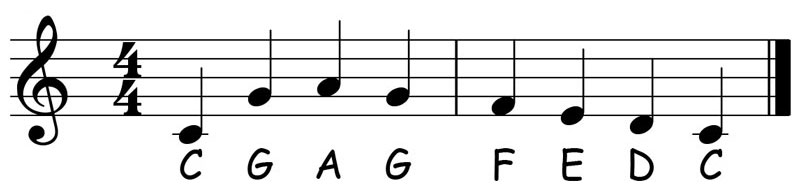
One way to transpose this sequence to any other key is to think, hear, and play the sequence in functional musical terms using scale degrees, in this case: 1-5-6-5-4-3-2-1. Once you know the scale degree sequence, all you have to do is think, hear, and play “1-5-6-5-4-3-2-1” in the new key. Here, for example is the process for transposing the sequence to the key of F…


In other other words, you do not “transpose” at all. You simply play the Scale Degrees in the new key! No counting half-steps. No mental gymnastics. No brute force calculations. All that’s required is to understand what notes are being played in functional terms using Scale Degrees! (If you really know your scales, this process should be a piece of cake.)
Transposing Melodies using Solfege
Again, let’s pretend we have a melody in the key of C major that consists of the sequence of notes: “C-G-A-G-F-E-D-C” as follows…
One way to transpose this sequence to any other key is to think, hear, and play the sequence in functional musical terms using Solfege Syllables: Do-So-La-So-Fa-Mi-Re-Do. Once you know the scale degree sequence, all you have to do is think, hear, and play “Do-So-La-So-Fa-Mi-Re-Do” in the new key. Here, for example is the process for transposing the sequence to the key of F…


How to Transpose Melodies YouTube
back to… Table of Contents
Some Words of Encouragement
This may seem like an overwhelming task, but I assure you it’s not as hard as it’s made out to be. For the moment, it’s enough just to understand and appreciate the power of transposing melodies using your knowledge of Scale Structure (Scale Degrees or Solfege). Keep on learning your scales the right way and you’ll quickly internalize the necessary knowledge and skills by osmosis, guaranteed!
Also See: How to Transpose Chord Progressions Like a Pro!
learn more… Scales