Bread & Butter Minor 2 5 1 Chord Voicings that every jazz piano player should have in their bag…
Table of Contents
Lesson Goal
To quickly internalize common practice Minor 2 5 1 Chord Voicings in all keys… by ear, intellect, eye, and muscle.
Prerequisites
Basic music reading… basic scale and chord theory… the LOVE of music… and the discipline to study and practice.
Why Learn These Minor 2 5 1 Chord Voicings…
- You will develop the ability to recognize a minor 2 5 1 chord progression by ear.
- You will develop the ability to recognize a minor 2 5 1 when you see the chord symbols in a chart.
- You will develop the skill to play a variety of minor 2 5 1 chord voicings and rhythms (comping).
- You will develop the skill to improvise melodic lines over a minor 2 5 1 in a variety of styles and rhythms (soloing).
“Basic” Minor 2 5 1 Chord Voicings
“Basic” Minor 2 5 1 Chord Voicings in C Minor
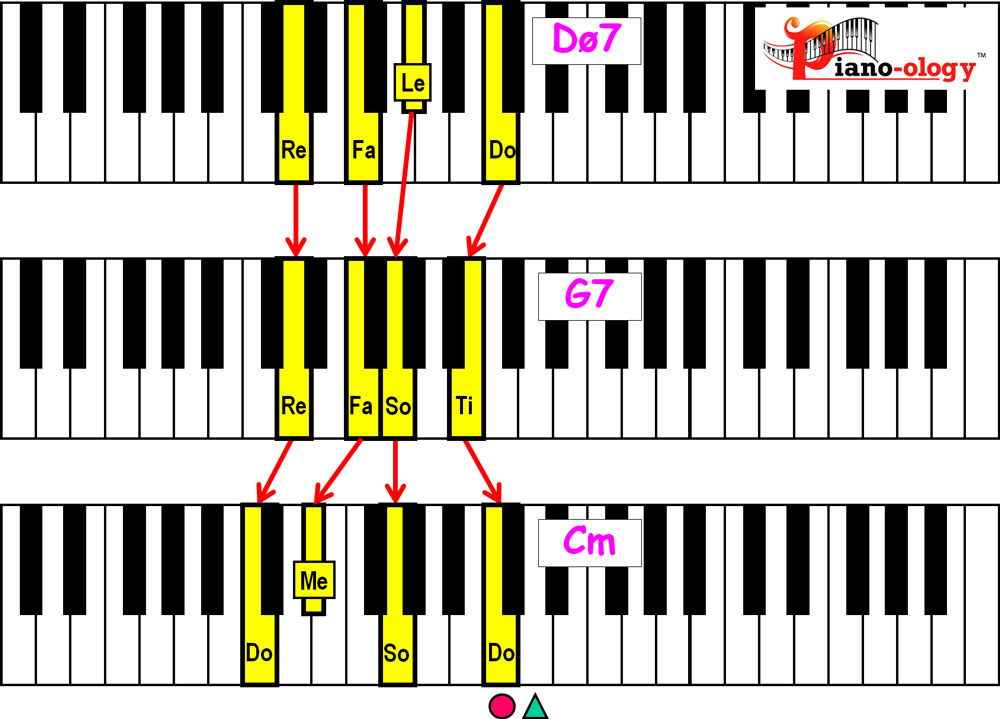
Here is the most basic rendition of the minor 2-5-1 (iiø7-V7-i) chord progression in the key of C Minor: Chord roots in the lfet hand and closed position chords with voice leading in the right hand…


In addition to seeing how the tones in each chord stack up vertically, it’s also important to see how the individual voices move horizontally through the chord changes (traced by the red arrows: From Dø7 to G7, the top two voices move down scale-wise while the bottom two voices remain the same… and from G7 to Cm, So remains the same, the leading tone Ti resolves up to Do, and the bottom two voices move down scale-wise.
Special Note: For many jazz ballads in a minor key, a simple minor triad is the most appropriate choice for the tonic chord. Depending on the mood of the piece, color tones such as “6”, “7”, and “9” may be added.
“Basic” Minor 2 5 1 Chord Voicings, All Keys
Using your ears and knowledge of scales and chord structure, play this iiø7-V7-i pattern in all 12 minor keys arranged around the cycle of dominants…
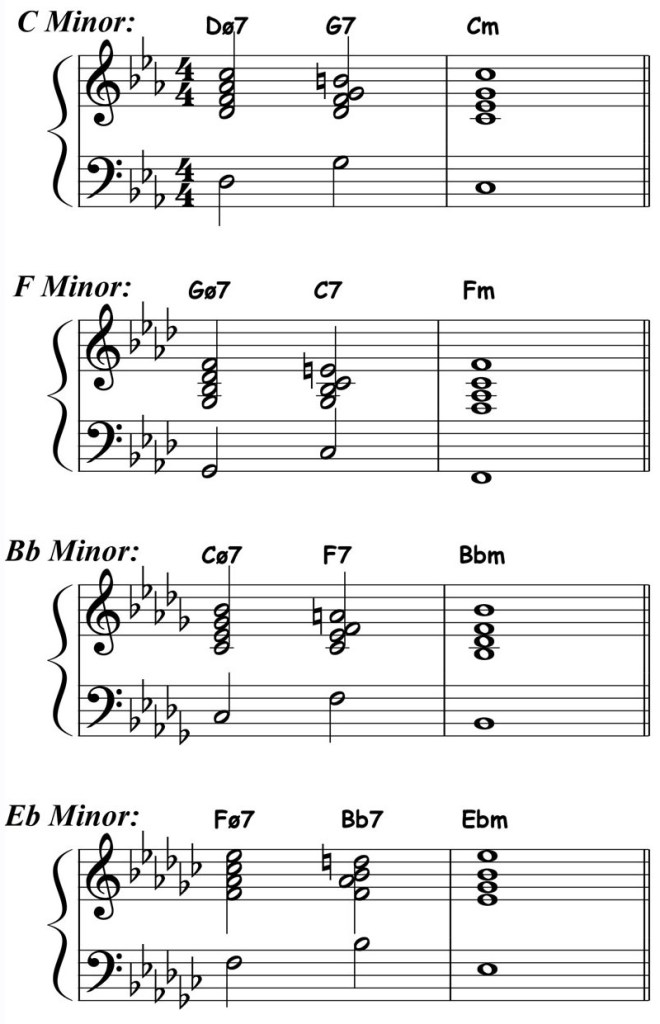
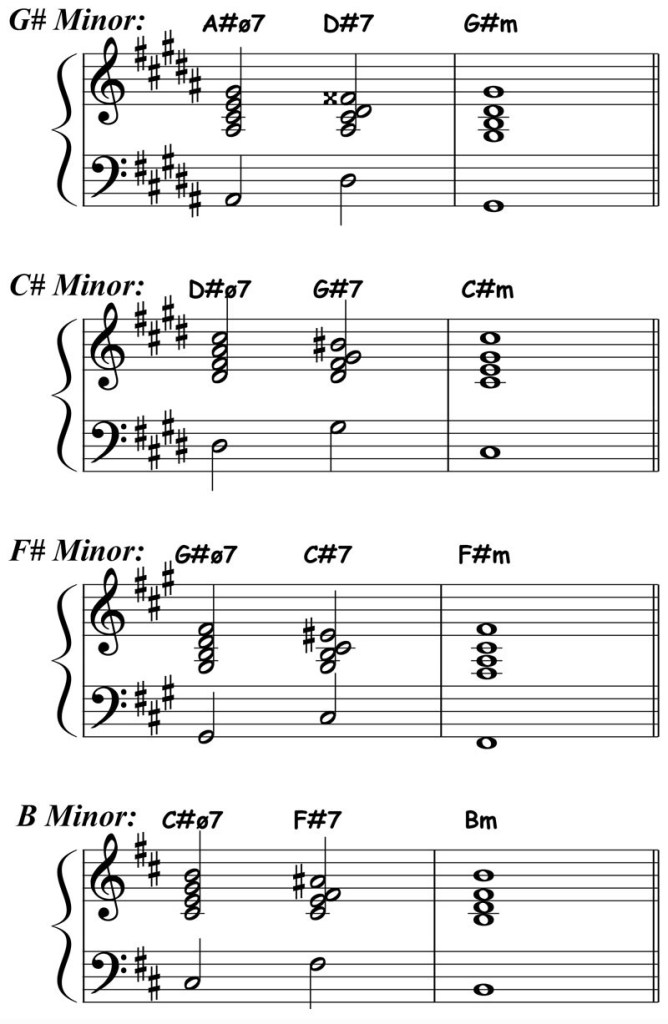
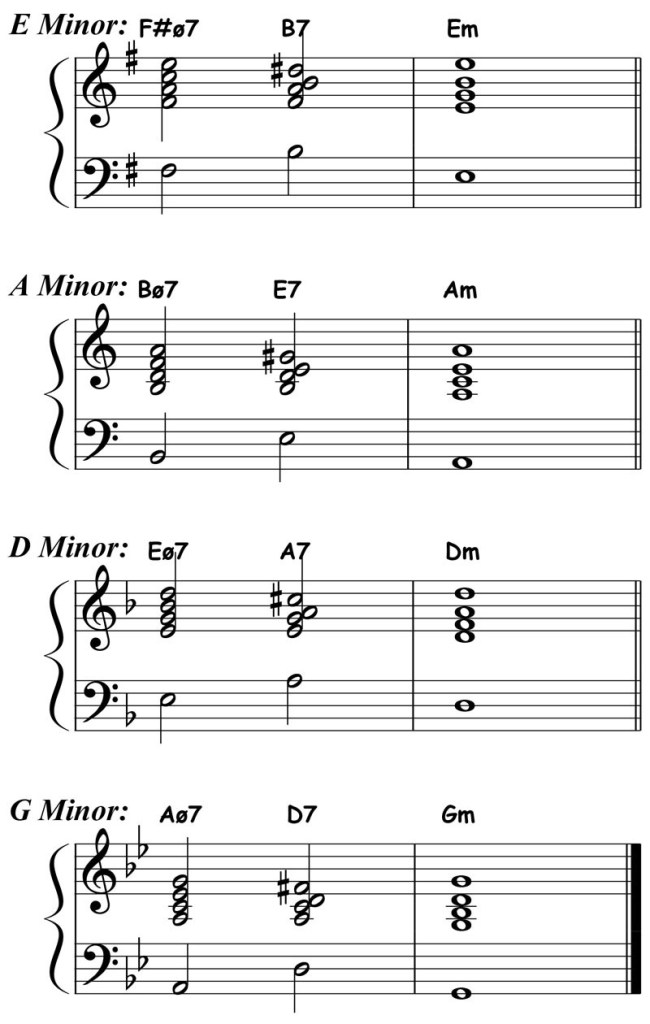
Learning by doing in this manner will build an enormous scale and chord vocabulary that integrates visuospatial keyboard awareness, ear training, technique, and rhythm… and lays a rock solid foundation for fluent improvisation.
back to… Table of Contents
Listen to an example at 120 beats per minute…
“Basic” Minor 2 5 1 Chord Voicings Practice Tracks, All Keys (MP3s)
Of the score above with a two bar count off at 60, 80, 100, 120, 140, 160, & 180 beats per minute…
Playing along at a variety of tempos is a highly effective way to discover and tighten up every loose screw in your thinking, technique, and rhythm. And as you do so, you’ll automatically internalize an enormous chord vocabulary–by ear, intellect, eye, and muscle!
back to… Table of Contents
“Left Hand Block” Minor 2 5 1 Chord Voicings
“Left Hand Block” Minor 2 5 1 Chord Voicings in C Minor

“Left Hand Block” Minor 2 5 1 Chord Voicings, All Keys
Using your ears and knowledge of scales and chord structure, play this iiø7-V7-i pattern in all 12 minor keys arranged around the cycle of dominants…


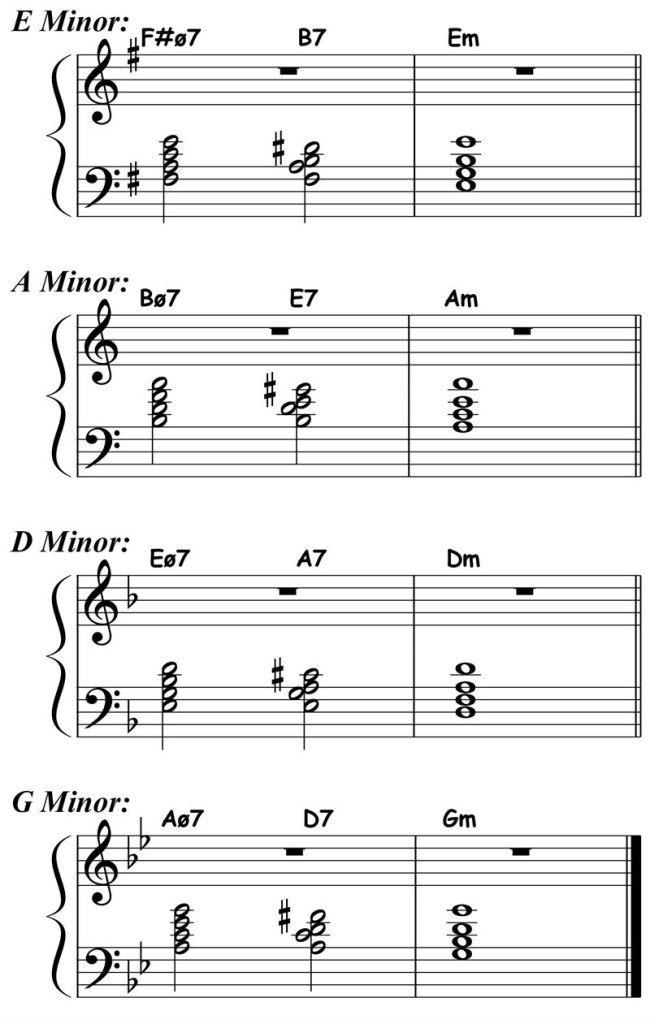
Listen to an example at 120 beats per minute…
“Left Hand Block” Minor 2 5 1 Chord Voicings Practice Tracks, All Keys (MP3s)
Play along tracks of the score above with a two bar count off at 60, 80, 100, 120, 140, 160, & 180 beats per minute…
Playing along at a variety of tempos is a highly effective way to discover and tighten up every loose screw in your thinking, technique, and rhythm. And as you do so, you’ll automatically internalize an enormous chord vocabulary–by ear, intellect, eye, and muscle!
back to… Table of Contents
“iiø7,b9-V7,b9-iM7,9” Chord Voicings
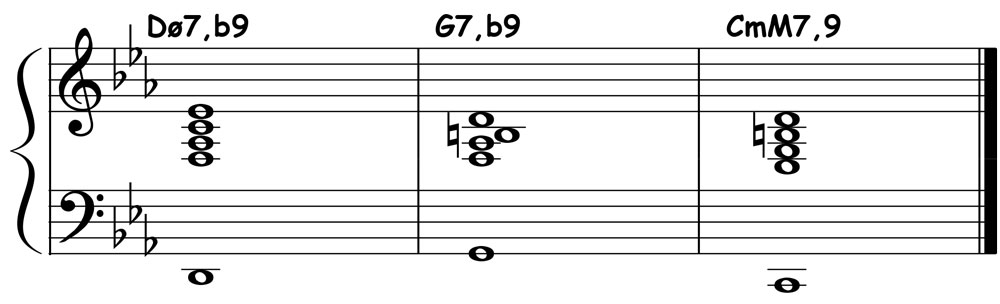
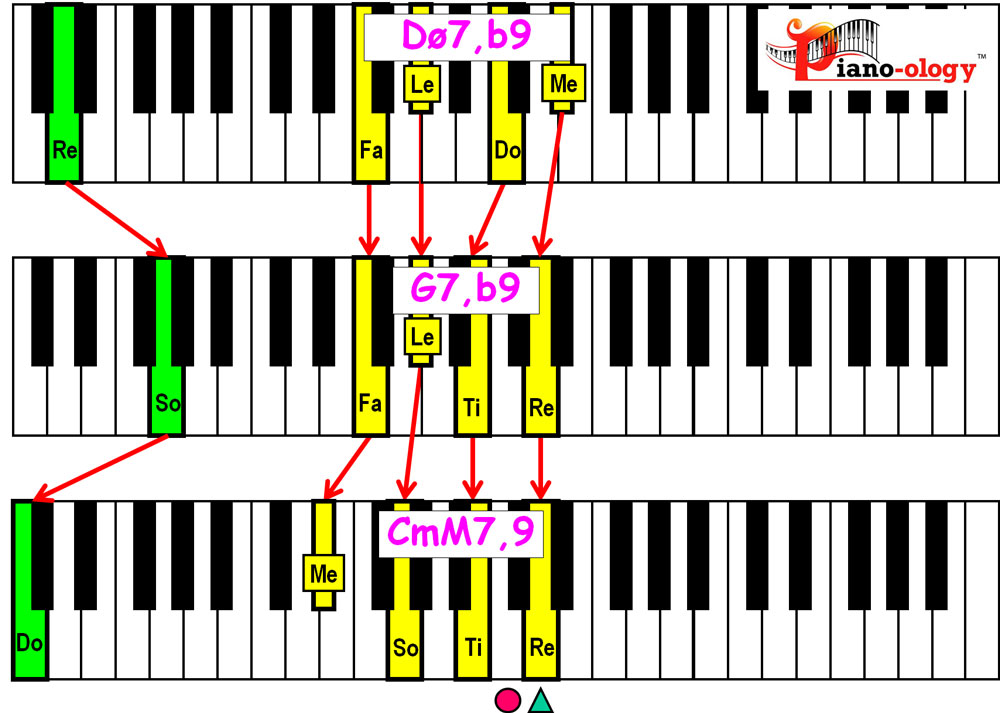
In order to achieve a jazzier sound, it is customary to add color tones to the basic seventh chords. A standard way to do so is to add “the 9” or “b9” to each 7th chord and drop all the roots in the right hand as follows…
“iiø7,b9-V7,b9-iM7,9” Variation #1
Notice that the chord roots are dropped in the right hand)…
“iiø7,b9-V7,b9-iM7,9” Variation #1, Rootless
Now play the right hand above as a rootless left-hand voicing, leaving your right hand free to play the melody or improvise…

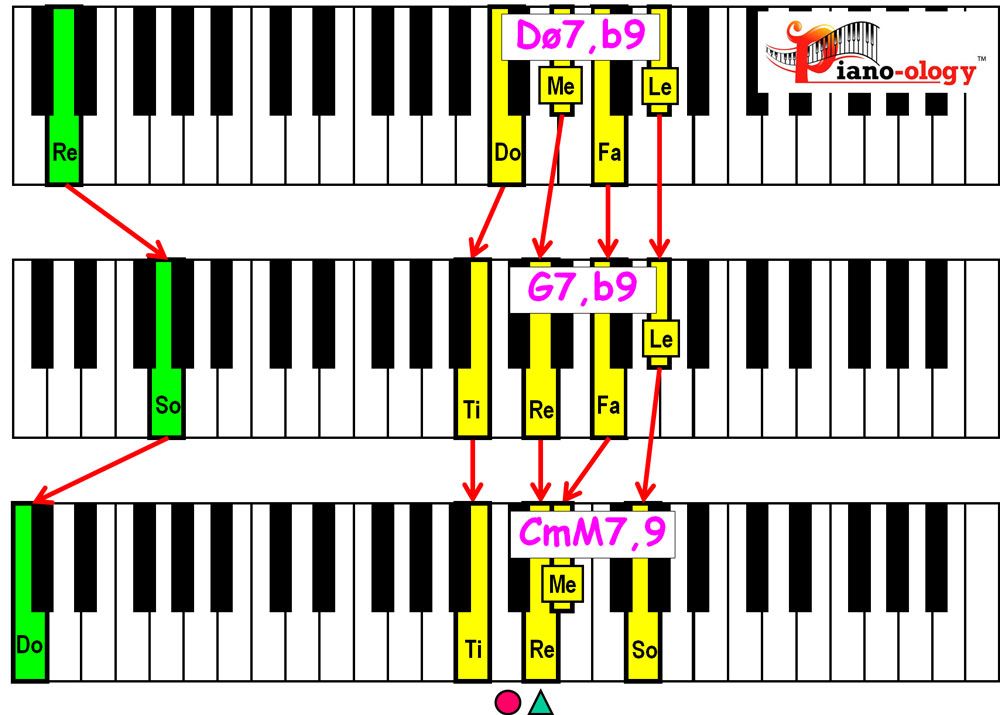
“iiø7,b9-V7,b9-iM7,9” Variation #2
Again, notice that the chord roots have been dropped in the right hand…

“iiø7,b9-V7,b9-iM7,9” Variation #2, Rootless
Now play the right hand above as a rootless left-hand voicing, leaving your right hand free to play the melody or improvise…

back to… Table of Contents
“iiø7,b9-V7,#9,b13-iM7,9” Chord Voicings
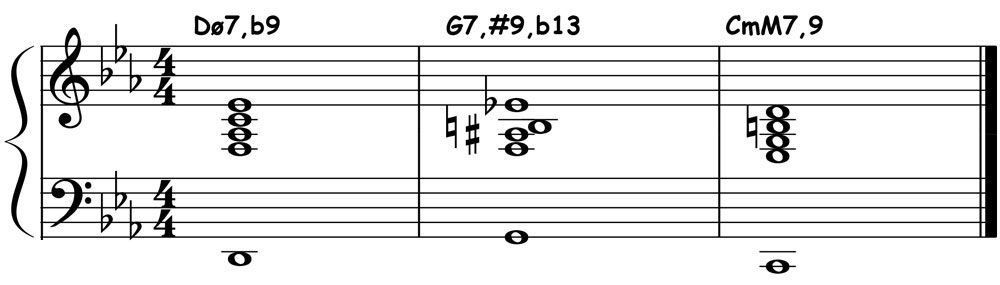
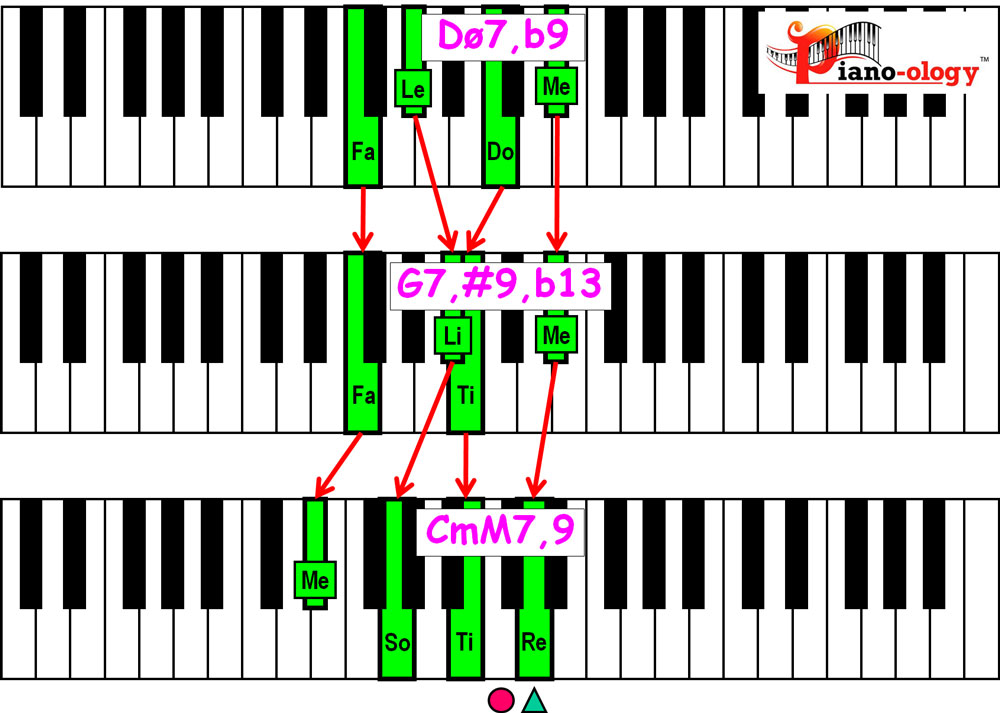
“iiø7,b9-V7,#9,b13-iM7,9” Variation #1
Lesson Goal: To master the minor 2 5 1 chord progression iiø7,b9-V7,#9,b13-iM7,9 chord voicings…
Notice that the chord roots are dropped in the right hand…

“iiø7,b9-V7,#9,b13-iM7,9” Variation #1, Rootless
Now play the right hand above as a rootless left-hand voicing, leaving your right hand free to play the melody or improvise…
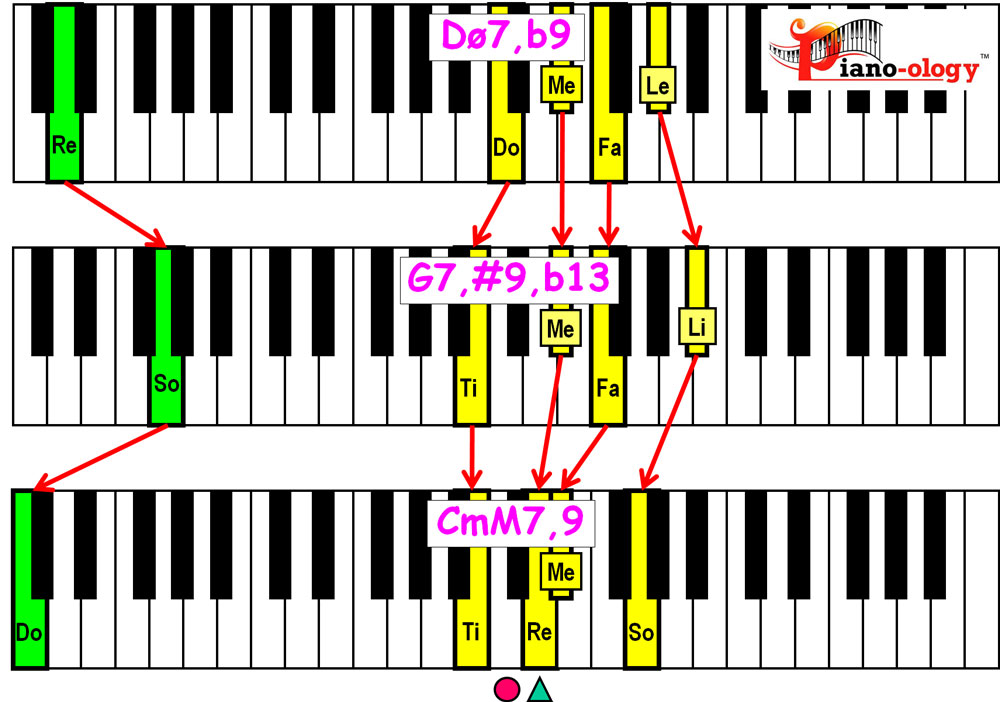
“iiø7,b9-V7,#9,b13-iM7,9” Variation #2
Again, notice that the chord roots have been dropped in the right hand…

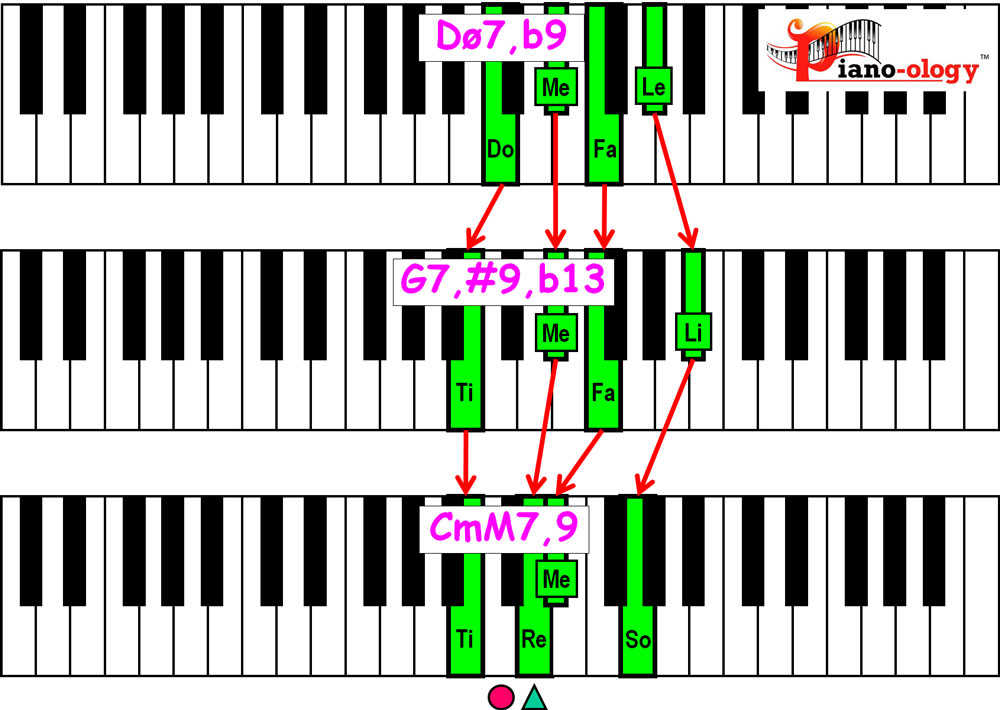
“iiø7,b9-V7,#9,b13-iM7,9” Variation #2, Rootless
Now play the right hand above as a rootless left-hand voicing, leaving your right hand free to play the melody or improvise…
back to… Table of Contents
learn more… Jazz Piano Lessons