Lesson Goal: To quickly internalize authentic comping and soloing vocabulary for “Memphis Underground”… by ear, intellect, eye, and muscle…
Table of Contents
Special Note: When Frank met Herbie Mann many years ago, he shared his one musical regret: That he never learned to read music… because it closed him off to learning so much more!
Prerequisites
Basic music reading skills… basic scale, chord, and chord progression theory… basic technique… the LOVE of music… and the discipline to study and practice.
Study, Practice, & Performance Tips
- Never play these mindlessly and mechanically. Always aspire to play them musically.
- Don’t just play dots. Play sounds!
- Never think, hear, and play one note at time. Hear and play in complete phrases.
- Don’t merely memorize these. Internalize them using all four musical intelligences: ears, intellect, eyes, and muscles.
- Every time you practice something, you are programming your brain. So always play accurately.
- Practice with a Click Track or a Rhythm Track. Doing so will give you immediate feedback on any rhythmic misconceptions or places where your timing gets sloppy.
- Record Yourself, always. Listen to the playback immediately, and ask yourself: Is that what you intended to play?”
- If anything feels tense or awkward, stop immediately and experiment with alternative fingerings or choreography.
- When you feel stuck or overwhelmed, realize that anything can and will be mastered if you slow things down or break things down to small enough pieces.
- Although it takes time to talk about all the above practice habits, practicing them takes almost no time at all because they can all be done simultaneously!
- Mastering all this takes no special talent. All it takes is a wee bit of knowledge and the discipline to employ a very short list of productive study and practice habits.
back to… Table of Contents
“Memphis Underground” Lead Sheet
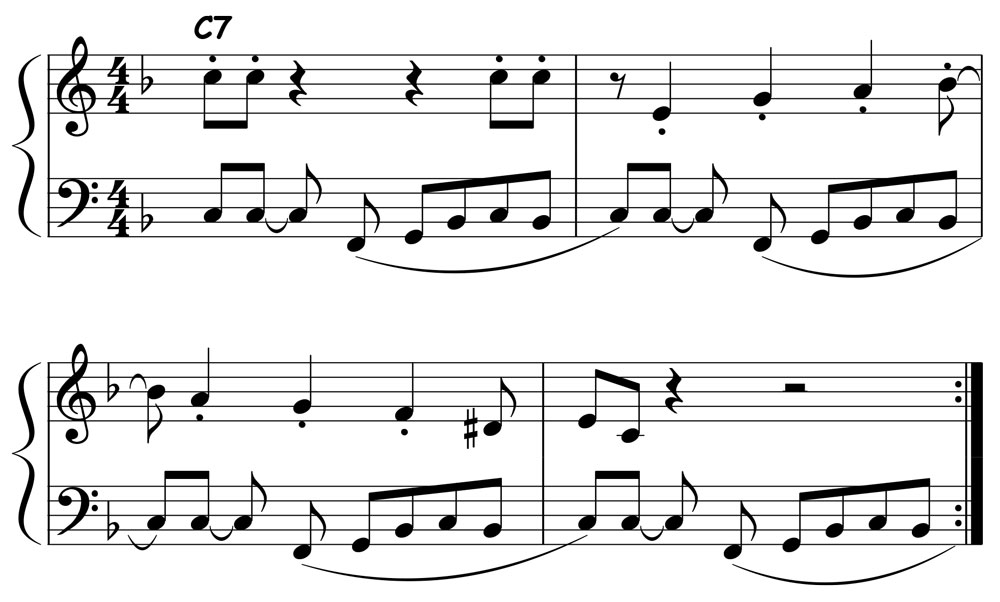
Memphis Underground, the famous one chord jazz-rock tune by Herbie Mann is as simple as it gets, but is a great introduction to the delicious mix of discipline and freedom that is jazz improvisation…
back to… Table of Contents
Listen to Frank Play the Chart…
back to… Table of Contents
Listen to the Original recording
back to… Table of Contents
Melody (Solfege)
Analysis of the melody using Solfege…
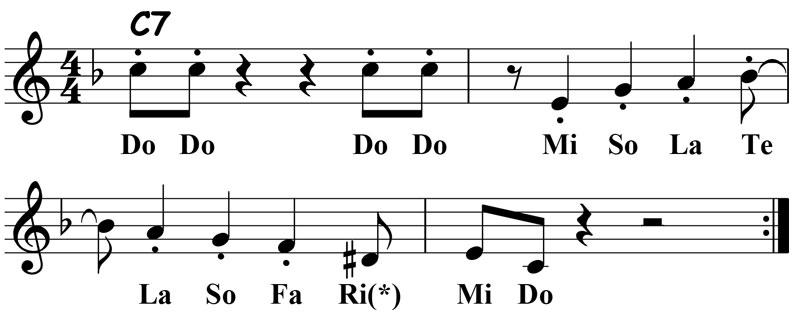
(*) It’s ok if you’d like to rename D# (Ri) as Eb (Me) instead. But don’t get hung up on the letter name and Solfege name here. It’s the sound, feeling, and function of the note that matters. As a composer and improviser, artist Frank thinks of this as a chromatic pickup into the primary chord tone Mi, so it makes sense to simply think of this as “Mi flat”.
Playing and singing the solfege syllables out loud is an extremely effective way to internalize the unique sound-feeling of each note in your minds’ ear.
back to… Table of Contents
Form
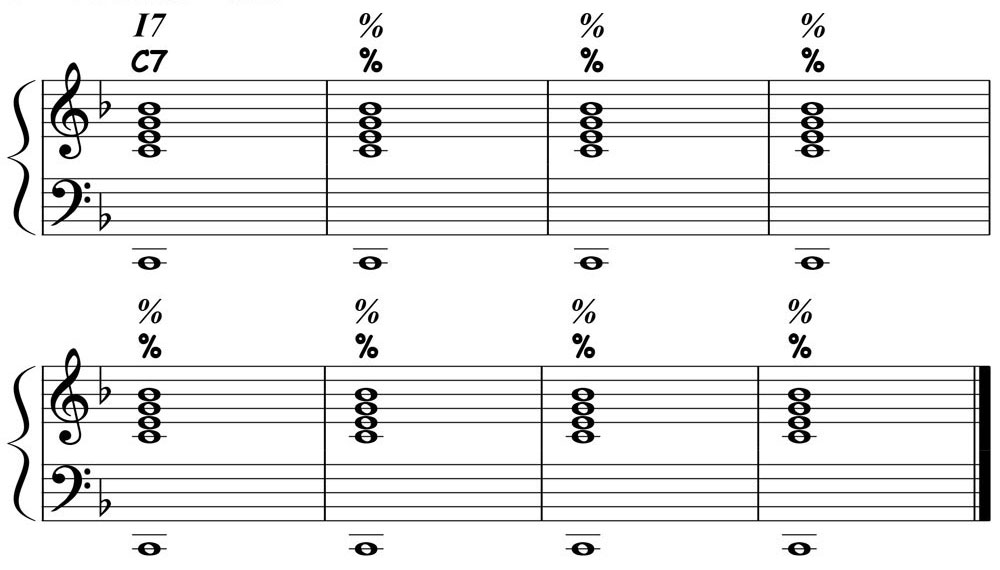
The form for “Memphis Underground” is 8 bars long, consisting of two 4 bar phrases…
back to… Table of Contents
Meter & Feel
“Memphis Underground” has a rock feel in 4/4 time…
back to… Table of Contents
Tonality & Useful Scales
Tonality: C Mixolydian / C Major Blues
In C Mixolydian/ Major Blues Tonality, there are at least four musically useful scale types: Mixolydian, Minor Blues, Minor Pentatonic, and Major Blues…
Listen to Frank model a fun and easy way to do ear training for this and the scales below…
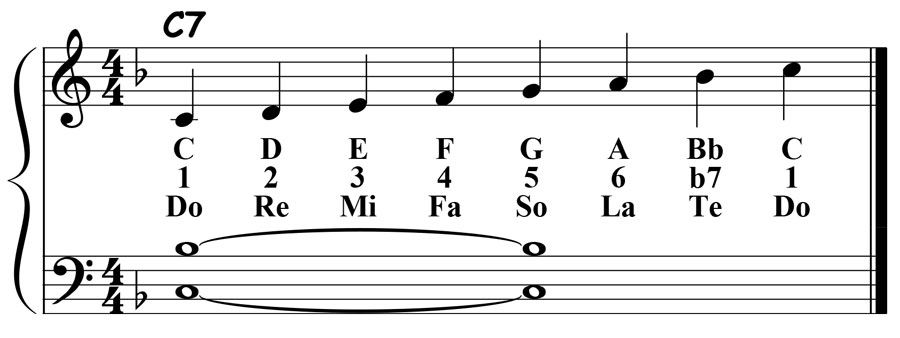
C Mixolydian Scale
Play and sing every note along with the C7 chord and allow the unique sound-feeling of each note to make a meaningful impression on your mind’s ear…
C Minor Blues Scale
Ditto the study, practice, and ear training tips above.

C Minor Pentatonic Scale
Notice that this is just a subset of the C minor Blues Scale (above).

Ditto the study, practice, and ear training tips above.
C Major Blues Scale
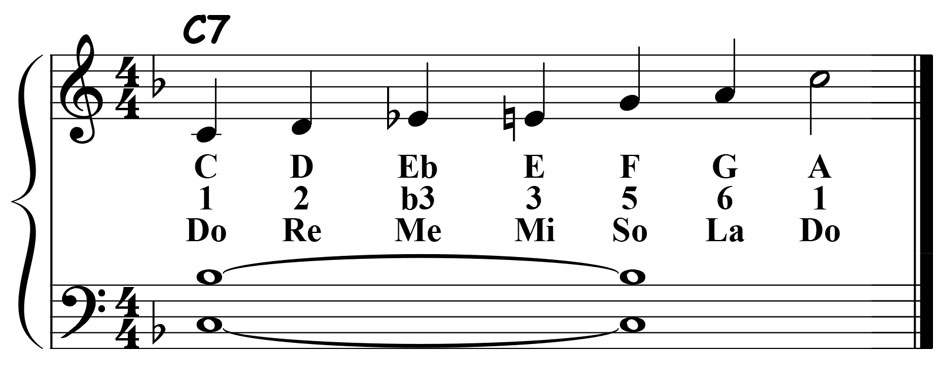
Ditto the study, practice, and ear training tips above.
back to… Table of Contents
Comping Patterns
insert some words about comping “Memphis Underground”
back to… Table of Contents
Play the Idea!
Listen to Frank model a tasty ways to comp with this groove…
Any interest in seeing a score for the above or hearing Frank demonstrate some other simple soloing ideas?
back to… Table of Contents
Please let Frank know if there is something else you’d Like to understand!
Your Turn to Improvise…
Download the following bass and drum practice track recorded by Frank…
(Yes, Frank is neither a bass player nor a drummer!)
Improvisation Tips
- Think, hear, feel, and play in 8-bar choruses and 4-bar phrases.
- The “feel” is a straight Rock Beat 1 & 2 & 3 & 4 & 1 & 2 & 3 & 4 &
- Tonality: C Mixolydian, C Major Blues
- Useful Scales: Minor Blues, Major Blues, Mixolydian, Minor Pentatonic
- Don’t get scale happy.
- Commit to playing coherent IDEAS.
- Realize that rhythm is as important as the notes.
- Vocabulary Sources: Rock, Jazz, Blues, Boogie Woogie, Gospel
- Borrow ideas from the head (the original melody).
- Cop ideas from other players.
- It’s not all about playing solos. It’s often about creative and tasteful comping, too!
- Don’t just think… FEEL & LISTEN!
- Experiment like a child playing with building blocks.
- Take your shoes off!
Yes, would love to see the voicings in the Lesson 4 comping track!
Sorry, I don’t anonymous requests.