Twenty-first in Frank’s HUGE collection of bread and butter jazz piano licks to add to your bag… by ear, intellect, eye, and muscle…
Table of Contents
Lesson Goals
To deeply internalize the sound, feeling, and function of a “scalewise” ascending line that strongly outlines the harmony for a minor 2 5 1 chord progression.
Special Note about the Design of these Studies
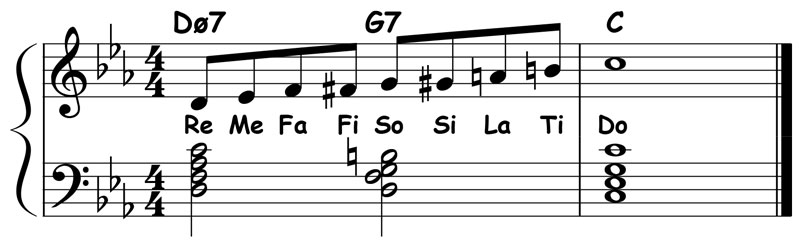
An extremely effective way to internalize any new lick and to simultaneously develop your comping and soloing chops is to play it “in context”: within an established form over a set of standard chord changes. In this lesson the context is a Minor 2-5-1 (iiø7-V7-i) chord progression in the key of C Minor.
Jazz Piano Lick 021 (Etude #1)
There are four important features make this lick really tick:
- Placing the “1” for each chord on the strongest beats clearly outlines the harmony.
- Playing in a continuous line establishes a strong sense of direction and expectation in the listener.
- Since you “run out of” diatonic scale tones, you have to insert chromatic tones to preserve the sense of flow and continuity.
- The top three notes (La, Ti, Do) are derived from the melodic minor scale, which provides strong voice leading up to Do.
Listen to Frank demonstrate one way to play this at 88 beats per minute…
Special Note about the Cm Chord: In some contexts a Cm6 chord or even a CmM7 may be appropriate and musical. Let the context, your ears, and artistic sensibilities be your guide.
back to… Table of Contents
Technique & Interpretation
Mentally and physically connect the last note of each quadruplet to the first note of the following quadruplet. Your facility in keeping the time and melodic line flowing in this way is a fundamental jazz performance skill. (Hint: One way to cultivate such continuity is to think of the last one, two, or three notes in each quadruplet as a pickup into what follows.)
back to… Table of Contents
Jazz Piano Lick 021 (Your Homework)
Use what you know about form, meter, scales, chords, chord progressions, chord voicings, and left hand patterns to play this etude in other keys you expect to play in and see what you discover.
Special Note from Frank: If there’s interest, I’d be happy to write this out in a few other keys.
Study & Practice Reminders
- You’re singing the Solfege or scatting aloud in order to internalize the sound-feelings, right?
- You practice with a metronome or rhythm track in order to instill good time, right?
- You record yourself, listen to the playback immediately, self evaluate, and respond accordingly, right?
The Open Secret…
The key to getting good isn’t “talent”; it’s the discipline to study and practice the right things the right way.
back to… Table of Contents
Reading, reading. And listening… Beginning to make sense.
Thanks a bunch for the feedback. Music to my ears!