Twentieth in Frank’s HUGE collection of bread and butter jazz piano licks to add to your bag… by ear, intellect, eye, and muscle…
Table of Contents
Lesson Goals
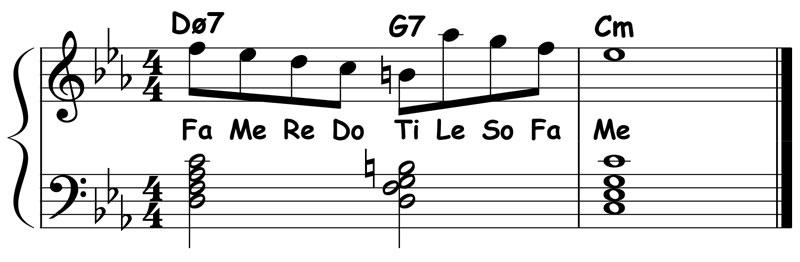
To deeply internalize the sound, feeling, and function of a “scalewise” descending line that strongly outlines the harmony for a minor 2 5 1 chord progression.
Special Note about the Design of these Studies
An extremely effective way to internalize any new lick and to simultaneously develop your comping and soloing chops is to play it “in context”: within an established form over a set of standard chord changes. In this lesson the context is a Minor 2-5-1 (iiø7-V7-i) chord progression in the key of C Minor.
Jazz Piano Lick 020 (Etude #1)
This lick is so much more that just rattling a random pieces of the C minor scale. The pattern here is quite deliberate and can be understood, heard, and felt in four important interrelated ways which give the line both melodic coherence and harmonic clarity:
- Each quadruplet follows the “3-2-1-7” sequence for each chord type.
- The “3” for each chord falls on the strongest beat (F is the 3 of Dø7, B is the 3 of G7, and Eb is the 3 of Cm).
- Playing the “3” of each chord on the strongest beat is a very strong way to outline the harmony.
- Playing in a continuous line establishes a strong sense of direction and expectation in the listener.

Listen to Frank demonstrate one way to play this at 104 beats per minute…
Special Note about the Cm Chord: In some contexts a Cm6 chord or even a CmM7 may be appropriate and musical. Let the context, your ears, and artistic sensibilities be your guide.
back to… Table of Contents
Jazz Piano Lick 020 (Etude #2)
Now let’s introduce a large skip which displaces the line by an octave. Such octave displacements create melodic interest and may be used to place the notes in a more pleasing register…
Listen to Frank demonstrate one way to play this at 104 beats per minute…
Technique & Interpretation
Mentally and physically connect the last note of each quadruplet to the first note of the following quadruplet. Your facility in keeping the time and melodic line flowing in this way is a fundamental jazz performance skill. (Hint: One way to cultivate such continuity is to think of the last one, two, or three notes in each quadruplet as a pickup into what follows.)
back to… Table of Contents
Jazz Piano Lick 020 (Your Homework)
Use what you know about form, meter, scales, chords, chord progressions, chord voicings, and left hand patterns to play these etudes in other keys you expect to play in and see what you discover.
Special Note from Frank: If there’s interest, I’d be happy to write this out in a few other keys.
Study & Practice Reminders
- You’re singing the Solfege or scatting aloud in order to internalize the sound-feelings, right?
- You practice with a metronome or rhythm track in order to instill good time, right?
- You record yourself, listen to the playback immediately, self evaluate, and respond accordingly, right?
The Open Secret…
The key to getting good isn’t “talent”; it’s the discipline to study and practice the right things the right way.
back to… Table of Contents
Descending and going back up…Hmmm. Sorry I sound so obvious, but It’s interesting to “read between the lines”…)
Between the lines and between the notes is where the real music happens!
Good point. I’ve often thought that my piano teacher when I was a teen insisted too much on the written notes. (I’ll make a not of that…)
Alas, most eager and trusting piano students are taught to play notation, not music… the equivalent of trying to read Hungarian phonetically without having a clue of what they are saying. Thanks, as always, for your engagement here, Brian. Cheers!
Hungarian! haha!