Fifteenth in Frank’s HUGE collection of bread and butter jazz piano licks to add to your bag… by ear, intellect, eye, and muscle…
Table of Contents
Lesson Goals
To deeply internalize the sound, feeling, and function of a “scalewise” descending line that strongly outlines the harmony for a major 2 5 1 chord progression.
Special Note about the Design of these Studies
An extremely effective way to internalize any new lick and to simultaneously develop your comping and soloing chops is to play it “in context”: within an established form over a set of standard chord changes. In this lesson the context is a Major 2-5-1 chord progression in the key of C Major.
Jazz Piano Lick 015 (Etude #1)
This lick is so much more that just rattling a random pieces of the C major scale. The pattern here is quite deliberate and can be understood, heard, and felt in four important interrelated ways which give the line both melodic coherence and harmonic clarity:
- Each quadruplet follows the same “3-2-1-7” sequence for each chord.
- The “3” for each chord falls on the strongest beat (F is the 3 of Dm7, B is the 3 of G7, and E is the 3 of C).
- The “3” defines each chord (as major, minor, etc), so playing the “3” of each chord on the strongest beat is a powerful way to outline the harmony.
- The “7” of each chord is the last note in each quadruplet, which provides strong voice leading into the 3 of the following chord. (By the way, you will see this “7 resolves to 3” pattern time and time and again in every genre of music).
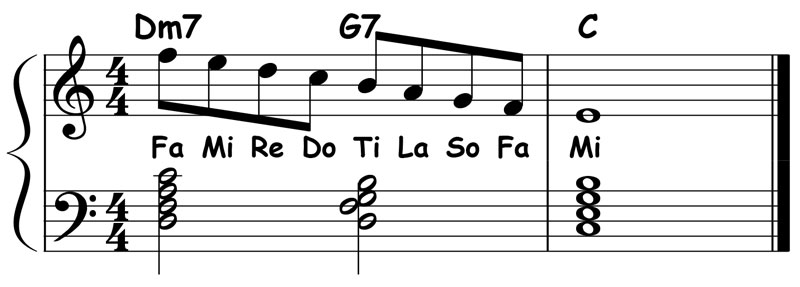
Listen to Frank demonstrate one way to play this at 116 beats per minute…
back to… Table of Contents
Jazz Piano Lick 015 (Etude #2)
Now let’s introduce a large skip which displaces the line by an octave. Such octave displacements create melodic interest and may be used to place the notes in a more pleasing register…
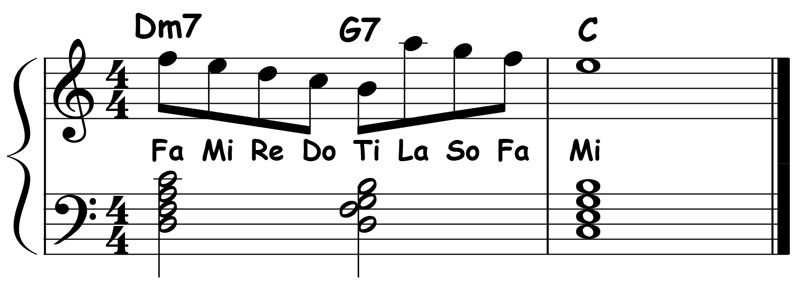
Listen to Frank demonstrate one way to play this at 116 beats per minute…
Technique & Interpretation
Mentally and physically connect the last note (the 7) of each quadruplet to the first note (the 3) of the following quadruplet. Your facility in keeping the time and melodic line flowing in this way is a fundamental jazz performance skill. (Hint: One way to cultivate such continuity is to think of the last one, two, or three notes in each quadruplet as a pickup into what follows.)
back to… Table of Contents
Jazz Piano Lick 015 (Your Homework)
Use what you know about form, meter, scales, chords, chord progressions, chord voicings, and left hand patterns to play these etudes in other keys you expect to play in and see what you discover.
Special Note from Frank: If there’s interest, I’d be happy to write this out in a few other keys.
Study & Practice Reminders
- You’re singing the Solfege or scatting aloud in order to internalize the sound-feelings, right?
- You practice with a metronome or rhythm track in order to instill good time, right?
- You record yourself, listen to the playback immediately, self evaluate, and respond accordingly, right?
The Open Secret…
The key to getting good isn’t “talent”; it’s the discipline to study and practice the right things the right way.
back to… Table of Contents
Nice. (If I may be so bold: the second sequence is Si La Sol Fa…) 😉
You may indeed be so bold, my friend. Thanks for your thoughtful comment. Some teachers prefer to use “Sol” instead of “So” (a needle pulling thread) and “Si” instead of “Ti” (a drink with jam and bread). While I use the “Sound of Music” version I encourage everyone to use the system they prefer as long as they deeply understand what these abstract name represent in the concrete reality of making music. In addition, I encourage students to abandon these arbitrary names altogether like training wheels once they internalize the sounds, feelings, and functions. Thanks again for your engagement here. Such is a great source of joy for me. Cheers!
All right. I didn’t know that. In Latin languages we still use DoReMiFaSolLaSi…
Have a great week.