Introduction to the particularly jazzy sound, feeling, and function of Altered Dominant Chords and the Altered Dominant Scale…
Table of Contents
Lesson Goal
To add altered dominant seventh chords and the altered dominant scale to your comping and soloing repertoire.
Prerequisites
Basic music reading skills… basic scale, chord, and chord progression theory… basic piano technique… the LOVE of music… and the discipline to study and practice.
A Quick Review of Dominant 7th Chords
Before getting into the theory, sound, feeling, and function of altered dominant chords, let’s review the basic function of an unaltered dominant 7th chord as part of a major 2-5-1 (ii7-V7-I) chord progression…

And notice how each of the five voices in the V7 chord resolves when the I chord arrives:
- G (So) in the bass resolves up or down to C (Do).
- B (Ti), also called the leading tone, resolves up to C (Do).
- D (Re) resolves down to C (Do).
- F (Fa) resolves down to E (Mi).
- A (La) resolves down to G (So).
How to Build Altered Dominant Chords
Adding dissonant “altered” tones to a dominant seventh chord is a fundamental feature of jazz harmony. There are at least three reasons for doing so:
- To make the chord itself sound and feel inherently more dissonant (vertically, locally, in and of itself).
- To add more leading tones that have a strong drive to resolve, both harmonically and melodically.
- To make the resolution, when it arrives, sound and feel that much more satisfying.
Practically speaking, there are only four alterations (thus the name “altered”) that can be made to a basic dominant 7th chord. Using standard chord structure notation, these alterations are b9, #9, b5, and #5.
Sidebar from Frank: Altered chords are much simpler than they appear. While you will see many kinds of chord symbols for altered dominant 7th chords (C7+5, C#5b9#11, C7#9b13, C7#9#11) realize that “#11” is really just a “#4” which is really just a “b5” in disguise. Likewise, “b13” is really just a “b6” which is really just a “#5” in disguise.
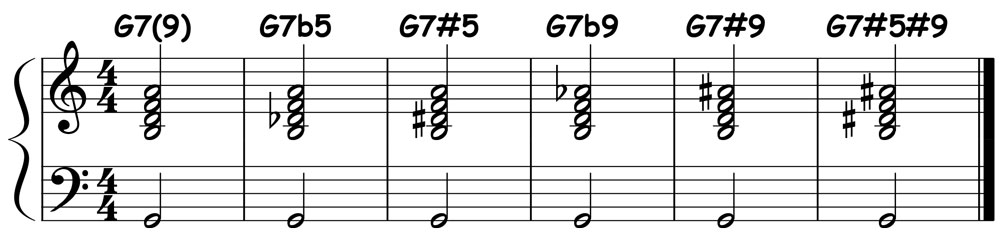
Here are the five commonly used G7alt chords (G7b5, G7#5, G7b9, G7#9, and G7#5#9) compared to an unaltered G7,9 chord…
How to Build an Altered Dominant Scale
You will see all kinds of overly complicated theoretical explanations on the internet, but here is a simple, practical, and musical way to think about, see, hear, and feel the altered dominant scale:
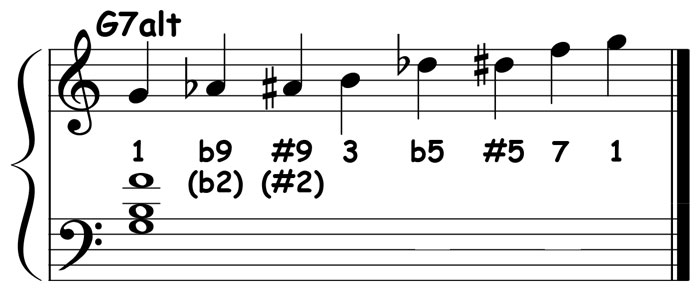
- The altered dominant scale has seven notes.
- Three of these notes are the very same notes that define every dominant seventh chord: 1, 3, and b7.
- There are four possible “altered” notes: b5, #5, b9, and #9 (It’s ok to think of b9 as b2 and #9 as #2).
- Think of the “alts” as “5 flat”, “5 sharp”, “9 flat”, and “9 sharp”.
- Notice that there is no “6”.
Here is the G altered dominant scales played over a basic G7 chord voiced using only the “1”, “3”, and “b7″…
Sidebar from Frank: You will see other names for the altered dominant scale: altered scale, super-Locrian scale, Locrian ♭4 scale, or 7th mode of the harmonic minor scale. But don’t get hung up on the name of the scale. Whatever you choose to call it, what really matters is that you internalize the arrangement of notes in a way that you relate to best, using all four musical intelligences.
Examples of Using an Altered Dominant Chord
Altered dominant seventh chords are commonly used as the V7 chord in either a major key 2-5-1 chord progression or minor key 2-5-1 chord progression.
Example of a V7alt Chord in a Major Key
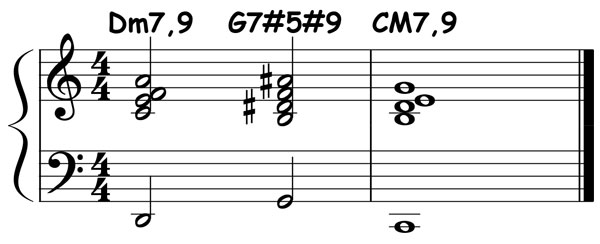
Here, for example, is how one might play a G7#5#9 chord as the V7 chord in a ii7-V7-I chord progression in C major…
Example of a V7alt Chord in a Minor Key
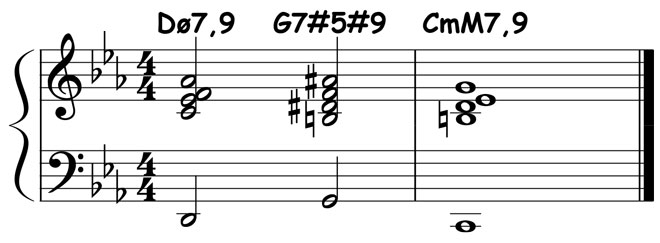
And here is how one might play a G7#5#9 chord as the V7 chord in a iiø7-V7-i chord progression C minor…
Takeaways
- “1”, “3”, and “b7” are the fundamental notes that define any dominant 7th chord.
- The optional color tones are b5, #5, b9, and #9.
- To build a V7alt chord, use the “1”, “3”, and “b7” and add “b5” or “#5” and/or “b9” or “#9”.
Your Homework
- Internalize some altered dominant 7th chord voicings and be able to play them as part of a major 2-5-1 chord progression and minor 2-5-1 chord progression in various keys.
- Internalize some licks that use the note in the altered dominant scale (with the understanding that real jazz improvisation is almost never about playing up and down a scale, but about clearly outlining the harmony (See: Bread & Butter Jazz Piano Licks).
Sounds good. I have to try it. One day…
Thanks, man. If we all only had a hundred free hours each day, Cheers!