A rich collection of practical lessons in how your brain works, laying a rock-solid foundation for a lifetime of fun and efficient learning…
Table of Contents
What is Learning?
Learning is a change in what or how we feel, think, or act as a result of experience, observation, study, experimention, instruction, training, coaching, or mentoring.
The ABC Model of Learning
The ABC Model of Learning views intelligence in three domains: affective, behavioral, and cognitive:
- The Affective Domain is the realm of feeling: emotions, attitudes, values, and motivations.
- The Behavioral Domain is the realm doing: bodily actions and skills, writing, speaking.
- The Cognitive Domain is the realm of thinking: language, definitions, concepts, associations, calculations, remembering, problem solving.
Notice that these three domains validate our intuitive notions of self as consisting of body, mind, and spirit.
Sidebar: Learning to play the piano deeply engages and excites all three of these domains. As you keep browsing the site, you’ll notice that Piano-ology routinely taps into all three of these fundamental, complementary, overlapping aspects of our being as we acquire new attitudes, skills, and knowledge. When we play, we don’t want to stop with merely thinking the music. We also want to feel the music. And if we do, our body will naturally express our musical intentions, guaranteed.
Intentional versus Unconscious Learning
Surprisingly little is known about how our brains learn and remember a phone number, friend’s face, familiar melody, or complex motor skill. It seems that we naturally wired to do so. In fact, the processes our brains use to seek, interpret, organize, remember, recall, and relate sensations and information are almost entirely unconscious. And they are so powerful that they need not ask permission from our conscious minds to do work their magic.
And so it’s critically important to highlight and understand the distinctions between two categories of learning:
- Conscious, active, intentional learning is the process by which we deliberately try to learn something.
- Unconscious, passive, unintentional learning happens to us without our awareness, typically in response to something in our environment (*), for better or worse.
(*) This includes the powerful conditioning processes of classical conditioning and operant conditioning, two vast subjects beyond scope of this discussion. For the moment, it suffices to realize that they exist and can have enormous influence on the courses of our lives if we let them.
The Power of Studying
While we cannot control the unconscious, behind-the-scenes workings of our brains directly, we can control what and how we feed this powerful and mysterious organ. To that end, we introduce the critically important notion of studying… and highlight how it relates to learning the right things the right way:
- Learning is an unconscious, passive process beyond our control.
- Studying is a conscious, active process within our control.
And so, learning how to study–by feeding our hungry brains meaningful and useful things in an appropriate way–is essential to the mastery of any complex skill–and has the power to make learning efficient, enjoyable, enduring, and self-sustaining.
The HUGE Takeaway: Success, in both music and life belongs to those who have the love and discipline to study.
back to… Table of Content
How Your Brain Works: One Organ, Many Functions
A quick introduction to the phenomenal variety of emotional, cognitive, sensory, and motor functions our amazing brains are capable of…
List of Brain Functions
Our brain is a complex collection of electro-chemical structures that perform the following functions:
- Some parts of your brain perceive the world around you, giving the ability to see, hear, smell, taste, and feel.
- Some move your many body parts.
- Some regulate your hormones.
- Some process the language that enters your ears; others process the language that exits your mouth.
- Some count numbers, some remember stories.
- Some perceive shapes, others see colors.
- Some perceive edges, other perceive orientations and movements.
- Some parts are logical; some are intuitive.
- Some rehearse a phone number for just a few seconds; others remember your ABCs for a lifetime.
- Some remember faces; others remember melodies.
- Some help different parts share information with each other.
- Some work together to integrate parts into wholes.
- Some trigger your fight, flight, or freeze responses.
- Some can imagine things… allowing us to “see” with our eyes closed or to “hear” with no sound entering our ears.
- Can you think of some others?
The HUGE Takeaway: You have an incredibly powerful and versatile tool called a brain at your disposal. If you learn how it works and how to use it properly, you will enjoy a lifetime of fun and efficient learning, guaranteed!
How Your Brain Works: Brain Lateralization
A practical introduction to Brain Lateralization and its implications for studying, practicing, and performing music.
What is Brain Lateralization?
Anatomically speaking, your brain consists of two distinct Hemispheres… or two functional “sides”, literally and figuratively. Each hemisphere tends to have unique functions not typically possessed by the other hemisphere. The notion and actuality that each hemisphere specializes is referred to as Brain Lateralization, described below.
Left Brain & Right Sides Compared
For the purposed of learning music, it’s useful to think of hemisphere not as an anatomical structure, but as figurative “side” of your brain, where each “side” has special skills, summarized as follows:
- Your Left Brain is logical, detail oriented, interested in facts, verbal, rational, intellectual, systematic, abstract, and controlling.
- Your Right Brain is intuitive, big picture oriented, interested in ideas, visual, emotional, inspirational, playful, concrete, and receptive.
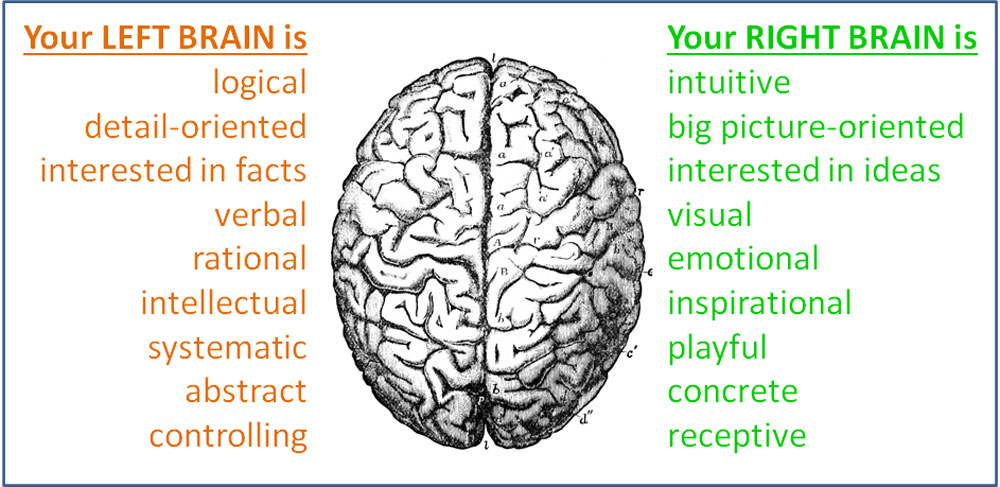
Each side possesses unique ways to understand and experience reality, with profound implications for the challenge of studying and performing music, as follows…
- Your Left Brain likes to name, explain, define, categorize, talk, count, and calculate. Your Right Brain likes to experience, imagine, feel, relate, listen, and express.
- Your Left Brain does one thing at a time. Your Right Brain does everything at once.
- Your Left Brain learns by structured plans. Your Right Brain learns by exploring.
- Your Left Brain likes to analyze wholes into parts. Your Right Brain likes to synthesize parts into wholes.
- Your Left Brain learns and remembers words, numbers, and facts. Your Right Brain learns and remembers images, body movements, impressions, and relationships.
- Your Left Brain is highly selective about what it pays attention to, enabling you to focus on important details. Your Right Brain can distribute its attention to many things at once, enabling you to grasp the essence of the big picture.
- Your Left Brain thinks about the past and future and is the home of plans, regrets, fears, worries, and criticisms. Your Right Brain senses and experiences everything in the present moment.
Which Side of Your Brain is Smarter?
In many ways, your Left Brain is “smarter” than your Right Brain to the degree that your Left Brain can do things that your Right Brain simply cannot do.
Likewise, your Right Brain is “smarter” than your Left Brain to the degree that your Right Brain can do things that your Left Brain cannot do.
Example of Brain Lateralization & Coordination
This is your Left Brain at work…
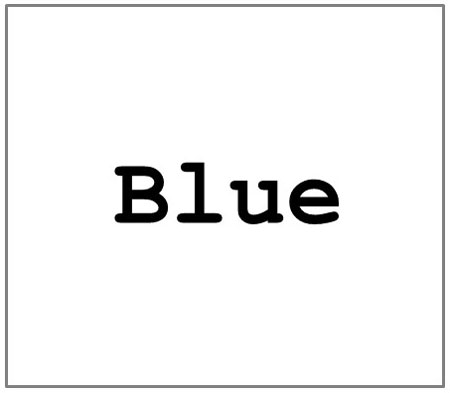
and this is your Right Brain at work…
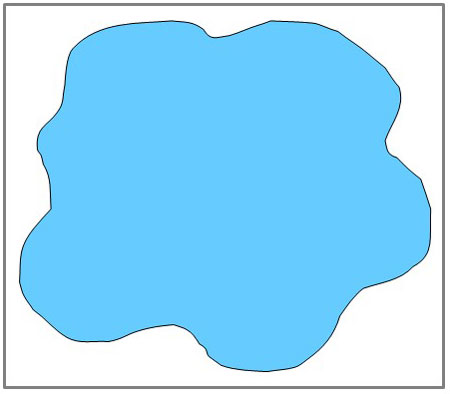
and this is both sides working together…
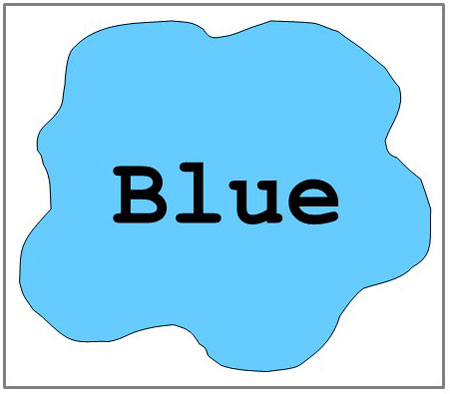
Implications for Studying, Practicing, and Performing Music
One reason why students struggle with music is that they are using the wrong side of their brain for the task at hand. Alas, most students (and teachers) are trapped in an educational system that places way too much emphasis on abstract Left Brain constructs that have little to do with how music actually works.
Unfortunately, music instruction is so poor that it has students trying to learn and play with half of their brain tied behind their backs. At best, the most “successful” students become skilled at playing music they neither hear nor understand.
While your Left Brain is often an essential gateway for understanding and remembering important musical concepts, it is impossible to understand how music works if you study and play using only the left side of your brain.
Ultimately, in order to perform with confidence and conviction, you must play in that magical Right Brain space where logic, names, and abstract constructs cannot go.
Here, for example, is something that your logical Left Brain simply cannot do… or even understand…
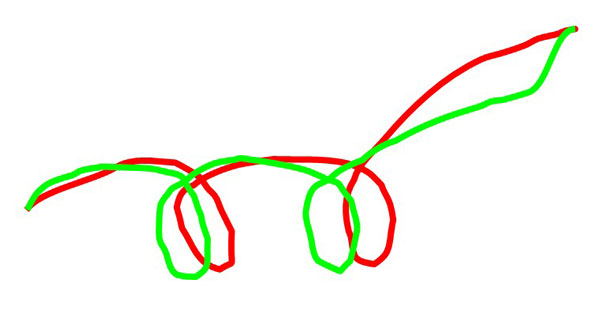
… while your artistic Right Brain grasps it immediately and effortlessly.
But don’t conclude that your Left Brain is useless or that your Right Brain is better than your left.
Both sides are necessary and important… and complement each other in significant ways that enable you to construct and internalize an incredible library of musical knowledge and skills.
The Big Takeaways: When you study or perform music, you want to use the side of your brain that is appropriate for the task at hand–allowing the natural capabilities of each side to do what is does best–while also allowing each side to collaborate with the other side as needed. This will all become clear in future learn-by-doing lessons that will bridge the gap between “Left Brain” theory and “Right Brain” experience.
back to… Table of Contents
The Power of Attention
An illuminating exploration of the role, limits, challenges, and Power of Attention… all with transformational implications for your future success. To appreciate the significance of focused attention in the learning process so deeply that it elevates your study and practice habits accordingly.
The Role of Attention in the Learning Process
The role of Attention is perhaps the least appreciated aspect of intentional learning. The capacity to intentionally direct our attention really really matters, not just in music but in life in general. In short, we consciously learn what we pay attention to… and we do not consciously learn what we don’t pay attention to.
Danger! Unconscious learning is another and deadly serious matter. In short, when we are not paying attention we are extremely vulnerable to learning certain things unconsciously. When we are not paying attention, we are at the mercy of another form of learning: conditioning… And we are as vulnerable to being trained as Pavlov’s dogs and Skinner’s pigeons.
back to… Table of Contents
The Challenges of Attention
Directing our attention to the right things is tough in a world were we are conditioned to be passive consumers of information.
Paying attention to the right things is one of the most difficult things we can do with our brains… for at least three reasons:
- There are lots of distractions vying for our attention: external sights and sounds, bodily sensations, and internal thoughts, memories, emotions.
- It takes experience and insight to know what to pay attention to.
- Focused attention requires lots of mental energy and can be absolutely exhausting.
back to… Table of Contents
The Limits of Attention
We are only human. And our attention, like all of our other capabilities, has its limitations:
- Our attention is always selective. There is always far more information available to us than we can attend to at one time.
- Our capacity for paying attention has two aspects: 1) the amount of stuff we can attend to and 2) the amount of time we can maintain our concentration.
- Our attention can be viewed as having two dimensions: breadth and depth. Our attention can be wide and shallow or narrow and deep or anything in between. In other words, we can trade breadth for depth and vice versa but we can never maximize both.
- If we pay attention to many things at once, we have less capacity to attend to the details about each individual thing.
- If we pay attention to one thing at a time, we have the capacity to attend to it in more detail, but lose the capacity to notice other things.
back to… Table of Contents
A Fascinating Example of Attention
A must-see, eye-opening demonstration of the power of attention…
The critically important, and deeply humbling point regarding the limits of our attention: We “see” with our brains, not just with our eyes…. so much so that our brains can render us blind to what is right in front of us despite the fact that light is hitting our retinas!
back to… Table of Contents
The Power of Attention
When it comes to studying and practicing music, the ability to direct your own attention is like a superpower with the following implications:
- Always have a clear goal in mind: What am I going to pay attention to today?
- You are what you pay attention to. So, pay attention only to things that are true and constructive.
- Focus on learning one thing at a time.
- Be extremely specific. For example: Focusing on an appropriate choreography for the left hand on the third beat in measure eleven of Bach’s Two Part Invention #8.”
- Focused attention is hard mental labor that cannot be done properly when you are tired, stressed, or distracted. Take a break when you get tired in order to recharge your batteries.
- Years of mindless mechanical practice is worthless compared to one minute of focused, meaningful attention.
- Focused attention is a choice available to anyone at this very moment.
Sidebar: The value of finding a great teacher cannot be overstated. Because a great teacher knows how to direct your attention to things you might not otherwise ever even consider or notice.
The Power of Patterns
How to maximize learning using your naturally pattern-seeking and pattern-loving brain. To appreciate the power of patterns when is comes to the learning process, so deeply that it elevates your study and practice habits accordingly.
About Your Pattern-Loving Brain
Did you know that your brain is a natural seeker, recognizer, discriminator, interpreter, relater, connector, and creator of patterns?
Your brain enjoys patterns and dislikes randomness as illustrated in these two illustrative examples…
Pattern Recognition Example #1
- “!nkcsrveeeoo htB” is no fun to read because it’s just an apparent jumble of random symbols with no apparent meaning.
- “Beethoven rocks!” is fun to read because it contains recognizable patterns that mean something.
Pattern Recognition Example #2
A particularly astonishing example of the power of our pattern-loving brains:
Cna yuo raed tihs? i cdnuolt blveiee taht I cluod aulaclty uesdnatnrd waht I was rdanieg aubot the phaonmneal pweor of the hmuan mnid aoccdrnig to a rscheearch at Cmabrigde Uinervtisy it dseno’t mtaetr in waht oerdr the ltteres in a wrod are the olny iproamtnt tihng is taht the frsit and lsat ltteer be in the rghit pclae the rset can be a taotl mses and you can sitll raed it whotuit a pboerlm tihs is bcuseae the huamn mnid deos not raed ervey lteter by istlef but the wrod as a wlohe.
back to… Table of Contents
A Memory Challenge
In order to illustrate the amazing power of patterns, let’s try a fun memory challenge…
Step 1 (Please don’t skip ahead!)…
Play the following music (30 seconds long) and memorize the following letter/symbol pairs…
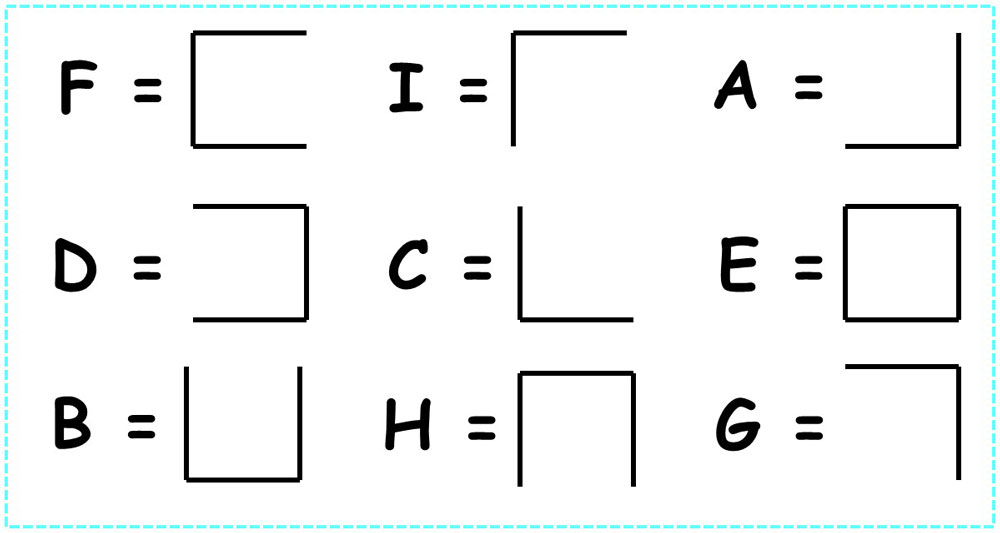
When the music stops, scroll down or jump to Step 2…
|
|
|
|
|
|
|
|
|
|
|
|
|
|
|
Step 2. Count backwards…
From 42 to 0 by 3s: 42… 39… 36… 33… 30… 27… 24… 21… 18… 15… 12… 9… 6… 3… 0…
After you count down to zero, scroll down or jump to Step 3…
|
|
|
|
|
|
|
|
|
|
|
|
|
|
|
Step 3. Test Your Memory…
What shapes correspond to each of the following letters?
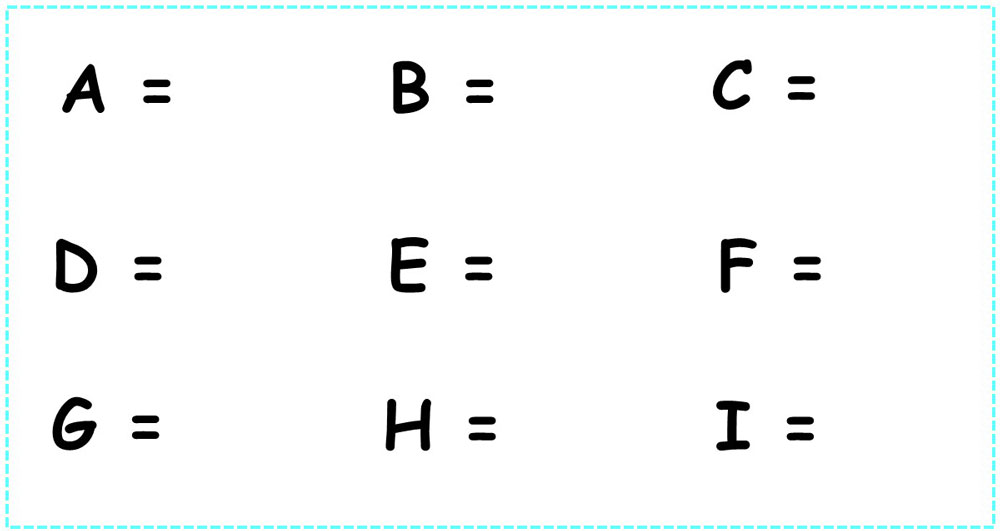
When you are finished or can’t stand it anymore, scroll down or jump to Step 4…
|
|
|
|
|
|
|
|
|
|
|
|
|
|
|
Step 4. Surprise!
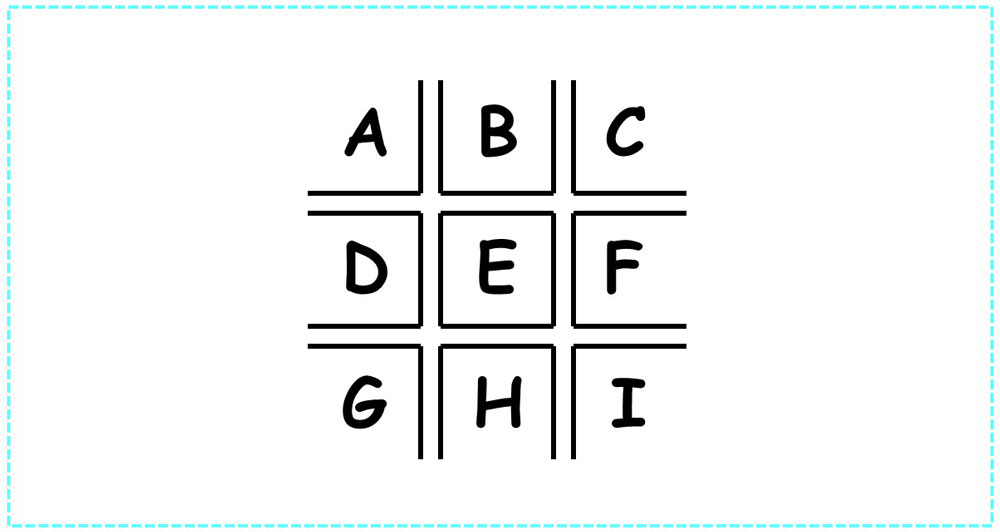
No matter how hard you try, you will not be able to forget the effortless connection you just made. In fact, it is highly likely that you will “remember” this connection a week, a year, or twenty years from now! Got it? Good!
back to… Table of Contents
Implications for Students and Teachers
- Learning need not be a brute force memory task.
- “Memorized” information is hard to learn and easy to forget.
- Memorization of unconnected information is mentally exhausting (and usually unnecessary).
- Once you see a pattern, you don’t have to try to remember it. It is impossible to forget.
- Learning new patterns is fun & easy if you connect them to patterns you already know.
- The more useful patterns you have stored in your long-term memory, the easier it is to learn new things. Each pattern already stored gives you a foundation on which to build even more complex patterns.
- If you are a teacher, you need to invest your time & energy teaching useful patterns.
- If you are a student, you need to invest your time & energy discovering, studying, and mastering useful patterns.
- A word of warning: BAD patterns also exist. Once a useless, confusing, or destructive pattern gets stored, useless, confusing, or dangerous things start to happen. And so, you must be careful what knowledge, beliefs, and habits you store in memory.
- Today’s ease was enabled by yesterdays efforts. For example, the effort you invested in learning your ABCs and phonics is makes reading these words easy. Likewise, tomorrow’s ease is enabled by today’s efforts!
back to… Table of Contents
Memory Fundamentals
Illuminating lessons in how your brain’s memory systems work… with huge practical implications for your study and practice habits… To learn how your brain works with and stores information… so that you can use your amazing brain in a way that makes learning fast, fun, and enduring.
The Four Main Memory Subsystems
Your brain’s memory system consists of four subsystems…
- Sensory Register
- Long-Term Memory
- Working Memory
- Central Executive
Before describing how they work together to create long-term memories, let’s discuss each subsystem in turn…
Sensory Register
The Sensory Register contains all the sensations that come from your environment through your five senses: vision, hearing, taste, smell, and touch…

The contents of the sensory register are always fleeting, consisting only of what you are experiencing at this very moment.
back to… Table of Contents
Long-Term Memory
Long-term Memory (LTM) is where all of your learning, both conscious and unconscious, is stored…

To a great extent, you are your long-term memory patterns: your rules, beliefs, hopes, dreams, fears, regrets, dreams, expectations, preconceptions, misconceptions, prejudices, self-concept, likes, dislikes, knowledge, skills, and habits.
These long-term memory patterns have a profound influence on many things: where you focus your attention, what you think is important, how you interpret new information, how you react to events, how you remember things, what you think about others, what scares you, what you are ready to learn… to name but a few.
Your long-term memory has essentially unlimited capacity, but it can absorb only so much so fast. You need to give it time to learn, as we will see later. And, because long-term memories are very hard to erase, we need to be very careful what we store there.
back to… Table of Contents
Working Memory (Short-Term Memory)
Working Memory is where thinking occurs. It is used to temporarily store and manipulate information and is filled by simply paying attention to “something” or “somethings”…

“Something” can be anything: a face, sound, sensation, idea, shape, texture, word, number, color, image, equation, emotion, concept, suggestion, memory… anything.
“Something” can come from two sources: your sensory register or your own long-term memory. It is possible to pay attention to multiple “somethings” if they do not interfere with each other or overwhelm your capacity to pay attention.
Importantly, working memory is the gateway to long-term memory.
The contents of your working memory are what you are paying attention to at the moment. Once you stop paying attention to something, it quickly fades away. This is why working memory is also called Short-Term Memory (STM). Unlike Long-Term Memory, the capacity of your working memory is extremely limited… not much more than the ability to remember a seven digit phone number.
The Phonological Loop & Visuospatial Sketchpad
Two noteworthy components of working memory are the Phonological Loop and Visuospatial Sketchpad:
The Phonological Loop is like a virtual sound recorder with a storage capacity of a few seconds, just long enough to rehearse the seven-digit phone number mentioned above by its audio trace.
Similarly, the Visuospatial Sketchpad is like a virtual image viewer that allows you to manipulate and relate visual information.
The Central Executive
The Central Executive tells your working memory what to pay attention to and initiates and terminates all the mental operations performed in your working memory. These operations include manipulating, relating, storing, and retrieving information.
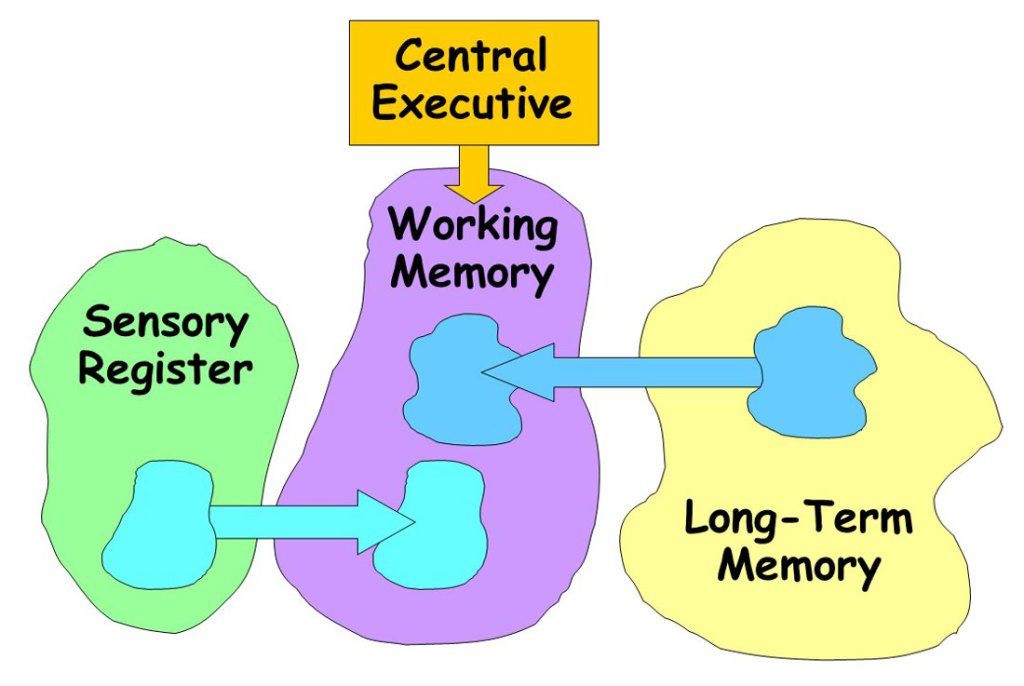
back to… Table of Contents
An Example of Expert Learning
Let’s describe how to use your brain’s memory systems to create a stable long-term memory.
Suppose we want to learn how a major triad sounds and feels. This is “Something New”.
Furthermore, suppose that you have already mastered how the music theory for forming a major triad by combining three notes. This is “Something you Already Know”.
Step 1. Pay attention to “Something New”.
Pay attention to the sound of a major triad played on the piano. The sound enters your ears and is perceived by your Sensory Register. When you pay attention to it, the sound is automatically loaded into your Working Memory.

Step 2. Relate this “Something New” to “Something You Already Know”.
Realize that you have pre-existing knowledge of the notes that comprise a major triad. This is a very relevant “Something You Already Know”. Connect the sound you hearing to this “somethingg you already know”.

Step 3. Keep “Something New” and “Something You Already Know” in your field of attention.
Maintain the sound you hear and your knowledge of the notes in a major triad in consciousness at the same time. Do this until you feel something “click”.

When you feel that “click”, it means that you’ve made a meaningful connection–a connection that’s made an impression on your long-term memory. Such learning is likely to be permanent after only a handful of, and maybe after just one, exposure.
Sidebar: The more things you already know, the more ways you have to understand and relate to new information. In other words, the more you know, the more you can learn… which leads to a very curious paradox: Unlike a computer memory which can get filled to capacity, every useful thing that you master—every fact, concept, attitude, and skill—makes your brain effectively bigger!!!
Takeaways for Students
The full appreciation of how your brain’s memory systems works can turn poor students into great students. It’s less about talent and more about establishing a short list of productive study and practice habits. To that end:
- If you want to learn the right things, you have to pay attention to the right things.
- If you want to remember something, you need to relate to it in a way that is memorable.
- If the information loaded into your short-term memory is perceived as meaningless (not related to any patterns you already know), the potential to be stored in your long-term memory is very low.
- If the information loaded into your short term memory is perceived as meaningful (related to patterns you already know), the potential to be stored in your long-term memory is high.
- Without meaningful associations between something you are trying to learn and something you already know, all you can do is memorize using brute force. Such memories are fleeting and unreliable.
- Complex tasks–such as ear-training or learning a precise physical movement–may require multiple exposures (also known as practice) to become permanently stored in long-term memory.
Takeaways for Teachers
Great teaching starts with understanding how the brain learns and remembers things. The more links to prior knowledge, the stronger the understanding and the more reliable the memory. To that end, it’s crucial to meet students where they are—not where you are—as you guide them step by step by connect each lesson to patterns they already know. If you do so, both of you can enjoy a lifetime of learning and teaching that is faster, deeper, and more enjoyable.
back to… Table of Contents
Memory Consolidation
How to harness the power of Memory Consolidation–the magical process by which short-term memories are transformed into long-term memories… To accelerate the process of learning a difficult concept or skill by appreciating and taking full advantage of Memory Consolidation.
What is Memory Consolidation?
Memory Consolidation is the unconscious process that creates long-term memories (declarative or procedural) by restructuring the electro-chemical connections in your brain.
Study and Practice Habits that Optimize Consolidation
Making the most of this behind the scenes long-term memory formation process is enabled by four study and practice habits:
- Focused Attention on what you want to learn.
- Repeated Exposures to what you are trying to learn.
- Sufficient Soak Time for the new concept or experience to fully register in short-term memory.
- Association or Relation of the new information to something you already know.
As you incorporate these habits into your daily practice, be patient. Realize that learning may not occur immediately. While simple things may be consolidated in a matter of seconds with just casual attention and a single exposure, more complex concepts and skills my take intense focus and repeated exposures over the course of days, weeks, or even months. This is especially true when learning a complex fine motor skill.
The Importance of Sleep
Another huge aspect of memory consolidation if this: The prime time for your brain to catch up on and permanently store what you studied and practiced today is while you are sleeping. And so, every day presents a potential consolidation cycle that consisting of the alternating activities of focused study and brain-restructuring sleep. This is one reason why studying and practicing a little bit every day beats doing a lot a bit once a week.
Takeaways
- One minute of focused attention beats one hour of unfocused attention.
- You attention must be focused on something “small enough” to fit within the capacity of your short-term memory.
- Pay attention long enough for the subject to make a meaningful impression.
- Relate new information to things you already know.
- Take advantage of every sleep by studying and practicing every day.
- Be patient. As long as you keep trying, you WILL get it!
back to… Table of Contents
Association and Elaboration
Two proven Memory Aids that every musician needs to use in their daily study and practice sessions: Association and Elaboration…
To understand how to use Association and Elaboration in your study and practice sessions to remember things faster, deeper, and more securely than you ever imagined.
Two Ways to Make Things Easy to Remember
Let’s begin with two huge insights:
- The best way to remember something is to make it memorable.
- If you want to make something memorable, it’s not enough to merely think of that something. You also need to think about that something.
And two proven ways to think about something are the memory aids known as Association & Elaboration. Let’s look at each one in turn…
How Association Works
One powerful way to think about something is to compare it with things you already know by asking:
- How they are alike?
- How they are different?
Such associations build enormous confidence and security because they tap into existing knowledge and build strong connections between different parts of your brain. Of course, the greater the number of and the more diverse the kind of associations, the better. It’s important to understand that such associations are NOT contrived and clever mnemonic tricks, but are based on the ways we naturally think about and experience music.
Examples of Association in Music
One way to apply association to learning music is to relate new scales, chords, and other musical patterns to patterns you already know. Common examples include:
- Realizing that both a minor triad and major triad share 1 and 5, but the 3s are different (major=3, minor=b3).
- Realizing that 1, 3, and 5 in a major pentascale form a major triad.
- Realizing that 1, b3, and 5 in a minor pentascale form a minor triad.
- Comparing a Mixolydian Scale to a Major Scale and noticing that they share the same notes except for one (Major=7, Mixol;ydina=b7).
- Realizing that a Major Pentatonic Scale is like a Major Scale, but with the two most unstable tones (Fa and Ti) removed.
How Elaboration Works
Another way to think about something is to explain or describe that something in more than one way, with special emphasis on the important details about that something. This manner of storing information builds enormous confidence and security because it encodes that information in rich networks of connections that use diverse parts of you brain. Naturally, the greater the number of and the more diverse the kind of elaborations, the better. As with association, it’s important to understand that such elaborations are NOT contrived and clever mnemonic tricks, but are based on the ways we naturally think about and experience music.
Examples of Elaboration in Music
One way to apply elaboration to music is to learn a melody as much more than just a sequence of dots or letter names. If you take the time to learn the melody in other ways–by singing it aloud, analyzing it in functional terms using Solfege, internalizing the rhythm pattern, relating it to the underlying harmony, seeing the visuospatial layout of the notes on the keyboard, relating it to scales and chords you already know, and connecting all the above to your fingering and choreography. Such elaborations illustrate the value of learning to play using all four musical intelligences: ears, intellect, eyes, and muscles.
Takeaways
There are at least seven big takeaways:
- It’s easy for our brains to forget things if we only know them in one way.
- The best way to remember something is to make it memorable.
- If you want to make something memorable, it’s not enough to merely think of that something. You also need to think about that something.
- When learning something new, relate it to things you already know.
- When learning something new, think about it in a variety of ways using all four musical intelligences: ears, intellect, eyes, and muscles.
back to… Table of Contents
The Power of Chunking
An introduction to the power of “Chunking“, how it relates to memory formation and usage, and an invitation to apply it to all your music making…To appreciate the significance of “Chunking” and be inspired to make it a routine study, practice, and performance habit.
The Concept of Chunking
Chunking is the cognitive process of integrating many small parts into meaningful wholes called chunks. Importantly, each chunk should be “small” enough to fit within the limited capacity of your short-term (working memory). This allows each chunk to be thought about or experienced without cognitive overload, while enabling that chunk to be encoded and stored in long-term memory. If a chunk is too “big” to fit in working memory you will feel overwhelmed, with predictable results: Extreme difficulty learning, remembering, and performing that piece of music.
Chunking is a huge contributor to music mastery because it simplifies the work that our brains have to do. Chunking allows us to transform the impossible task of doing many complicated things all at the same time into the easy task of doing just one or two simple things at a time.
By the way, chunking is how you are reading these words. You are chunking individual, meaningless things called letters into unified, meaningful things called words, then words into phrases, and phrases into complete sentences. Musical literacy works the very same way. Only the symbols, meanings, and muscle groups used are different.
Sidebar: Unfortunately, most students are taught to read and play notation, not music: one-note-at-a-time. But if you want to play like an artist you have to think about and play in meaningful musical chunks, not as a sequence of disconnected isolated notes.
Examples of Chunking in Music
- Reading, thinking about, hearing, and playing a melody as a complete phrase, not separate notes.
- Reading, thinking about, hearing, and playing a left hand accompaniment as one unified harmonic idea, not separate notes.
- Instead of thinking about playing with two separate hands, think as if you’re playing with a ten finger hand.
- Can you think of some others?
Benefits of Chunking in Music
- Memorization becomes easy. In fact, you’re no longer merely memorizing at all, but understanding.
- You’ll learn and perform music as complete musical ideas, with the same ease that you can read and speak these words.
- You won’t have to try to play like an artist. You’ll play like an artist without even trying.
Implications for Studying, Practicing, and Performing
- Chunking is accomplished by zooming out and seeing the music at a higher level of meaningful musical patterns.
- The ability to hear, think about, read, and understand these meaningful patterns is enabled by studying the fundamental building blocks of music: scales, chords, rhythms, etc. This is why you really need to study music theory.
- Never play one note at a time. Always study and perform in complete, meaningful musical chunks using all four musical intelligences: ears, intellect, eyes, and muscles.
- If you feel overwhelmed reading, thinking about, and playing the music, don’t despair. Just break things up into smaller chunks that you can digest before combining them into even larger chunks.
The HUGE Takeaway: Fluent performers don’t have some superhuman capacity to think about, remember, and perform enormous strings of unrelated data. Fluent performers always play in meaningful chunks they have internalized by studying and practicing the right way. You, too, can do the same, because learning how to chunk music is no harder than learning how read and say these words.
back to… Table of Contents
The Notion of Soak Time
A short & sweet lesson on the two ways that your brain is like a sponge and how to apply this knowledge to instill productive study and practice habits that maximize learning.
Your Brain is Like a Sponge
Your brain is like a sponge in at least two important ways…
- It will absorb what you immerse it in.
- It can only absorb so much so fast.
What Do We Mean by “Soak Time”?
Akin to the length of time we immerse a sponge in water, “Soak Time” refers to the length of time we pay attention to something we are trying to learn. Soak time matters because it takes time for new information or a new sensation to register in short-term memory. If the soak time is too short, the new information or sensation will not make a sufficient impression and learning will not occur. But when the soak time is long enough, the new information or skill will register in short-term memory where–using our other study and practice habits–it can be transferred to long-term memory.
Implications of Soak Time for Students
- Immerse your brain only in true and constructive things.
- You must pay attention to something long enough for it to soak in.
- If you want to learn X, you need to slow down and focus your attention on X and maintain your focus on X until you feel something “click” or “seep in”.
- Once you feel “full” or tired, your brain is saturated. Studying beyond that point will not produce much fruit. In fact, sometimes it can interfere with and displace what you have just learned.
Implications of Soak Time for Teachers
- When you ask a student a question it’s critically important to give them enough time to think about it and to respond.
- Sometimes, just a few extra seconds to think about things is all it takes.
- When you’re teaching a new skill, let the student take as much time as they need to experiment.
- As long as the student is “on task” do NOT interrupt their process. (unless they are clearly off task or off track, of course).
- Mindful patience is the key. As long as the student is “on task”, let them think or explore at their own pace. You’ll both be glad you did.
back to… Table of Contents
State-Dependent Learning
An illuminating introduction to the phenomenon of State-Dependent Learning and how to use it to prepare for an exam or performance. To learn the importance of state-dependent learning and how to use it to enhance your ability to remember, especially under pressure, preparing for a performance.
What is State-Dependent Learning?
State-Dependent Learning, also called state-dependent memory, is the phenomenon that people remember and perform things better when they study and practice these things under the same conditions than they expect to recall or perform them.
How State-Dependent Learning Works
Remember that we have the capacity to learn both consciously and unconsciously. When we are immersed in any environment, there are countless numbers of things that lie beyond our conscious attention. And any number of these things–location, time of day, state of mind, health, clothes you’re wearing, mood, drug usage, hormone levels, and others–have the potential to become unconsciously associated with the conscious behaviors we are studying or practicing. Therefore, any of these things has the potential to become a memory trigger. So, if one of these memory triggers disappears when we move to another environment or if we are surprised by an unexpected trigger, there is a risk that our memories will suffer or fail completely. This phenomenon is particularly important when preparing to recall complex information or perform a difficult task under pressure.
Examples of State-Dependent Learning
- Pre-season scrimmages for sports teams.
- Dress rehearsals for theater companies.
- Final hour exam prep by psychology majors. (Visit any upper-level college psychology class an hour before an exam and notice how many psych majors are studying in the very same classroom, with the same lighting, and in the very same seat in which they are about to take their test. No kidding!)
Implications for Students and Teachers
When preparing for performance…
- Practice in under several different environments and conditions so that your behavior generalizes to all environments and conditions. If you can, practice playing the same piece on different pianos.
- Practice in the very same environment, on the very same piano on the very same stage, with the very same lighting, while role-playing your entrance, in front of a small real or imagined audience.
- Practice having stage fright (see: Performance Anxiety (Stage Fright).
back to… Table of Contents
Memory Interference
Sometimes we “forget” because we’re trying to learn too much too fast in a single study session…
memory Interference
Such “forgetting” occurs by a process called interference, which can be understood as follows:
- Similar mental activities use similar parts of your brain.
- It is possible to saturate any part of your brain with new information. In this state, your brain is like a fully soaked sponge that can absorb no more.
- Once any part of your brain becomes saturated with new information, any attempt to add more information will be fruitless and possibly destructive by interfering–becoming confused with or by replacing the information that is already there.
It’s important to understand that interference only applies to similar material that is studied in a similar way. Information that is dissimilar (that uses different parts of your brain) does not interfere.
Information that has already been consolidated (already securely stored in long-term memory) is not vulnerable to interference.
Implications for Students and Teachers
Don’t study or practice too much of a single skill (technique or ear training, for example) in a single session. Your brain can absorb only so much so fast and needs time and rest in order to consolidate the new material.
Study and practice a diversity of skills (technique, scales, chords, chord progressions, rhythm, ear training, improvisation) in each session. This works because different parts of your brain do not interfere with each other.
Study and practice any given skill in small sessions spaced over time. You will learn far more if you study a single topic for five minutes a day every day than if you cram on the same topic for one hour once a week.
back to… Table of Contents

you are Godsent sir! the topics and points you raised are just on point for both teaches and aspiring teachers, you did not leave any stone unturned ,thanks a lot Frank. i just wish you had some documents uploaded
Thank you for the most kind words of appreciation, my anonymous friend from Botwsana! I am happy to be of service. But please say more about the kind of documents you would like to see.