Learn-by-doing lessons for quickly internalizing the Dorian Scale in all keys… by ear, intellect, eye, and muscle…
Table of Contents
Lesson Goal
To quickly internalize the letter names, scale degrees, solfege, notation, sounds, feelings, and visuospatial keyboard layouts for the Dorian Scale in all keys.
Prerequisites
Basic music reading skills… the LOVE of music… and the discipline to study and practice.
Why Learn the Dorian Scale?
Because it’s widely used in a variety of musics all around the world: classical, folk, blues, pop, rock, country, and modal jazz.
back to… Table of Contents
Dorian Scale Theory
- The Solfege Syllables for the Dorian Scale are Do-Re-Me-Fa-So-La-Te-Do (no matter what key you are in).
- The Scale Degrees for the Dorian Scale are 1-2-b3-4-5-6-b7-1 (no matter what key you are in).
- The notes for the Dorian Scale in the key of C are C-D-Eb-F-G-A-Bb-C…
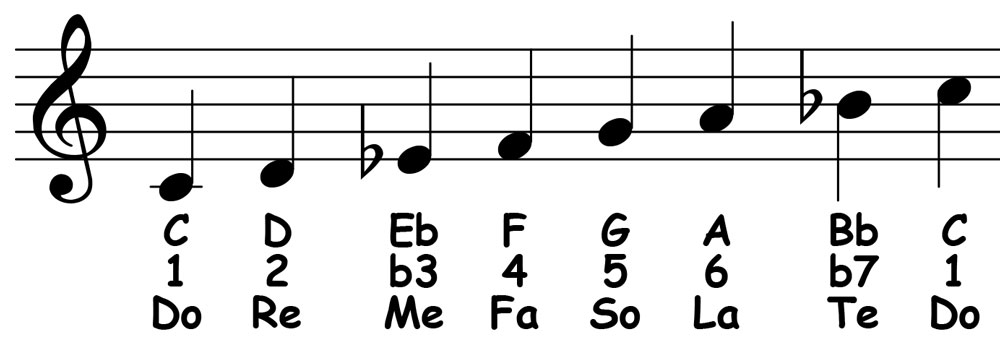

Notice that the Dorian Scale has a primitive, minor, sometimes jazzy quality.
Important: Don’t confuse this with the second mode of the major scale! (Hint: The distinction is which note serves as the key center Do).
back to… Table of Contents
Dorian Compared to the Mixolydian Scale
The C Dorian Scale uses the same notes as the C Mixolydian Scale with one exception: Eb/b3/Me instead of E/3/Mi. This is a great example of how much certain scale types have in common, how learning one kind of scale helps you to learn others, and how the addition or subtraction of just one note can profoundly change the character of a scale and allows you to create a whole new kind of music!

Play and sing the C Dorian and C Mixolydian Scale “side by side”, slowly enough to hear and feel the distinct difference between Mi and Me…
Play and listen to the [major-ish] C Mixolydian Scale…
Play and listen to the [minor-ish] C Dorian…
Mi gives the Mixolydian a major flavor, while Me gives the Dorian a minor flavor. And so, it’s appropriate to think of the C Dorian as the minor version of the C Mixolydian Scale.
back to… Table of Contents
Dorian Scale Solfege Ear Training
Reading, playing, and singing the Solfege Syllables out loud is an extremely effective way to tune up your ears and to internalize the unique sound-feeling of each note in the scale with respect to the key center Do. Make sure to do this slowly enough for the unique sound-feeling of each Solfege Syllable to make a meaningful impression on your mind’s ear.
Linear Ascending…

Linear Descending…

Do-X-Do Ascending…

Do-X-Do Descending…

Special Note about Ear Training in Context
We could sing a lot more musical patterns, but a more effective and efficient approach (80:20 Rule) is to get your ear training material directly from the music that YOU want to play!
back to… Table of Contents
Dorian Scale Theory & Ear Training, All Keys
Showing the notation, key signature, letter names, scale degrees, solfege syllables, and keyboard layouts… arranged chromatically ascending (C, Db, D, Eb, E, F, F#, G, Ab, A, Bb, B)…
Scale Structure Reminders:
- Dorian Scale Solfege = Do-Re-Me-Fa-So-La-Te-Do (no matter what key you are in).
- Dorian Scale Scale Degrees = 1-2-b3-4-5-6-b7-1 (no matter what key you are in).
C Dorian
Say this aloud as you read and play: “The C Dorian Scale is spelled C-D-Eb-F-G-A-Bb-C.” (Also sing the solfege syllables out loud… ditto for all the keys below)
Sidebar: The goals here are to get the sounds in your mind’s ear, to learn how to read, and to know where the notes are on the keyboard. Don’t worry about fingerings right now. In fact, it’s perfectly fine and maybe even preferrable to play these with one finger for now so that you don’t instill poor technical habits.


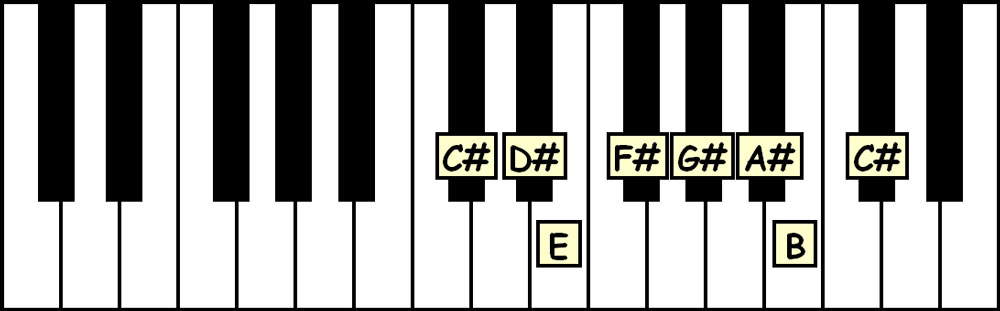
C Sharp Dorian
Say this aloud as you read and play: “The C# Dorian is spelled C#-D#-E-F#-G#-A#-B-C#.”

D Dorian
Say this aloud as you read and play: “The D Dorian is spelled D-E-F-G-A-B-C-D.”


E Flat Dorian
Say this aloud as you read and play: “The Eb Dorian is spelled Eb-F-Gb-Ab-Bb-C-Db-Eb.”


E Dorian
Say this aloud as you read and play: “The E Dorian is spelled E-F#-G-A-B-C#-D-E.”


F Dorian
Say this aloud as you read and play: “The F Dorian is spelled F-G-Ab-Bb-C-D-Eb-F.”


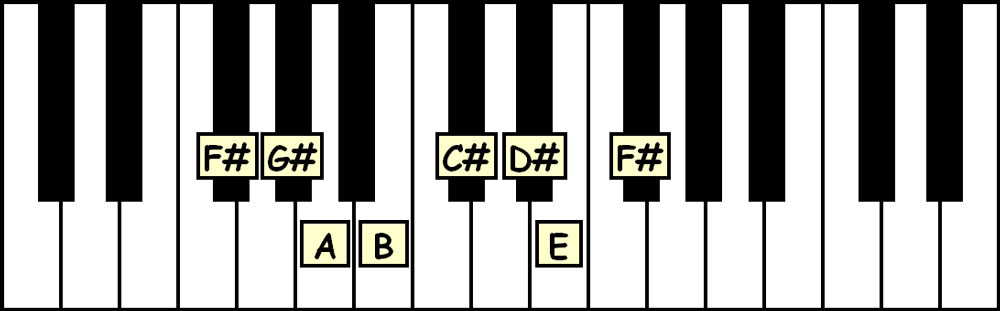
F Sharp Dorian
Say this aloud as you read and play: “The F# Dorian is spelled F#-G#-A-B-C#-D#-E-F#.”

G Dorian
Say this aloud as you read and play: “The G Dorian is spelled G-A-Bb-C-D-E-F-G.”


A Flat Dorian
Say this aloud as you read and play: “The Ab Dorian is spelled Ab-Bb-Cb-Db-Eb-F-Gb-Ab.”


A Dorian
Say this aloud as you read and play: “The A Dorian is spelled A-B-C-D-E-F#-G-A.”


B Flat Dorian
Say this aloud as you read and play: “The Bb Dorian is spelled Bb-C-Db-Eb-F-G-Ab-Bb.”


B Dorian
Say this aloud as you read and play: “The B Dorian is spelled B-C#-D-E-F#-G#-A-B.”


back to… Table of Contents
This is slightly baffling to me!! should I learn this by heart or just look and play and sing… and what does it ‘mean’…? probably dim question!
Thanks so much for asking, Paula. Such a question is not dim in the least. In fact, it is an essential part of me getting to know the Piano-ology audience… so that I can learn how to more effectively present material. That said, your questions prompted two things: First, that I should explain in the intro to this lesson WHY the Dorian Scale matters (It is used extensively in Folk, Pop, Jazz, and Rock). Noteworthy examples: Carol King “Too Late”, Simon and Garfunkel “Scarborough Fair”, “Santana “Evil Ways”, Miles Davis “So What”, The Doors “Riders on the Storm”. Second, that I should upload an audio file that models how to do the ear training studies. Thanks so much for your thoughtful and generous engagement, Paula. You are already having quite a positive influence on how Piano-ology is unfolding. Cheers!
Thank you, Frank for your prompt reply.I had in the meantime looked up the scale on the internet and I understand now..I deduct from that that, for me as an absolute beginner…it is just as well to leave that kind of stuff for now and stick to getting to know the keys by name and putting name , piano key and dot on line together …and stick to doing fluent hand movements along the scale …I do so much see that it is crucial to get the basics right before progressing . Your Piano-ology is progressing amazingly well, is going to be a great success, I bet. Must be quite difficult to make sure it does not become an unwieldy giant though…pffft. Thank you again.
Yes, it’s mostly about seeing the dots, letter names, scale degrees, solfege syllables all as important ways of conceiving the same musical stuff. And to start internalizing the associated sound-feelings, too. And thanks so much for the vote of confidence, Paula!
Can I have your permission to copy these images to use as my personal practice material? Do you own the copyright? Thank you for the amazing contribution!
I just saw this [https://piano-ology.com/creative-commons-license/]. Once again thanks for keeping music alive in this age of information and knowledge!