An introduction to the Chromatic Scale and what you really need to understand about names and note sounds, feelings, and functions…
Table of Contents
Lesson Goal
To understand the note naming conventions (letter names, scale degrees, and solfege) for the Chromatic Scale.
Special Note from Frank: Don’t fuss too much over the naming conventions for the chromatic scale. It’s presented here only in the key of C in order to show one way that all twelve notes in any given octave might be named theoretically using both the Solfege system and number system.
Prerequisites
Basic music reading skills… the LOVE of music… and the discipline to study and practice.
Chromatic Scale Theory in the Key of C
The Chromatic Scale includes all twelve possible pitches played as a sequence of minor 2nds, and where the names of the chromatic notes depend on whether you are going up or down the scale, as follows…
C Chromatic Scale, Ascending
When you go up the scale, it’s common practice to name the chromatic notes by modifying the diatonic notes in C Major using sharps as follows (C, C#, D, D#, E, F, F#, G, G#, A, A#, B, C)…


- The scale degrees for the ascending Chromatic Scale are 1-#1-2-#2-3-4-#4-5-#5-6-#6-7-1.
- The Solfege syllables for the ascending Chromatic Scale are Do-Di-Re-Ri-Mi-Fa-Fi-So-Si-La-Li-Ti-Do.
Pronunciation Hints: Di, Ri, Fi, Si, and Li sound like “Dee”, “Ree”, “Fee”, “See”, and “Lee”
Notice that each chromatic Scale Degree uses the exact same number as the diatonic note that it is derived from and that each “chromatic” Solfege name begins with same consonant as the diatonic note that it is derived from.
back to… Table of Contents
C Chromatic Scale, Descending
When you go down the scale, it’s common practice to name the chromatic notes by modifying the diatonic notes in C Major using flats as follows (C, B, Bb, A, Ab, G, Gb, F, E, Eb, D, Db, C)…

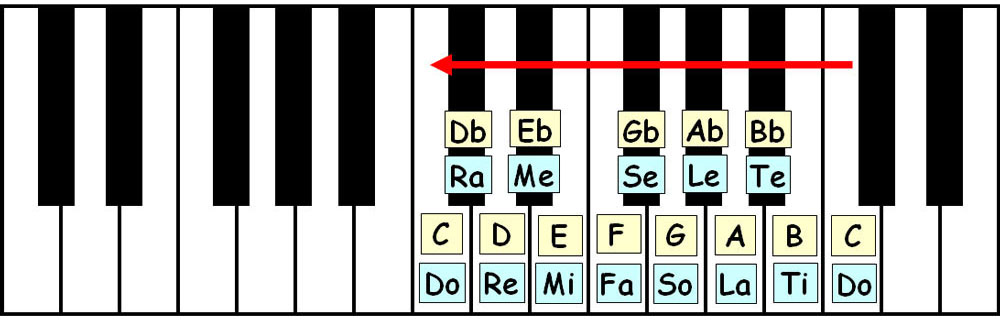
- The scale degrees for the descending Chromatic Scale are 1-7-b7-6-b6-5-b5-4-3-b3-2-b2-1.
- The Solfege syllables for the ascending Chromatic Scale are Do-Ti-Te-La-Le-So-Se-Fa-Mi-Me-Re-Ra-Do.
Pronunciation Hints: Me, Se, Le, and Te sound like “May”, “Say”, “Lay”, and “Tay”.
Notice that each chromatic Scale Degree uses the exact same number as the diatonic note that it is derived from and that each chromatic Solfege name begins with same consonant as the diatonic note that it is derived from.
back to… Table of Contents
Solfege Ear Training
Reading, playing, and singing the Solfege Syllables out loud is an extremely effective way to tune up your ears and to internalize the unique sound-feeling of each note in the scale with respect to the key center Do. Make sure to do this slowly enough for the unique sound-feeling of each Solfege Syllable to make a meaningful impression on your mind’s ear.
C Chromatic Scale: Linear, Ascending…

C Chromatic Scale: Linear, Descending…

back to… Table of Contents
Takeaways
- Naming notes using letters, scale degrees, or Solfege syllables is NOT a necessary performance skill.
- Names are just a temporary way for us to communicate with each other while training our ears, intellect, eyes, and muscles.
- The ultimate goal is to abandon the use of names altogether.
- Being able to name each note might get you a few extra points on a music theory test, but what really matters is the melodic and harmonic function of any note.
- The sound, feeling, and function of any note always depends on the context. This will all start to make sense as you continue your studies of scales, chords, chord progressions, and real music.
back to… Table of Contents