Eighteenth in Frank’s HUGE collection of bread and butter jazz piano licks to add to your bag… by ear, intellect, eye, and muscle…
Table of Contents
Lesson Goals
To deeply internalize the sound, feeling, and function of the Harmonic Minor Modes for the Minor 2 5 1 Chord Progression.
Benefits of Internalizing the Harmonic Minor Modes for the Minor 2 5 1 Chord Progression
If you internalize the harmonic minor modes of the Minor 2 5 1 chord progression (using all four musical intelligences):
- You will understand how scales and chords are inseparable, interrelated views of the same musical stuff.
- You will appreciate how knowing your scales helps your know your chords and how knowing your chords helps you know your scales.
- You will really start to “know your way around the piano”.
- You will internalize a musical framework for attaching more complex comping and soloing ideas.
- You will develop an intuition about what makes good melodies tick.
- You will develop the ability to recognize a minor 2 5 1 by ear.
- You will develop the ability to recognize a minor 2 5 1 when you see the chord symbols in a chart.
- You will develop the skill to play a variety of minor 2 5 1 chord voicings and rhythms (comping).
- You will develop the skill to improvise melodic lines over a minor 2 5 1 in a variety of styles and rhythms (soloing).
- You will build a huge vocabulary of musical patterns that enable you to “speak” the minor 2 5 1 chord progression in a wide variety of contexts.
Preparatory Study for Jazz Piano Lick 018
One way to conceive of the iiø7-V7-i chord progression in the key of C Minor is as three sets of “chord/mode” or “mode/chord” pairings as follows…
Dø7 & the 2nd Mode of the C Harmonic Minor Scale
The Dø7 (iiø7) chord is paired with the second mode of the C Harmonic Minor Scale…
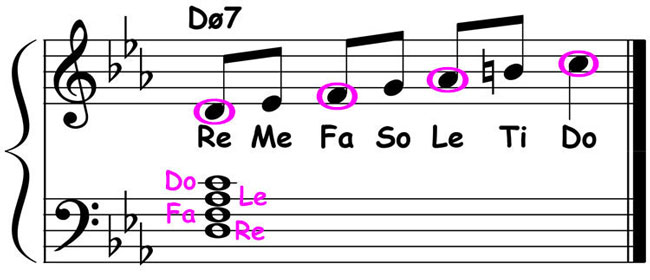
Functional Ear Training: The placement of the notes within the meter is no accident. Notice that the chord tones all fall on down beats, while the passing tones all fall on up beats… in this case creating a strong outline of the pre-dominant harmony iiø7 that craves resolution to the dominant V7 chord.
G7 & the 5th Mode of the C Harmonic Minor Scale
The G7 chord is paired with the fifth mode of the C Harmonic Minor Scale…
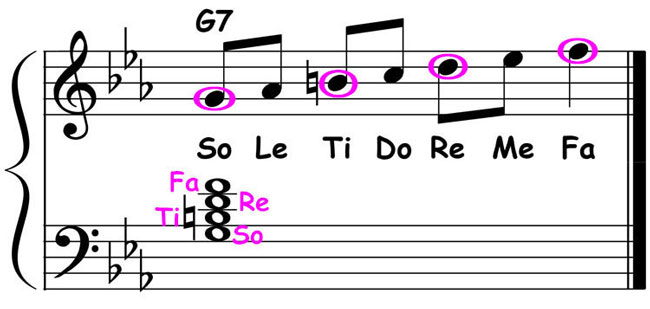
Functional Ear Training: Again, the placement of the notes within the meter is no accident. Notice that the chord tones all fall on down beats, while the passing tones all fall on up beats… in this case creating a strong outline of the dominant harmony V7 that craves resolution to the tonic I chord.
CmM7 & the 1st Mode of the C Harmonic Minor Scale
The CmM7 chord is paired with the C “Harmonic” Minor Scale that you already know…
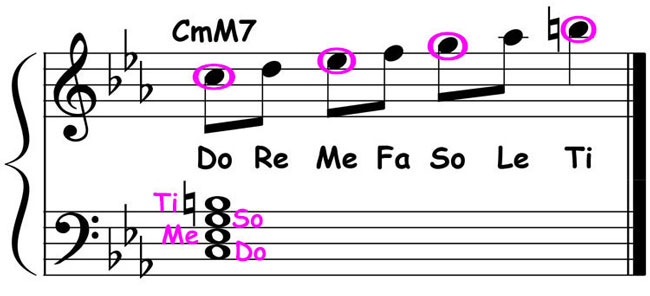
Functional Ear Training: Again, the placement of the notes within the meter is no accident. Notice that the chord tones all fall on down beats, while the passing tones all fall on up beats… in this case creating a strong sense of the tonic minor harmony.
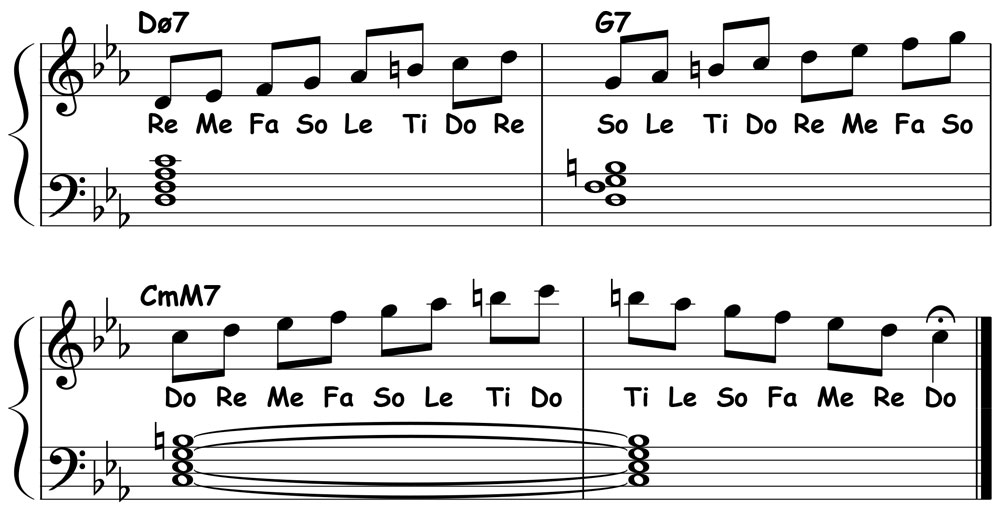
Minor 2 5 1 Harmonic Minor Modes in C Minor
Now let’s put it all together (with voice leading for the left hand chords)…
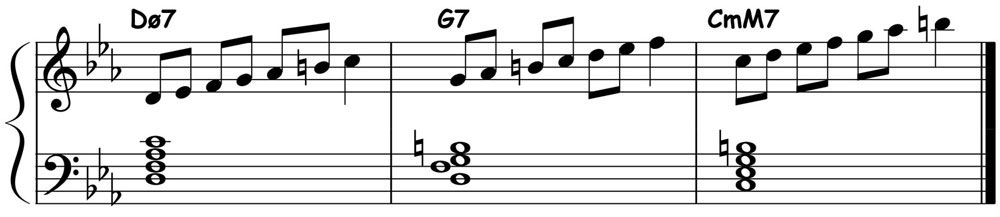
Functional Ear Training: THIS is what a minor iiø7-V7-iM7 chord progression sounds and feels like. Such mindful listening is nothing more than ear training by experience and association. And it won’t take long for you to recognize a iiø7-V7-i chord progression when you hear it!
Special Note about the Design of these Studies
An extremely effective way to internalize any new lick and to simultaneously develop your comping and soloing chops is to play it “in context”: within an established form over a set of standard chord changes. In this lesson the context is a Minor 2-5-1 (iiø7-V7-i) chord progression in the key of C Minor.
Jazz Piano Lick 018 (Etude #1)
Your left hand plays four-note block chords in the middle register, connected using voice-leading… while your right hand plays the mode that corresponds to each chord. Again, notice that every chord tone falls on a down beat, while each passing tone (the scale tone that connects them) falls on an up beat…
Listen to Frank demonstrate one way to play this at 108 beats per minute…
Jazz Piano Lick 018 (Your Homework)
Use what you know about form, meter, scales, chords, chord progressions, chord voicings, and left hand patterns to play this etude in other keys you expect to play in and see what you discover.
Special Note from Frank: If there’s interest, I’d be happy to write this out in a few other keys.
Study & Practice Reminders
- You’re singing the Solfege or scatting aloud in order to internalize the sound-feelings, right?
- You practice with a metronome or rhythm track in order to instill good time, right?
- You record yourself, listen to the playback immediately, self evaluate, and respond accordingly, right?
The Open Secret…
The key to getting good isn’t “talent”; it’s the discipline to study and practice the right things the right way.
back to… Table of Contents
Right hand is a scale too… (I remembered the English word for “gamme”.) Re-hmmm.
Indeed. All derived in this case from the C Harmonic Minor Scale. Cheers!