Twelfth in Frank’s HUGE collection of bread and butter jazz piano licks to add to your bag… by ear, intellect, eye, and muscle…
Table of Contents
Lesson Goals
To deeply internalize the sound, feeling, and function of the “1-2-3-5” Chord Outline played as a quadruplet cell through a standard major key turnaround chord progression.
Special Note about the Design of these Studies
An extremely effective way to internalize any new lick and to simultaneously develop your comping and soloing chops is to play it “in context”: within an established form over a set of standard chord changes. In this lesson the context is a Major 2-5-1-#1°7 (ii7-V7-I-#I°7) turnaround chord progression in 4 bar form in the key of C Major.
Jazz Piano Lick 012 (Etude #1)
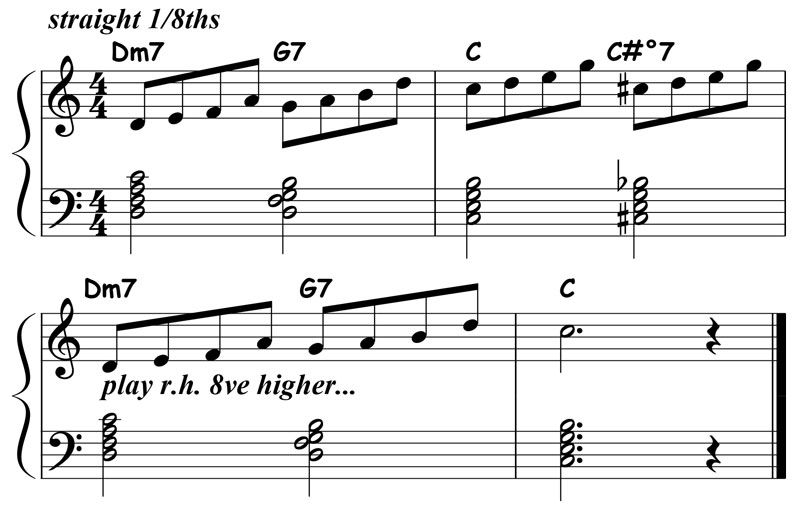
A “1-2-3-5” chord outline for each chord played in straight 1/8th notes. Notice that every chord root and 3rd falls on a down beat, while the passing tone falls on an up beat, as does the 5 of each chord, which flows nicely into the 1 of the following chord…
Listen to Frank demonstrate one way to play this at 108 beats per minute…
Music Theory Notes
Notice how each quadruplet naturally outlines the chord structure for each chord type: Dm7 = 1-2-b3-5, G7 = 1-2-3-5, C = 1-2-3-5, C#dim7 = 1-b2-b3-b5.
back to… Table of Contents
Jazz Piano Lick 012 (Etude #2)
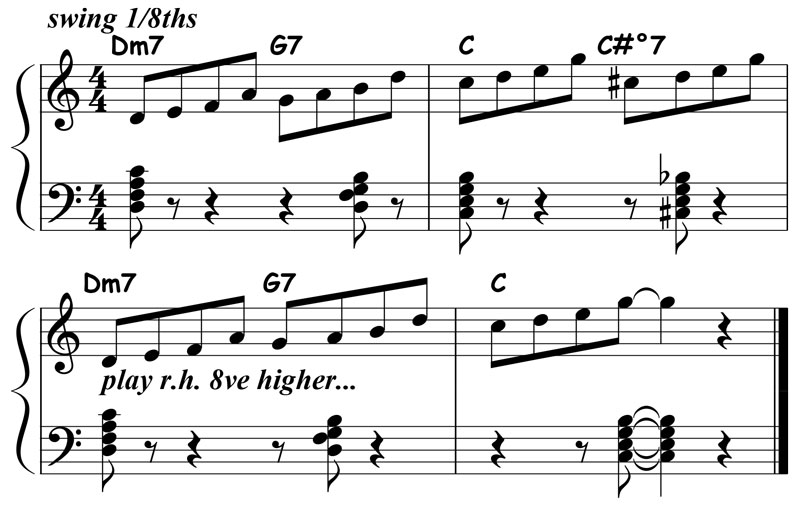
Now let’s spice things up by swinging the 1/8th notes and applying some tasty jazzifying syncopation in the left hand…
Listen to Frank demonstrate one way to play this at 132 beats per minute…
back to… Table of Contents
Jazz Piano Lick 012 (Your Homework)
Use what you know about form, meter, scales, chords, chord progressions, chord voicings, and left hand patterns to play these etudes in other keys you expect to play in and see what you discover.
Special Note from Frank: If there’s interest, I’d be happy to write this out in a few other keys.
Study & Practice Reminders
- You’re singing the Solfege or scatting aloud in order to internalize the sound-feelings, right?
- You practice with a metronome or rhythm track in order to instill good time, right?
- You record yourself, listen to the playback immediately, self evaluate, and respond accordingly, right?
The Open Secret…
The key to getting good isn’t “talent”; it’s the discipline to study and practice the right things the right way.
back to… Table of Contents