An illuminating lesson in a commonly used chromaticism: To indicate the Ascending Melodic Minor Scale…
Table of Contents
Lesson Goal
To quickly learn how to think about, read, and hear the cancellation of the natural minor key signature to indicate the ascending melodic minor scale.
Prerequisites
Basic music reading… LOVE of music… and the discipline to study and practice.
What Does “Chromatic” Mean?
Chromatic is just a fancy adjective that refers to notes that are not defined by the key signature. And so, chromatic notes are identified using an accidental–a sharp, flat, or natural symbol–that momentarily overrides the key signature. In the simplest terms, diatonic means the notes defined by the key signature and chromatic is everything else.
How to Recognize and Hear the Ascending Melodic Minor Scale
Bach’s bourrée in E Minor is a famous illustration of the ascending melodic minor scale in action in real music…
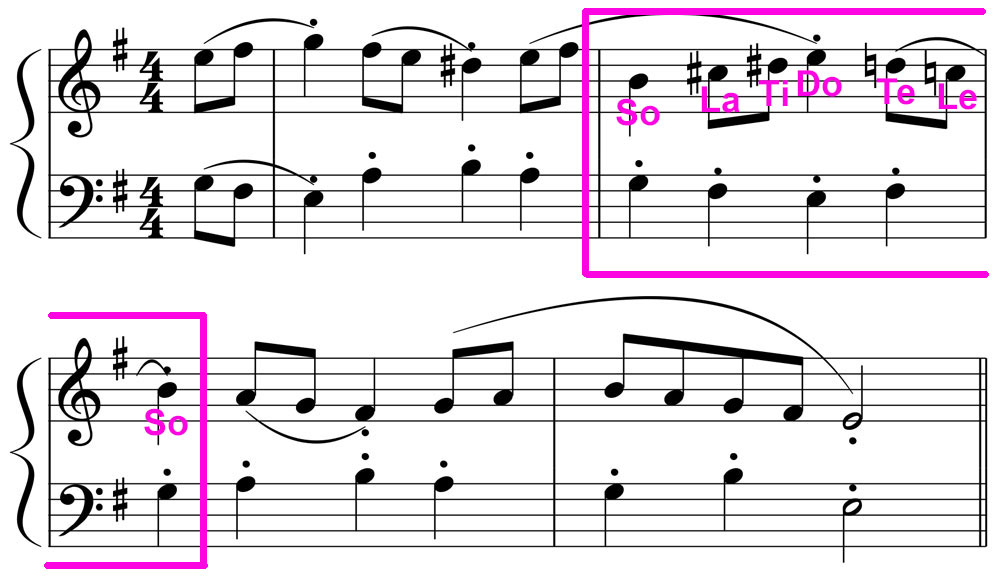
Focusing on the notes in the box above, let’s break things down in order to see, understand, hear, and feel what is happening here…
- Going up, the melody is a scale fragment B-C#-D#-E (So-La-Ti-Do). Notice the strong melodic drive of this pattern going up form So to Do.
- Coming back down, the melody is a scale fragment E-D-C-B (Do-Te-Le-So). Notice the strong melodic drive of this pattern going down from Do to So.
- For historical reasons (that will not be discussed here) the key signatures for all tonal minor keys are based on the natural minor scale. Because the C# and D# are not in the E Minor key signature, they must be indicated by being sharpened.
Let’s do a Quick Experiment…
Play this passage the “wrong” way playing C=b6=Le and D=b7=Te going up and D#=7=Ti and C#=6=La as follows (“wrong” notes boxed)…

and compare that to playing it the “right” way…

… and notice how the “wrong” way lacks melodic drive of the “right” way and just doesn’t sound and feel right.
Sidebar. Notice that C#=6=La and D#=Ti=7 are the notes in the E Major Scale. This is no accident… and yet another example of how knowing your scales deepens your knowledge, hearing, and skills as a musician.
Ascending Melodic Minor Scale, All Keys
The general pattern is always the same no matter what minor key your are in:
- The key signature is based on the natural minor scale, always.
- The ascending melodic minor scale is indicated by “sharpening” the 6th and 7th degrees of the natural minor.
- b6 becomes 6 and b7 becomes 7.
- Le becomes La and Te become Ti (the leading tone).
- Notice that “5-6-7-1” (“So-La-Ti-Do”) are the same notes from the parallel major scale.
C Minor
Say this aloud: “The key signature for C minor is three flats: Bb, Eb, Ab. Changing Ab(Le) to A(La) and Bb(Te) to B(Ti) gives you the C Ascending Melodic Minor Scale…
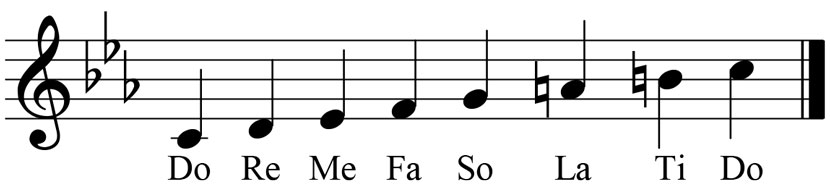
Play and sing the C ascending melodic minor scale, slowly enough to allow the natural flow of the La-Ti-Do to make a deep impression on your mind’s ear…
C Sharp Minor
Say this aloud: “The key signature for C# minor is four sharps: F#, C#, G#, D#. Changing A(Le) to A#(La) and B(Te) to B#(Ti) gives you the C# Ascending Melodic Minor Scale…

Play and sing the C# ascending melodic minor scale, slowly enough to allow the natural flow of the La-Ti-Do to make a deep impression on your mind’s ear…
D Minor
Say this aloud: “The key signature for D minor is one flat: Bb. Changing Bb(Le) to B(La) and B(Te) to C#(Ti) gives you the D Ascending Melodic Minor Scale…
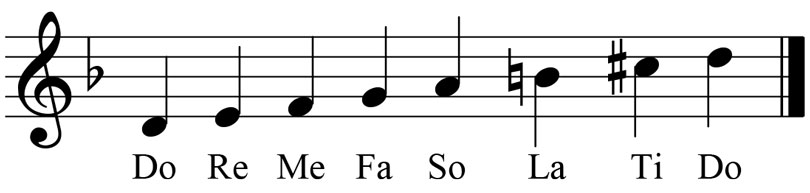
Play and sing the D ascending melodic minor scale, slowly enough to allow the natural flow of the La-Ti-Do to make a deep impression on your mind’s ear…
E Flat Minor
Say this aloud: “The key signature for Eb minor is six flats: Bb, Eb, Ab, Db, Gb, Cb. Changing Cb(Le) to C(La) and Db(Te) to D(Ti) gives you the Eb Ascending Melodic Minor Scale…
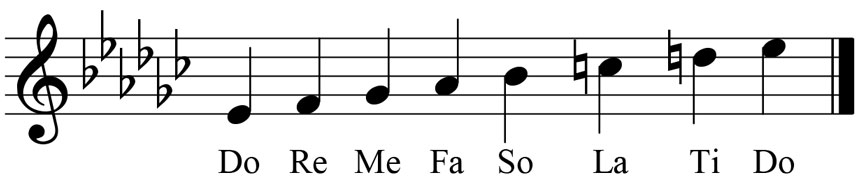
Play and sing the Eb ascending melodic minor scale, slowly enough to allow the natural flow of the La-Ti-Do to make a deep impression on your mind’s ear…
E Minor
Say this aloud: “The key signature for E minor is one sharp: F#. Changing C(Le) to C#(La) and D(Te) to D#(Ti) gives you the E Ascending Melodic Minor Scale…

Play and sing the E ascending melodic minor scale, slowly enough to allow the natural flow of the La-Ti-Do to make a deep impression on your mind’s ear…
F Minor
Say this aloud: “The key signature for F minor is four flats: Bb, Eb, Ab, Db. Changing Db(Le) to D(La) and Eb(Te) to E(Ti) gives you the F Ascending Melodic Minor Scale…
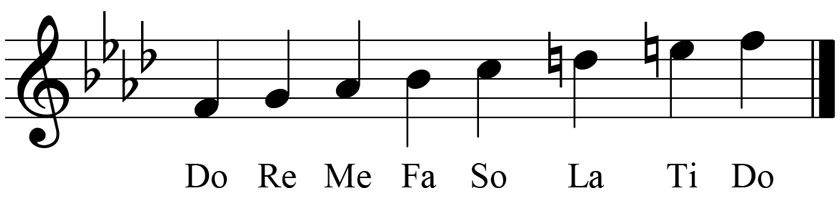
Play and sing the F ascending melodic minor scale, slowly enough to allow the natural flow of the La-Ti-Do to make a deep impression on your mind’s ear…
F Sharp Minor
Say aloud: “The key signature for F# minor is three sharps: F#, C#, G#. Changing D(Le) to D#(La) and E(Te) to E#(Ti) gives you the F Ascending Melodic Minor Scale…

Play and sing the F# ascending melodic minor scale, slowly enough to allow the natural flow of the La-Ti-Do to make a deep impression on your mind’s ear…
G Minor
Say aloud: “The key signature for G minor is two flats: Bb, Eb. Changing Eb(Le) to E(La) and F(Te) to F#(Ti) gives you the G Ascending Melodic Minor Scale…he leading tone (Ti) is F#.” This gives you the G Harmonic Minor Scale…
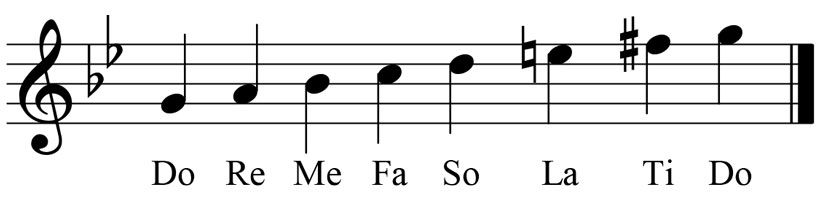
Play and sing the G ascending melodic minor scale, slowly enough to allow the natural flow of the La-Ti-Do to make a deep impression on your mind’s ear…
G Sharp Minor
Say aloud: “The key signature for G# minor is five sharps: F#, C#, G#, D#, A#. Changing E(Le) to E#(La) and F#(Te) to Fx(Ti) gives you the G# Ascending Melodic Minor Scale…
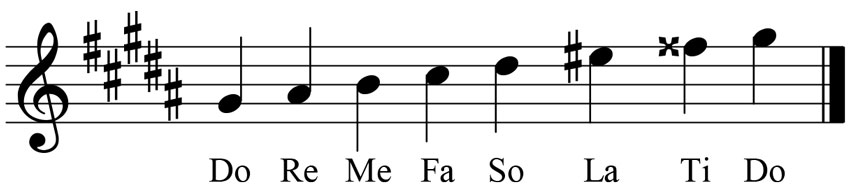
Play and sing the G# ascending melodic minor scale, slowly enough to allow the natural flow of the La-Ti-Do to make a deep impression on your mind’s ear…
A Minor
Say aloud: “The key signature for A minor is no sharps or flats. Changing F(Le) to F#(La) and G(Te) to G#(Ti) gives you the A Ascending Melodic Minor Scale…
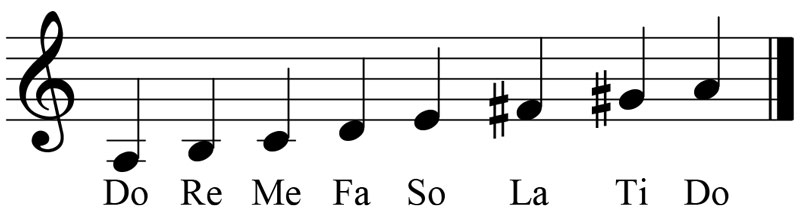
Play and sing the A ascending melodic minor scale, slowly enough to allow the natural flow of the La-Ti-Do to make a deep impression on your mind’s ear…
B Flat Minor
Say aloud: “The key signature for Bb minor is five flats: Bb, Eb, Ab, Db, Gb. Changing Gb(Le) to G(La) and Ab(Te) to A(Ti) gives you the Bb Ascending Melodic Minor Scale…
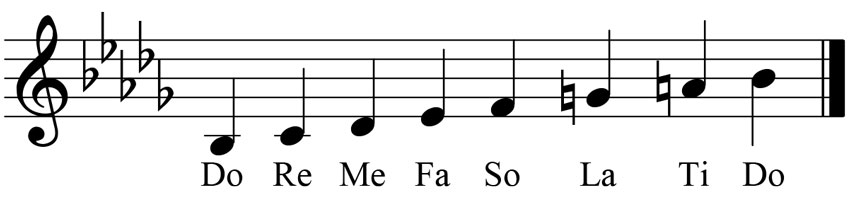
Play and sing the Bb ascending melodic minor scale, slowly enough to allow the natural flow of the La-Ti-Do to make a deep impression on your mind’s ear…
B Minor
Say aloud: “The key signature for B minor is two sharps: F#, C#. Changing G(Le) to G#(La) and A(Te) to A#(Ti) gives you the B Ascending Melodic Minor Scale…
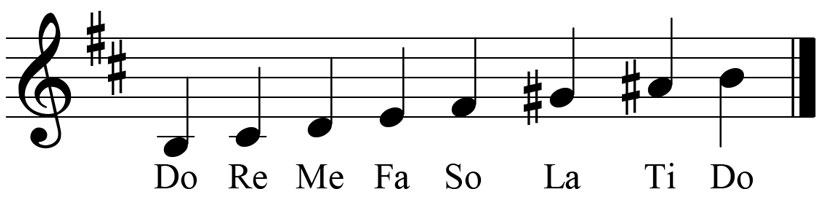
Play and sing the B ascending melodic minor scale, slowly enough to allow the natural flow of the La-Ti-Do to make a deep impression on your mind’s ear…
Takeaway
We’re not just doing intellectual “music theory” here. We are learning how to read music and hear music like a musician. With just a wee bit of experience, you will start to recognize the “ascending melodic minor scale” when you see it in written music (as indicated by “sharpening” the sixth degree and seventh degree of the natural minor key signature) and when you hear it being played.
more like this… How Music Works