Lesson Goal: To quickly internalize some Killer Blues Piano Intros… by ear, intellect, eye, and muscle…
Table of Contents
Prerequisites
Basic music reading skills… basic scale, chord, and chord progression theory… basic technique… the LOVE of music… and the discipline to study and practice.
Study, Practice, & Performance Tips
- Never play mindlessly and mechanically. Always aspire to play musically.
- Your goal is not to merely memorize these, but to study and practice them until you internalize them using all four musical intelligences: ears, intellect, eyes, and muscles.
- Every time you practice something, you are programming your brain. So always play accurately.
- Practice with a Click Track or a Rhythm Track. Doing so will give you immediate feedback on any rhythmic misconceptions or places where your timing gets sloppy.
- Record Yourself. Always. Listen to the playback immediately. And ask yourself: Is that what you intended to play?”
- If anything feels tense or awkward, stop immediately and experiment with alternative fingerings or choreography.
- Play this in other keys you expect to play in. By the way, once you see the patterns (which is guaranteed if you know your scales and chords) finding the notes in other keys will be a piece of cake!
- If you feel stuck or overwhelmed, realize that anything can and will be mastered if you slow things down or break things down to small enough pieces.
- All of this might sound like a lot of work, but it’s not nearly as much as you think. Because even though it takes time to talk about all these things, in practice they can all be done simultaneously!
back to… Table of Contents
Why You Should Learn Some Stock Blues Piano Intros
Having some blues piano intros in your bag gives you the opportunity to expand the form, build excitement, and establish the mood and expectations before jumping into a tune.
back to… Table of Contents
Blues Piano Intro #1
A common pattern is to establish a tonal center, then to move in contrary motion towards the V chord, which creates lots of harmonic tension that is resolved when you play the I chord at the top of the first/next chorus.

back to… Table of Contents
Blues Piano Intro #2
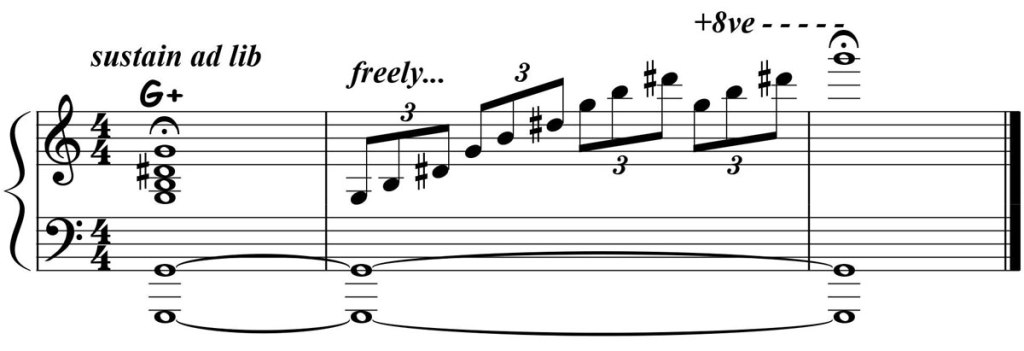
A commonly-used idea is to emphasize a dominant harmony (the V chord). In this example, a delicious augmented V chord creates an ambiguous harmonic tension that sets up the harmonic release with the arrival of the I chord on the downbeat of the first chorus. Try playing it very freely (not in strict time) in order to heighten the expectation of what is to come…
back to… Table of Contents
Blues Piano Intro #3
A staple of boogie/blues is “that b3-b5 thing”… Don’t try to name the chords, but do understand the basic pattern as three lines of motion: 5-b5-4-3, 3-b3-2-1 and b7-6-b6-5…

back to… Table of Contents
learn more… Blues Piano Lessons